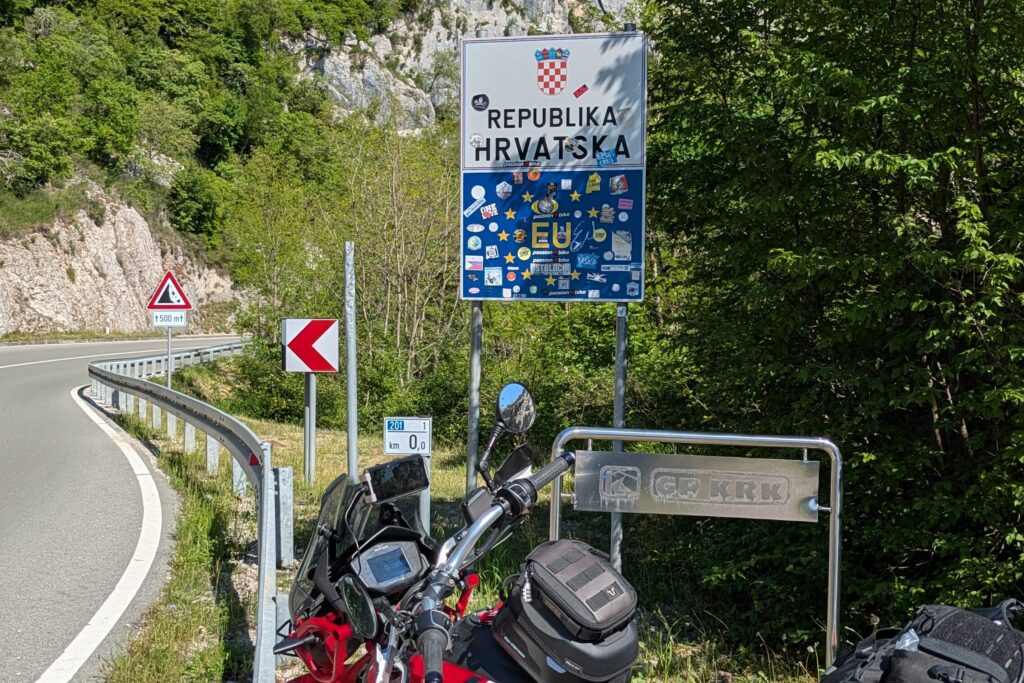
Cross from Croatia into Bosnia and within twenty minutes the landscape, the architecture, the road surface, and the entire atmosphere of the ride shifts completely. Cross from Bosnia into Montenegro a day later and it shifts again — from Ottoman minarets and river canyons to a dramatic Adriatic coastline that looks like it was designed specifically for motorcycle travel. Two countries, two completely different experiences, connected by some of the best riding roads in the Balkans and separated by a border crossing that takes fifteen minutes.
The montenegro bosnia motorcycle combination is one of the most rewarding two-country pairings in Europe for riders. Neither country gets the attention that Croatia and Slovenia receive, which means emptier roads, lower prices, and the particular satisfaction of riding somewhere that still feels genuinely discovered rather than curated. This guide covers the best routes in both countries, realistic daily budgets, border crossing practicalities, and the specific details that make the difference between a good Balkan tour and an exceptional one.
Why Bosnia and Montenegro Belong Together on a Motorcycle Tour
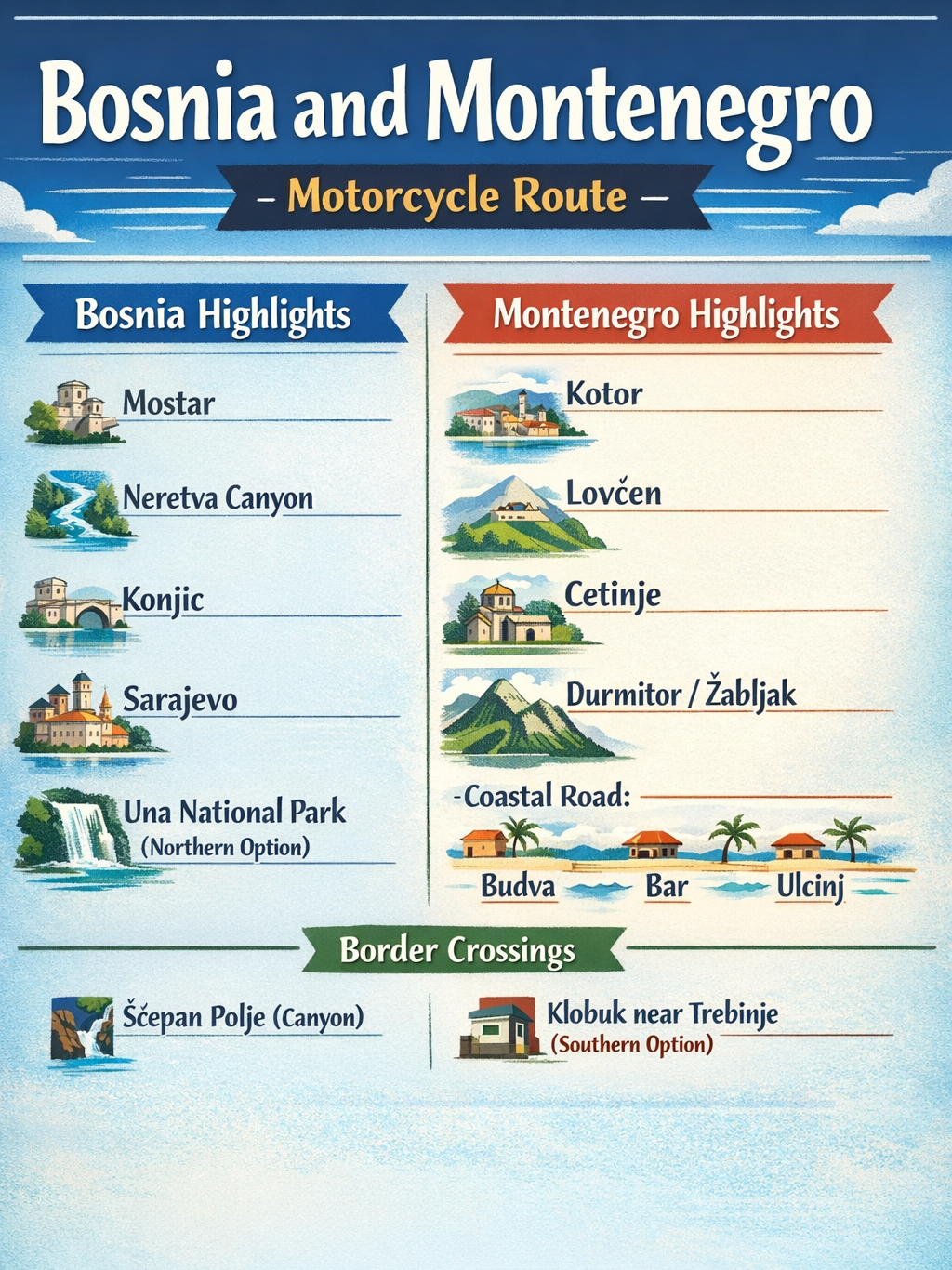
The geographical logic is straightforward: Bosnia and Montenegro share a border, connect naturally within a broader Balkan loop, and between them offer more riding variety than most European countries manage individually. What makes the combination particularly compelling is contrast.
Bosnia is landlocked, Ottoman in character, and defined by river canyons and mountain valleys that feel genuinely remote. Montenegro has a short but spectacular Adriatic coastline, a dramatic mountain interior, and a riding highlight — the Bay of Kotor serpentine road — that belongs on any serious motorcyclist’s European bucket list. Riding both countries in sequence produces the kind of variety that makes a tour memorable rather than merely pleasant.
Both countries sit in the affordable tier of Balkan touring. Daily budgets run significantly below Croatia and Slovenia, accommodation is good value, and fuel prices are among the lower end of the European range. The roads in both countries range from excellent to variable — canyon routes and main national roads are consistently good, secondary mountain roads require attention and decent tyres. Go in with realistic expectations and you’ll have no complaints.
Bosnia Motorcycle Routes — Canyon Roads and Ottoman Cities
The Neretva Canyon — Bosnia’s Best Kept Secret
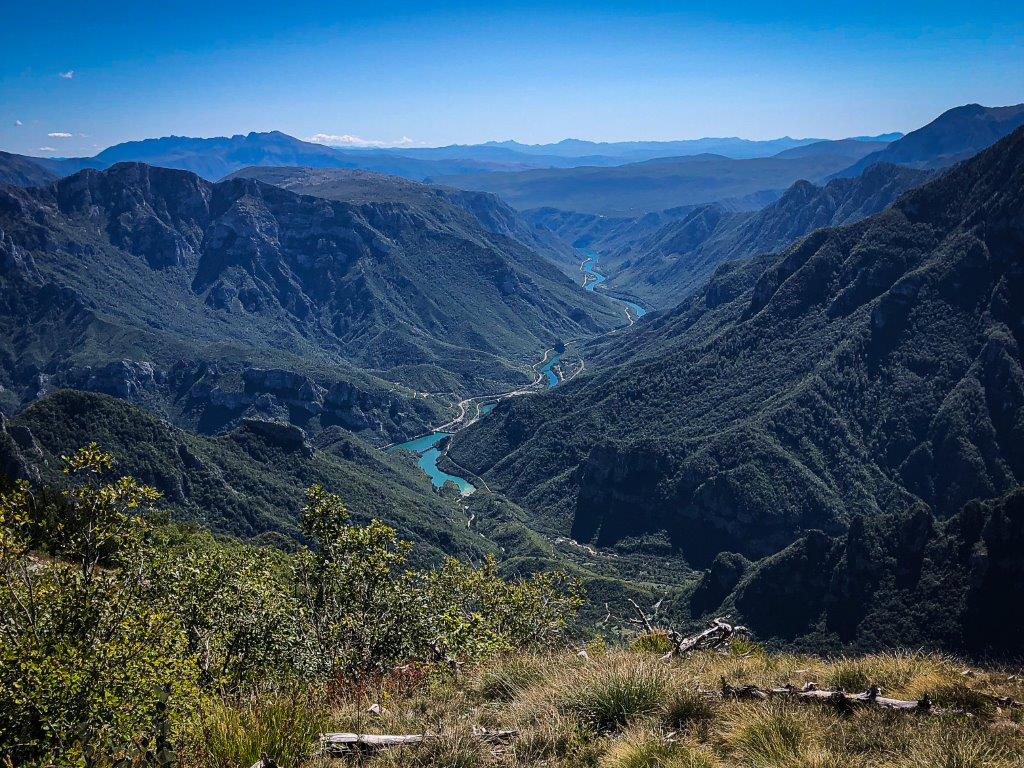
The road north from Mostar through the Neretva canyon toward Jablanica and Konjic is one of the most underrated motorcycle roads in Europe. The canyon walls rise steeply on both sides, the river runs a deep green-blue far below, and the road surface is consistently good with minimal traffic outside the immediate Mostar area. If this canyon were in France or Austria it would be famous. In Bosnia it remains largely the preserve of riders who know where to look.
The distance from Mostar to Konjic is roughly 60 km — allow ninety minutes minimum because stopping to look is irresistible. From Konjic the road continues north toward Sarajevo through a landscape that gradually opens from canyon to valley. The canyon route works equally well in both directions — south from Sarajevo toward Mostar or north from the Croatian coast heading inland.
Mostar — The Essential Stop
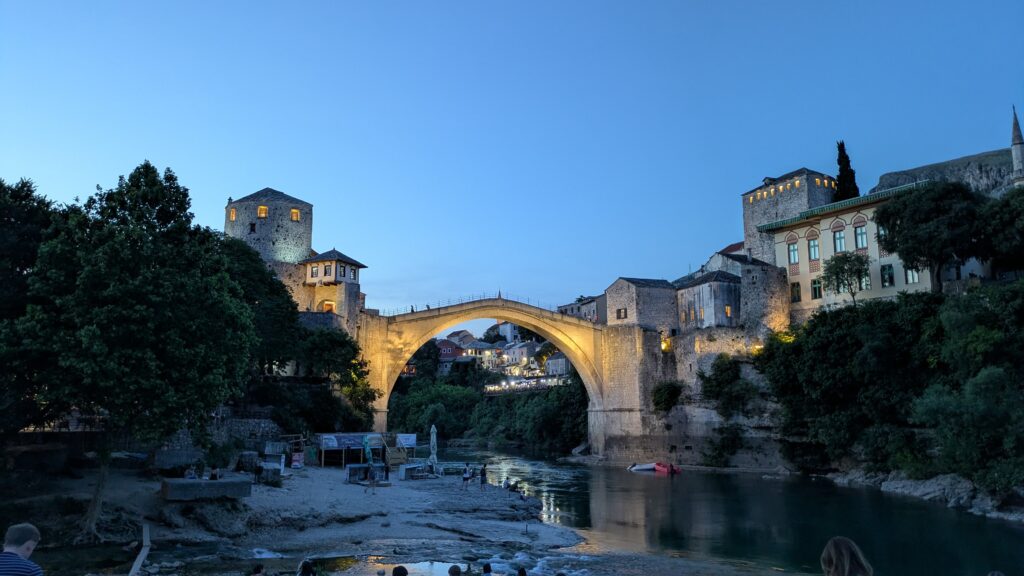
Approaching Mostar from the south on the E73, the city appears suddenly in a valley below — a cluster of minarets and Ottoman rooftops with the Neretva cutting through the centre. It is immediately clear why this is the most visited city in Bosnia.
The Stari Most bridge — rebuilt after its deliberate destruction in 1993 and restored to its original 16th century design — is the obvious centrepiece. Allow half a day minimum for Mostar: the bridge, the old bazaar streets, and the riverfront. Motorcycle parking is available near the old town entrance on both the east and west banks — ask locally for the current situation as it changes seasonally.
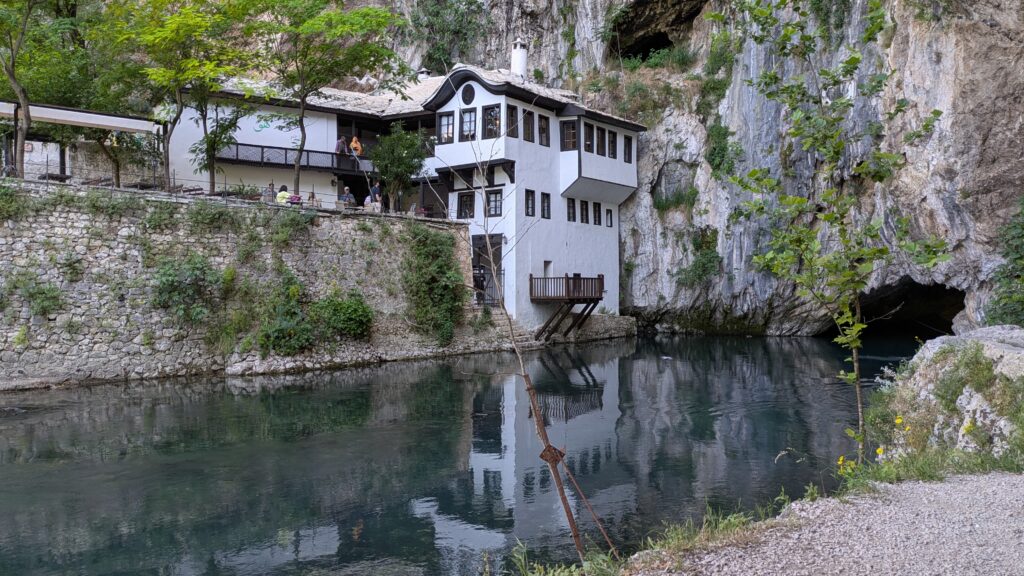
Fifteen minutes south of Mostar, the Blagaj tekke is one of those stops that justifies the detour without question. A 16th century Dervish monastery built into a cliff face at the source of the Buna river — the water emerges from a cave at the base of a 200-metre vertical cliff and the tekke sits directly above it. There is a small entry fee for the monastery itself. Visiting the site around it is free and extraordinary.
Arriving in Mostar after riding up from Greece, the city felt like exactly the right place to slow down. I spent the afternoon eating my way through the bazaar streets, wandered the old town as the light faded, and ended the day sitting at the river bank at the foot of Stari Most — watching the bridge reflect in the Neretva while the call to prayer echoed off the stone walls above me. Some evenings on a motorcycle tour earn their place in the memory permanently. That one did.
Sarajevo — Optional but Worthwhile
Sarajevo divides opinions among Balkan motorcycle tourers. Some find it an essential stop — the Baščaršija bazaar, the war history, the cable car to Trebević with its mountain road context. Others prefer to keep moving and leave cities to non-riding days. Both positions are reasonable.
What isn’t debatable is the approach: riding into Sarajevo from Konjic through the final section of the Neretva canyon is one of the most dramatic urban approaches anywhere in Europe. The city appears at the end of a valley that has been tightening for twenty kilometres, surrounded by hills that still bear the scars of the 1990s siege. It’s a powerful arrival.
Sarajevo is the most affordable capital city in the Balkans for overnight stays — budget guesthouses in the old town area run 25–40 €. If the itinerary allows, one night here is worth it.
Montenegro Motorcycle Routes — Coast, Mountains, and Everything Between
The Bay of Kotor — Europe’s Most Dramatic Coastal Riding
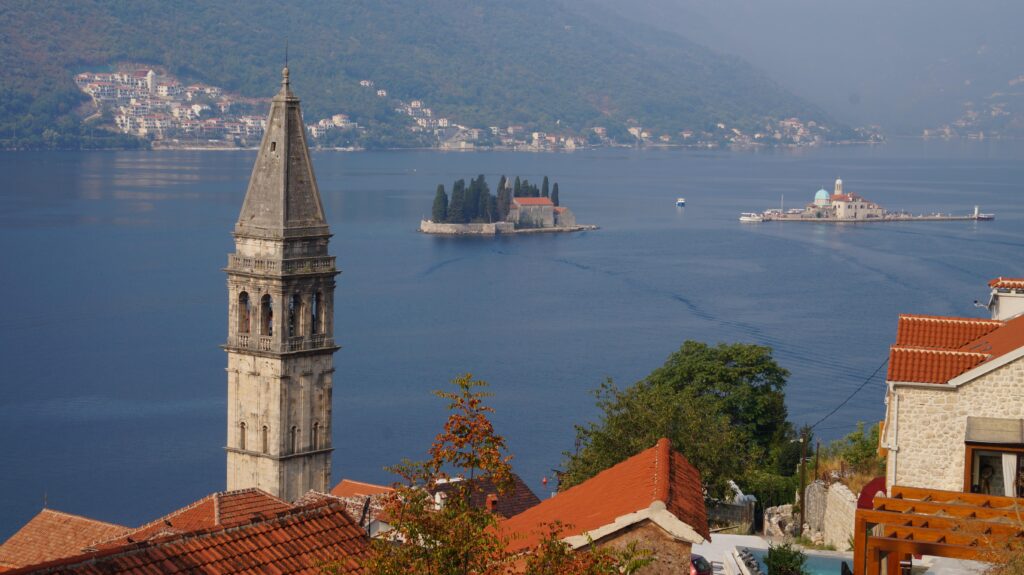
The Bay of Kotor is the reason Montenegro ends up on motorcycle bucket lists. The approach from Croatia or Bosnia — descending toward the coast with the bay spreading out below — sets up an arrival that the riding itself then delivers on completely. The road around the bay hugs the shoreline tightly, passes through small fishing villages, and deposits you at Kotor’s medieval walls with the limestone mountains rising almost vertically behind the town.
Kotor old town is worth an hour on foot — UNESCO listed, well preserved, genuinely atmospheric despite the summer tourist presence. Park the bike at the town walls and walk in. The streets are too narrow and too crowded for anything else.
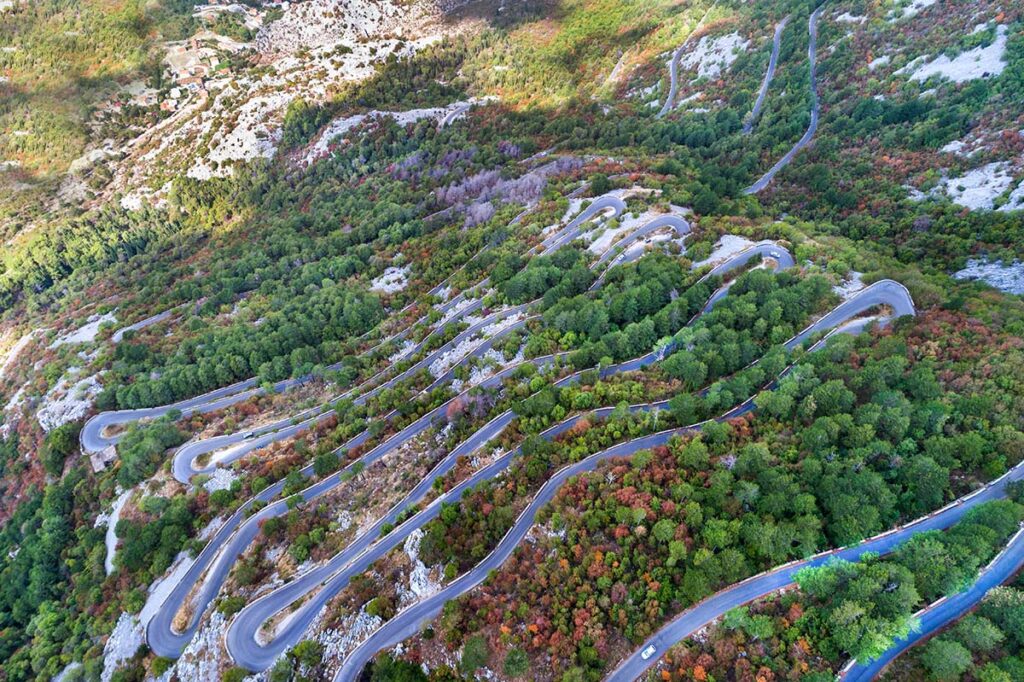
The Kotor serpentine is what most riders come for. Twenty-five hairpins climb the face of Mount Lovćen above the town, each one opening a wider view back over the bay below. At the top, the perspective is extraordinary — the entire Bay of Kotor visible as a map, the Adriatic beyond it, and the road you just climbed a thin line zigzagging down the cliff face. Ride it in the morning before the tourist buses start. The serpentine in a convoy of coaches is a different and significantly less enjoyable experience.
Lovćen National Park and Cetinje
The road through Lovćen National Park above the serpentine is consistently good — smooth tarmac, dramatic scenery, and traffic that thins to almost nothing once the day-trippers turn back toward Kotor. The viewpoint at Njeguši, the village where Montenegro’s most famous dynasty originated, looks back over the bay with a different perspective from the top of the serpentine — wider, more elevated, less dramatic but more complete.
Cetinje, Montenegro’s old royal capital, sits in a plateau below Lovćen and deserves more time than most riders give it. Small, unhurried, and genuinely Montenegrin in character — none of the coastal tourist infrastructure, just a town that was briefly the capital of an independent kingdom and hasn’t entirely forgotten it. Accommodation runs 35–55 € for a good private room.
Durmitor — The Crown of Montenegro
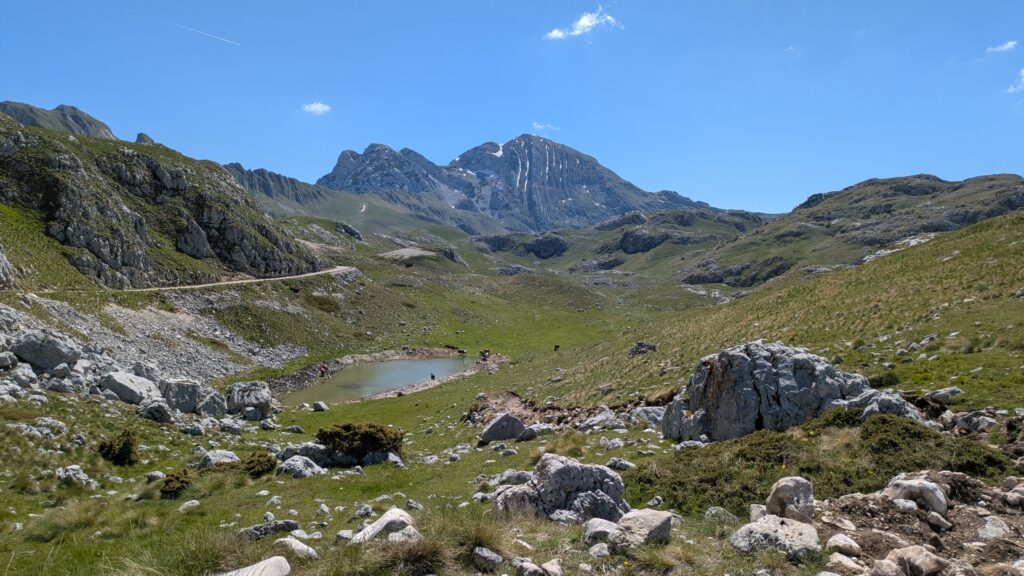
I wasn’t fully prepared for Durmitor. After two days on the Montenegrin coast — spectacular as it is — the climb up onto the Durmitor plateau feels like entering a completely different country. Every corner opens onto something more dramatic than the last: black pine forests, glacial lakes, limestone peaks pushing above 2,500 metres. Žabljak is a small town but a perfect base, and if you have a spare morning, ride the road around the Black Lake before the day starts. It’s one of those places that makes you question every future holiday decision that doesn’t involve a motorcycle.
The Tara Canyon — one of Europe’s deepest at over 1,300 metres — runs along the northern edge of the Durmitor massif. The road along the canyon rim provides viewpoints that stop you mid-corner. Allow a full day in the Durmitor area rather than passing through — this is the kind of scenery that justifies the entire trip.
Accommodation in Žabljak runs 30–50 € for a comfortable guesthouse including breakfast in most cases. Book ahead in July and August when the plateau attracts domestic tourism. In May, June, or September you’ll have the roads largely to yourself.
The Bosnia–Montenegro Border Crossing
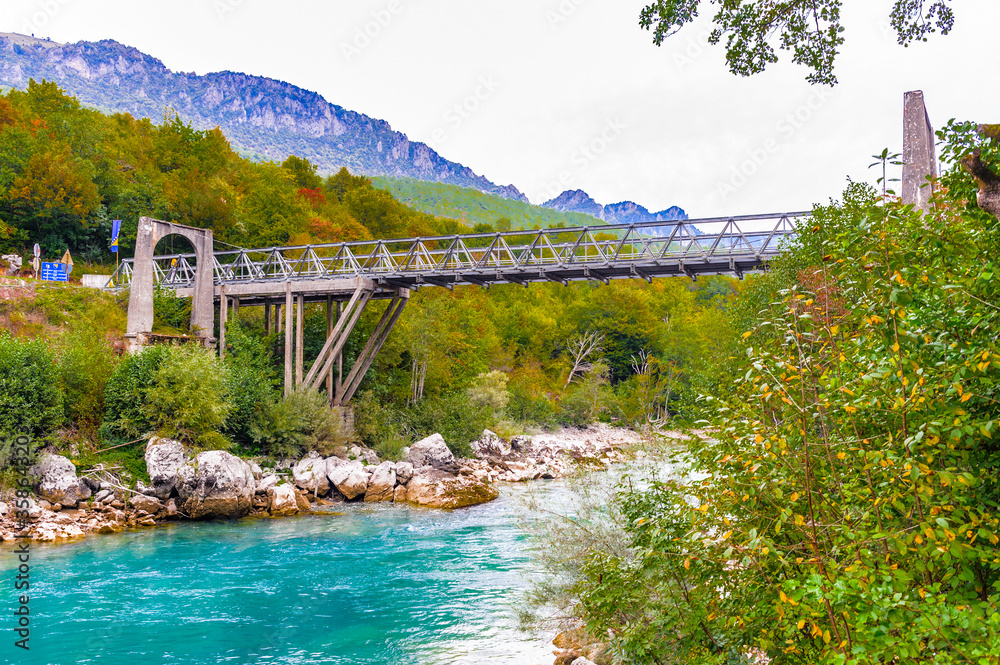
The most dramatic border crossing on the montenegro bosnia motorcycle route is Šćepan Polje — a river canyon crossing where the road drops to the Tara River and climbs steeply into Montenegro on the other side. The scenery at the crossing itself is extraordinary and the border is efficient — typically ten to fifteen minutes in both directions outside summer peak.
The alternative crossing near Trebinje in the south is more straightforward if you’re routing from Mostar directly to the coast rather than via Durmitor. Both crossings require passport, green card insurance, and vehicle registration. Standard European policies usually cover Montenegro — verify explicitly before departure.
Budget and Daily Costs
Bosnia is among the cheapest countries in Europe for motorcycle touring. Fuel runs 1.45–1.60 € per litre. A full meal at a local restaurant costs 6–10 €. Budget guesthouses charge 20–35 € per night. The currency is the Convertible Mark — approximately 0.51 € per BAM — pegged to the Euro and effectively stable. Withdraw BAM at ATMs on arrival as card acceptance outside tourist areas is variable. Daily budget tiers: 30–45 € budget, 50–70 € comfortable, 70–90 € mid-range.
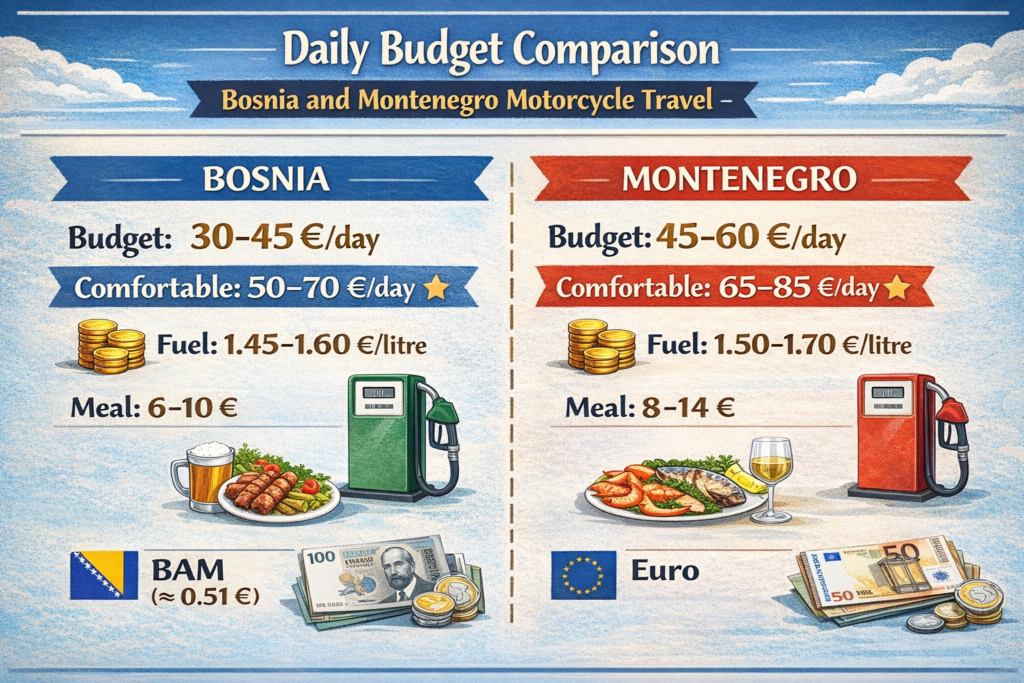
Montenegro runs slightly higher, particularly on the coast in summer. Fuel prices sit at 1.50–1.70 € per litre. Accommodation ranges from 35–60 € for budget options inland to 80 €+ on the coast in July and August. Food costs 8–14 € for a full restaurant meal, cheaper inland than coastal. Montenegro uses the Euro, which simplifies budgeting. Daily budget tiers: 45–60 € budget, 65–85 € comfortable, 85–110 € mid-range.
Practical Riding Tips
In Bosnia: speed limits are 50 km/h urban, 80 km/h rural, and 130 km/h on the limited motorway sections. Road markings are faded in places — particularly on secondary roads — so stay alert especially in low light. Fuel is plentiful on main routes; plan ahead if heading into remote canyon areas. English is spoken in tourist areas but less reliably in rural Bosnia — a translation app with offline capability is worth having.
In Montenegro: speed limits are 50 km/h urban, 80 km/h rural, and 100 km/h on expressways. Traffic police are active on tourist routes in summer and speed limit enforcement is taken seriously. The coastal road between Kotor and Budva carries heavy traffic in July and August — ride it early morning or accept the convoy. Mandatory equipment mirrors the rest of the Balkans: reflective vest, warning triangle, first aid kit.
In both countries: tyre condition matters. The canyon roads are forgiving on good rubber and unpleasant on worn tyres. Check condition before crossing from Croatia.
Combining Both Countries with Neighbouring Routes
The most natural combination is the three-country loop: Croatia south to Dubrovnik, across into Bosnia via Mostar, through the canyon to Sarajevo, south into Montenegro via Kotor and Durmitor, then either back north or continuing into Albania. Two weeks covers this comfortably with time to slow down.
Continuing south from Montenegro into Albania is the logical next step for riders who want to extend the tour — the Sukobin border crossing south of Ulcinj is efficient and the contrast between Montenegro and Albania is as dramatic as the contrast between Bosnia and Montenegro.
Final Thoughts
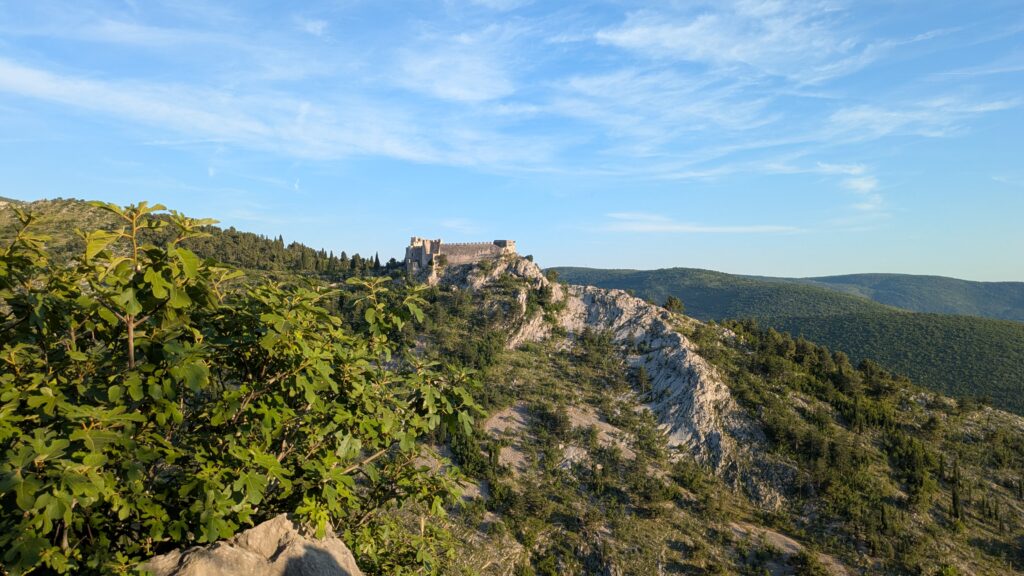
Bosnia and Montenegro together deliver the most varied riding in the Balkans. Canyon roads in the morning, mountain passes at midday, a coastal serpentine in the afternoon, and a UNESCO old town for the evening — that kind of variety within a single riding day is genuinely unusual in European touring and genuinely typical of the montenegro bosnia motorcycle experience.
Both countries are less visited than their western Balkan neighbours, more affordable, and arguably more rewarding for riders who want roads that feel discovered rather than curated. The Neretva canyon deserves to be as famous as any road in Europe. Durmitor deserves more time than most riders give it. And the Kotor serpentine is exactly as good as every rider who’s ridden it says it is.
Have you ridden Bosnia or Montenegro — or both? Drop your route tips and overnight recommendations in the comments. There’s always a rider planning their first Balkan loop who’ll benefit from knowing what works in practice.