The motorcycle touring jacket has to do more than any other piece of kit in your wardrobe. It needs to protect you in a crash, manage your body temperature across a range that can span 25 degrees in a single riding day, keep rain out for hours on an alpine pass, and be comfortable enough to wear from first light to last stop without becoming a distraction. No single jacket does all of this perfectly. The ones that come closest are the result of deliberate trade-offs — and understanding those trade-offs is what this guide is about.
Variable weather is the defining challenge of European motorcycle touring specifically. A rider in southern Spain in July has different needs from one crossing the Nockalmstraße in May. A Balkan tour in June demands something different from an Atlantic coast run in September. The right motorcycle touring jacket for your riding isn’t the one with the highest spec sheet — it’s the one that handles the conditions you actually ride in most often, with enough flexibility to manage the rest.
Why Variable Weather Makes Jacket Choice Harder
European touring temperature ranges are genuinely extreme by motorcycle standards. A spring morning in the Austrian Alps starts at 5–8°C and the same afternoon on the Italian lakes side runs at 25°C. A Balkan tour in June swings between cool mountain passes above 1,500 metres and coastal riding in 32°C heat within the same riding day. No jacket handles both ends of that range without a layering strategy.
The layering solution and the all-in-one solution are the two valid approaches to this problem. An all-in-one jacket — built-in waterproof membrane, removable thermal liner, good ventilation — attempts to cover the full range in a single garment. A layering approach uses a core jacket and adds or removes layers underneath and over it as conditions change. Both work. The all-in-one is more convenient. The layering approach is more flexible and often performs better at the extremes.
Seasonal timing shapes this choice significantly. Spring and autumn touring in the Alps or northern Europe demands the most versatile jacket — thermal liner in the morning, vents open by afternoon, rain layer over everything when the pass clouds close in. Summer Mediterranean riding is simpler: ventilation is primary, waterproofing is a backup. Match your jacket choice to the season and region you actually ride rather than an imagined average.
Key Features to Look for in a Motorcycle Touring Jacket
CE Protection Standards
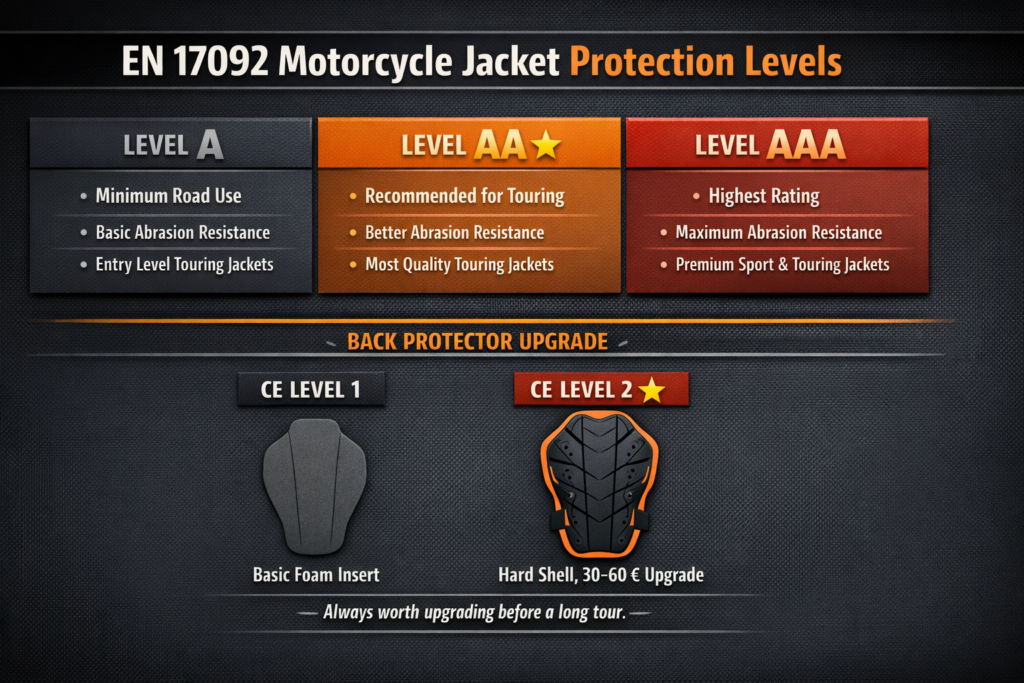
The current European protection standard for motorcycle jackets is EN 17092, which replaced EN 13595. It grades jackets across three protection levels: A, AA, and AAA. Level A is the minimum for road use. Level AA — the most common in quality touring jackets — offers meaningfully better abrasion resistance. Level AAA is the highest rating, found in premium sport and touring jackets.
Armour locations matter as much as the jacket’s overall rating. Shoulders and elbows are standard in all but the cheapest jackets. Back protection is where most jackets cut corners — a basic CE Level 1 foam back protector is included, and a CE Level 2 hard-shell protector is available as an upgrade or optional purchase. The Level 2 upgrade costs 30–60 € and is worth making before any serious tour. Check that armour stays in position over a full riding day rather than migrating toward the elbow or falling out of the shoulder pocket.
Waterproofing
The integrated waterproof liner vs. separate rain jacket debate sits at the centre of every motorcycle touring jacket buying decision. An integrated liner — zip-in, sitting between the outer shell and your mid-layer — is convenient and keeps the jacket profile clean. The performance trade-off is real: water saturates the outer shell before hitting the membrane, and in sustained heavy rain the system works harder than a standalone waterproof layer worn over the jacket.
Gore-Tex laminated construction — where the membrane is bonded directly to the outer fabric rather than sitting as a removable liner — is the premium option and performs significantly better in sustained rain. It’s found in 400 €+ jackets and is worth the investment for riders who tour in consistently wet climates. For riders who use a separate packable rain jacket over their touring jacket, a less expensive integrated liner is perfectly adequate.
Collar and cuff sealing are where integrated waterproofing fails first. A collar that gaps at the neck in wind-driven rain and cuffs that don’t overlap your glove gauntlets effectively negate a high-specification membrane. Check both fit points when trying any waterproof motorcycle touring jacket.
Ventilation
Ventilation in a motorcycle touring jacket is as important as waterproofing for all-season European use. A fully sealed waterproof jacket with no ventilation becomes genuinely uncomfortable in anything above 20°C. The most effective ventilation designs use chest and back vents in combination — chest vents scoop air in, back vents allow it to exit. Pit zips and underarm vents are the most effective single ventilation feature in any touring jacket, allowing significant airflow without compromising rain protection.
Mesh panel jackets — where large sections of the outer shell are replaced with open mesh — are excellent for warm climate touring but impractical for all-season European use. A zippered vent system on a waterproof outer shell is the more versatile solution for riders who tour across multiple seasons and climates.
Thermal Management
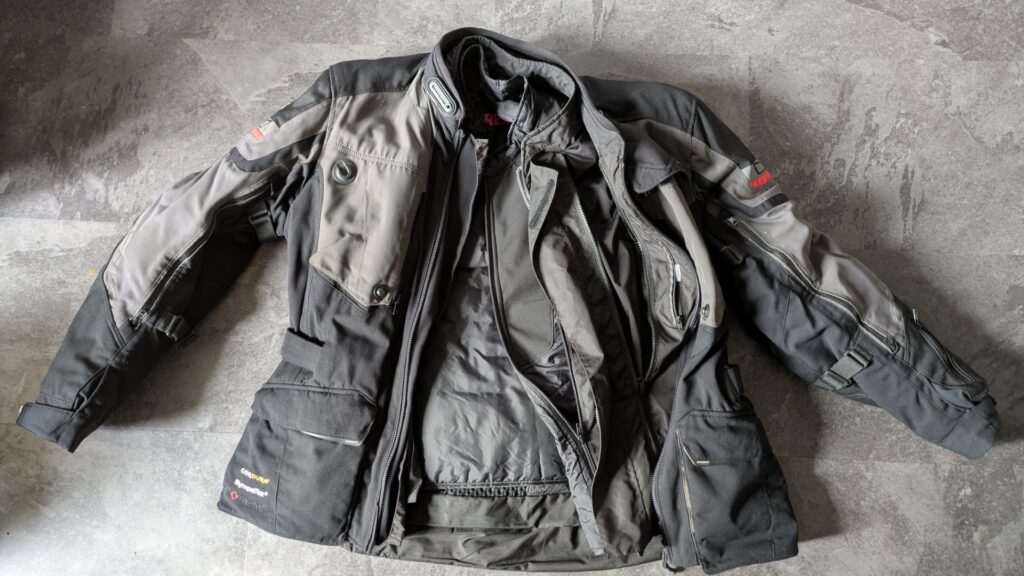
The removable thermal liner is the key feature that makes a motorcycle touring jacket functional across a wide temperature range. A quality liner — proper insulated fill rather than a thin fleece — adds meaningful warmth at 5–10°C and removes cleanly for riding at 25°C+. Check whether the liner can be worn independently as a mid-layer off the bike, which adds versatility to the overall kit system.
Liner compatibility with mid-layers underneath is worth checking during fitting. A jacket sized for the liner only, with no room for a fleece underneath the liner in very cold conditions, limits the usable temperature range significantly. Try the jacket with both a liner and a mid-layer before buying if cold weather touring is likely.
Fit and Ergonomics
Motorcycle touring jacket fit in riding position differs significantly from standing fit, and it’s the riding position that matters. Sleeves that pull up above the wrist when arms are extended on the bars are the most common and most frustrating fit mistake — water runs straight down your arm into your glove and cold air channels in at speed. Check sleeve length with arms forward, not hanging at your sides.
Waist adjustment — velcro tabs, belt, or drawstring — determines how much cold air enters from below at speed. A well-adjusted waist seal makes a measurable difference in cold weather riding comfort. The connection between jacket and riding trousers via a zip system prevents the jacket from riding up in a crash and keeps cold air from entering at the waist — worth prioritising if you tour regularly in cold or wet conditions.
Materials — Textile vs. Leather for Touring
Textile Jackets
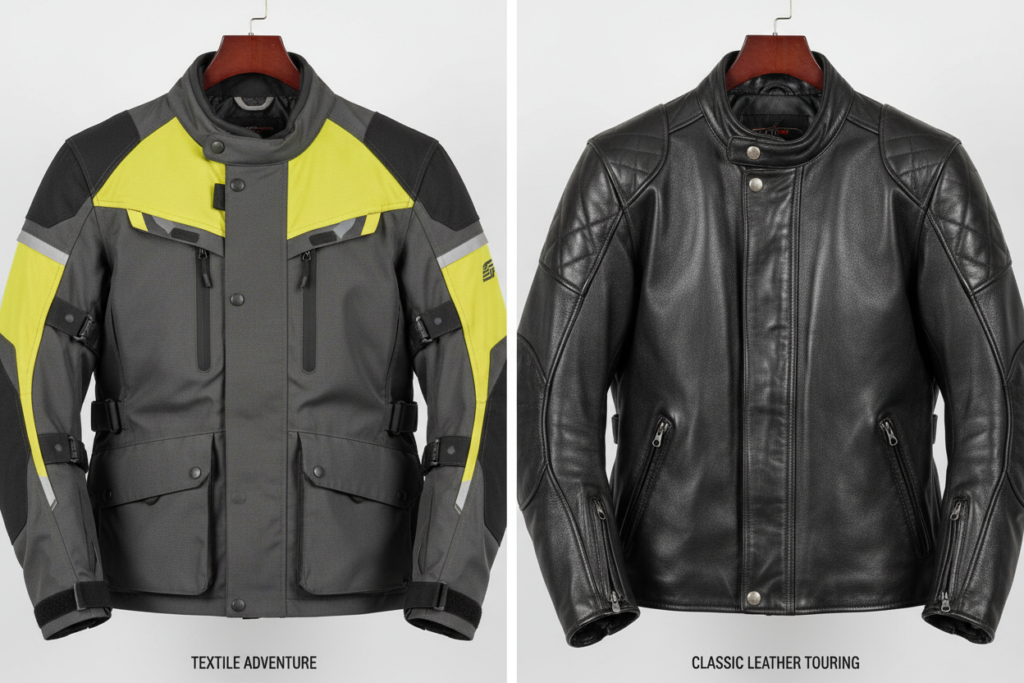
Textile is the dominant material for European motorcycle touring jackets and for good reason. Lighter than leather, easier to integrate waterproof membranes and ventilation systems, more versatile across seasons, and available across a wider price range. Cordura and ballistic nylon are the primary outer fabrics — higher denier ratings indicate greater abrasion resistance, though construction quality matters as much as the number.
The abrasion resistance gap between textile and leather at equivalent price points is real but has narrowed significantly in recent years. Quality Cordura textile at 500D and above performs well in real-world crash scenarios. For the majority of European touring riders, textile’s versatility advantages outweigh leather’s marginal protection edge. Price range for quality touring textile: 150–600 €.
Leather Jackets
Leather’s abrasion resistance advantage is most pronounced at speed — the material that slides rather than grabs in a high-speed slide. For touring, the practical disadvantages are significant: heavier, poor waterproofing integration, limited ventilation, and less comfortable in sustained heat. Perforated leather addresses the ventilation issue for summer touring at the cost of any weather resistance.
Leather earns its place in warm climate touring and for riders who prioritise long-term protection investment — a quality leather touring jacket maintained properly outlasts multiple textile jackets. For all-season European touring with variable weather as the primary consideration, textile is the more practical choice. Price range: 200–800 €.
Hybrid Jackets
Hybrid construction — leather panels at shoulders, elbows, and spine, textile body panels — attempts to combine leather’s abrasion resistance at impact zones with textile’s versatility and waterproofing compatibility. It works well in practice and represents a genuinely useful middle ground for riders who want leather-level protection without the full weight and weather limitations of an all-leather jacket.
Jacket Types for Different Tour Styles
Adventure / Dual-Sport Jackets
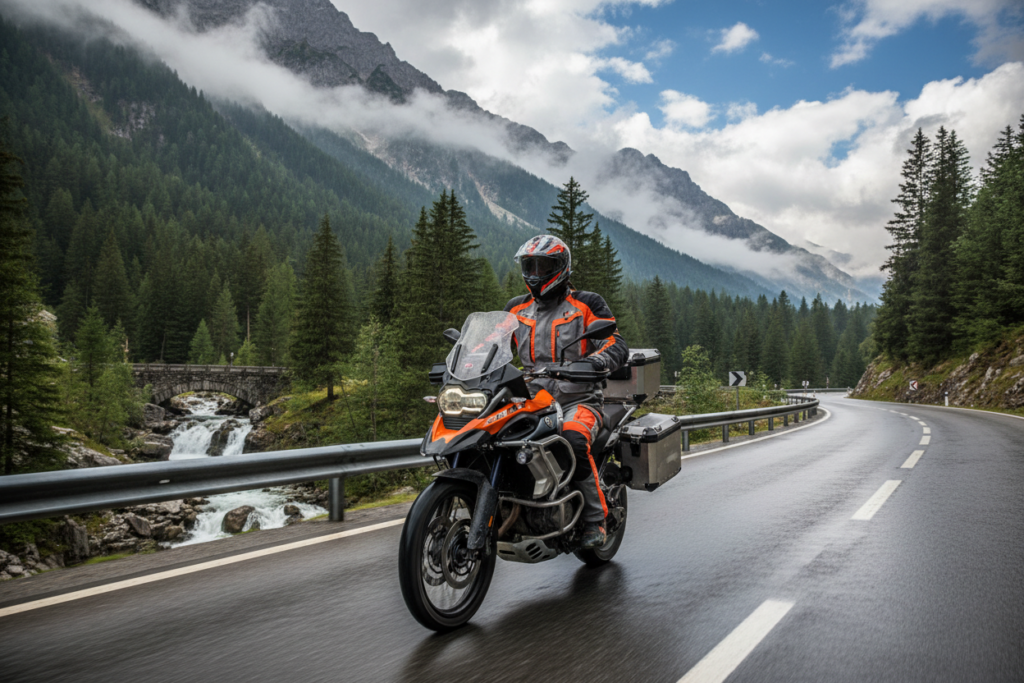
The adventure motorcycle touring jacket is the most versatile category for European touring. Higher cut than sport-touring options, maximum armour coverage, and ventilation systems well-developed across most mid-range and premium models. Built-in waterproofing is standard at 300 €+ in this category. The profile is upright and practical rather than aerodynamic — exactly right for the pace and variety of touring riding.
This is the jacket category I settled on after trying others, and it’s the choice I’d make again. The three-layer system — thermal liner, waterproof membrane, and ventilated outer shell — covers more conditions than any other jacket type I’ve ridden in. Large closable vents keep things manageable on summer tours through Greece and Italy where the heat is a genuine problem. The same jacket with liner inserted gets me through spring alpine passes without discomfort. And when the tarmac ends — which it does regularly on Balkan tours — it doesn’t punish you for leaving the road.
Sport-Touring Jackets
Sport-touring jackets prioritise aerodynamics and long-distance highway comfort over the upright versatility of adventure jackets. Waterproofing and thermal liner systems are well-developed in this category, and the protection ratings are often the highest available. The trade-off for touring is a more aggressive riding position fit that becomes uncomfortable on winding mountain roads and off-bike walking.
Urban Touring Jackets
Lower profile protection, more casual appearance, and significantly better off-bike versatility than dedicated touring jackets. The trade-off — less armour, less weatherproofing — matters on a long tour in variable conditions. Urban touring jackets suit city-heavy routes in warm climates where the riding day is relatively short and walking time is significant.
The Layering Approach for Variable Weather Touring
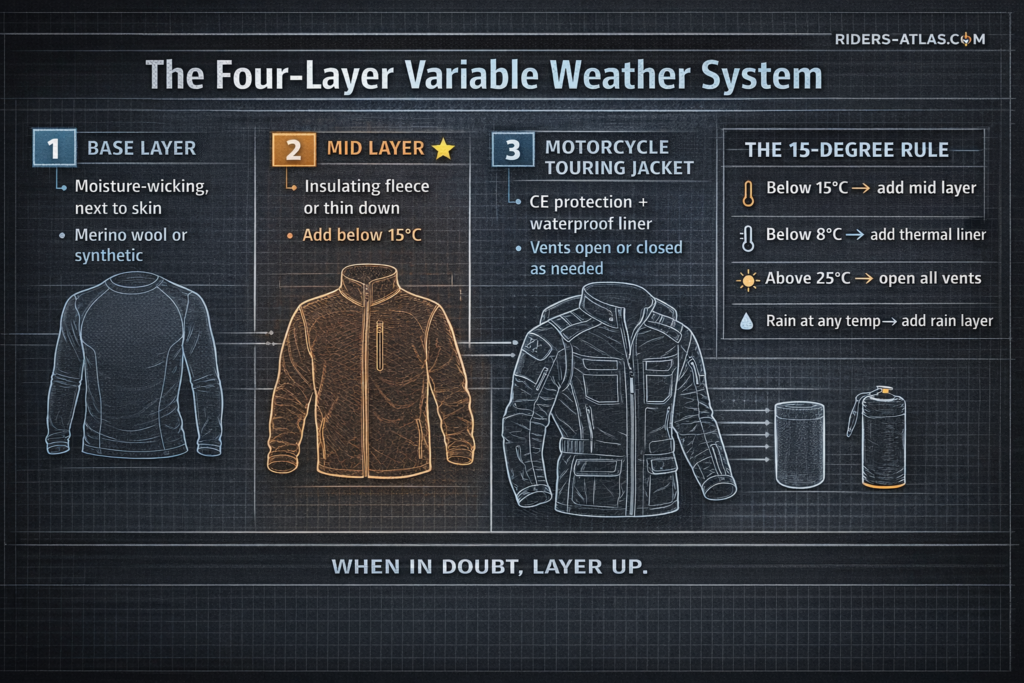
Building a system around a core jacket rather than seeking a single jacket that does everything is the approach most experienced tourers settle on. The four-layer system — moisture-wicking base layer, insulating mid-layer, motorcycle touring jacket, packable rain layer — covers the full European touring temperature range more effectively than any single garment.
The 15-degree rule works as a practical guide: below 15°C, add the mid-layer inside the jacket. Below 8°C, add the thermal liner. Above 25°C, open every vent. Rain at any temperature, add the packable outer layer. Each transition takes two to three minutes at the roadside and makes the next section of riding significantly more comfortable.
Jacket sizing for the layering approach requires buying one size up from your standing fit — enough room for a mid-layer and liner underneath without restricting movement. A jacket that fits perfectly over a t-shirt will be uncomfortably tight with a fleece and liner inside.
The layering system earned its place on a single riding day from the Greek coast to Kosovo to meet a friend — a route that threw everything at me in one go. Temperatures hit 30°C on the coast, dropped sharply in a windy canyon section mid-afternoon, and turned to rain by early evening. Three completely different weather situations in one day. Every transition took about ten minutes at the roadside — liner in or out, vents open or closed, rain layer on or off — which also gave my legs and back a chance to loosen up. One fixed jacket would have meant being miserable for at least two of those three sections. The layering system meant none of them were a problem.
Budget Guide — What to Expect at Each Price Point
- Under 150 €: basic CE Level A certification, limited waterproofing, short lifespan under regular touring use. Acceptable as a first jacket for occasional riding — not for serious touring.
- 150–300 €: CE AA rating, genuine waterproof liner, removable thermal liner, decent ventilation. The entry point for touring that takes the riding seriously. Lifespan two to four years with regular use.
- 300–500 €: premium Cordura or Gore-Tex construction, CE AA or AAA rating, well-developed ventilation system, quality thermal liner. The sweet spot for regular European tourers. Lifespan four to seven years.
- 500 €+: top-tier construction from brands like Rukka, Klim, and Held. Maximum protection ratings, Gore-Tex Pro membranes, multi-year lifespan. Justified for daily riders and those touring multiple months per year.
End of season sales — September through November — offer 30–50% reductions on current season stock. Timing a jacket purchase to clearance rather than buying in spring at full retail saves 80–200 € at the mid-range tier.
Matching Your Jacket to Your Tour
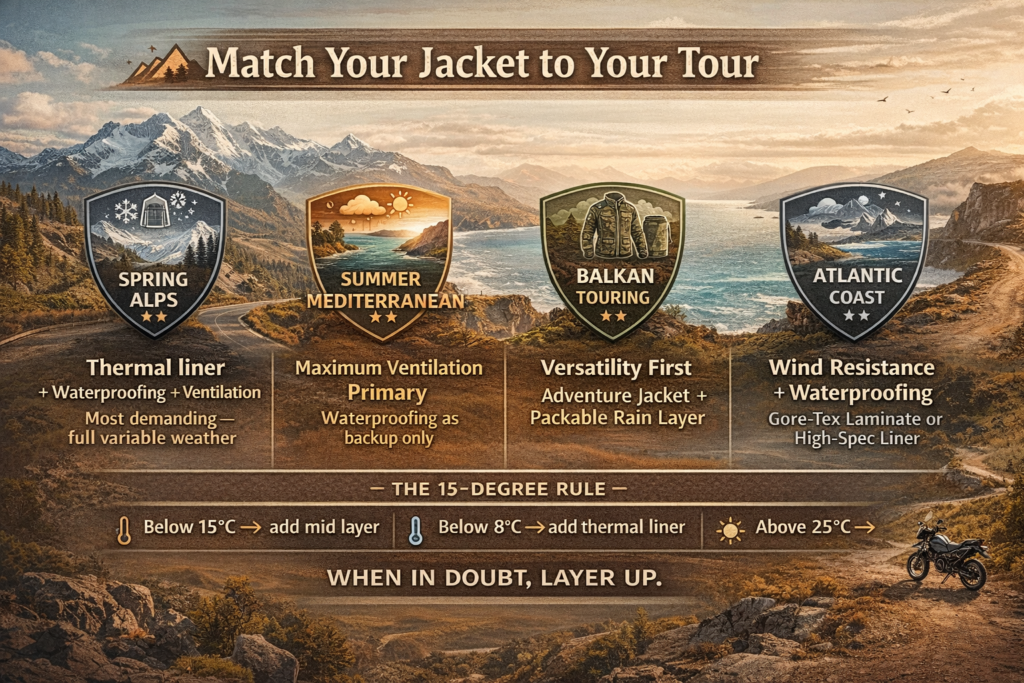
Spring Alpine touring demands thermal liner, quality waterproofing, and at least basic ventilation for the inevitable warm afternoon descents. This is the most demanding use case for a motorcycle touring jacket — the full variable weather challenge in a single riding day.
Summer Mediterranean touring flips the priority: maximum ventilation is the primary requirement, waterproofing is the backup, and the thermal liner stays in the luggage. A highly ventilated textile jacket with a packable rain layer in the tank bag covers this use case effectively and comfortably.
Balkan touring demands versatility above all else. Coastal riding in 30°C heat, mountain passes above 1,500 metres in the afternoon, and the occasional sudden storm — all within the same riding day. An adventure jacket with a good ventilation system and packable rain layer backup handles this better than any single-condition optimised alternative.
Atlantic coast touring — Portugal, western France, Ireland, and the UK — prioritises wind resistance and waterproofing above all else. Rain here is sustained and wind-driven. A Gore-Tex laminated jacket or high-specification integrated liner combined with a packable outer layer is the right system for this routing.
Final Thoughts
No motorcycle touring jacket does everything perfectly, and the search for one that does leads to expensive disappointment. The right jacket is the one that handles your primary riding conditions well, with a layering strategy that covers the extremes on either side.
The 300–500 € range delivers the best balance of protection, waterproofing, and ventilation for most European tourers. Buy for the conditions you actually ride in, not the average of all possible conditions. Break it in on shorter rides before committing it to a two-week tour — fit and comfort reveal themselves over distance in ways that a shop try-on never will.
What jacket are you currently touring in and what would you change about it? Drop it in the comments — there’s always a rider about to make their first serious jacket purchase who’ll benefit from real-world experience.