Riders will spend 800 € on a jacket without blinking. They’ll agonise for weeks over helmet brands, visor tints, and intercom systems. Then they’ll grab whatever boots look decent and call it done. It’s one of the most consistent mistakes I see among tourers — and one of the most painful ones, literally. Your feet are on the pegs for eight hours a day. Get the boots wrong and no amount of great roads will save you.
Good motorcycle touring boots are a different animal from what most riders start out wearing. They need to protect you in a crash, keep your feet dry through three hours of mountain rain, and then carry you comfortably around a cobblestoned Croatian harbour town at the end of the day. That’s a complicated brief, and not every boot delivers on all three. This guide breaks down exactly what to look for, which styles suit which riders, and how to avoid the most common mistakes when buying, so that this part of your packing list will not leave you disappointed.
Why Touring Boots Are Different from Regular Motorcycle Boots
Most motorcycle boots are designed around one primary use case. Sport boots are built for track performance — stiff, heavily armoured, and absolutely miserable to walk in. Motocross boots are for off-road riding and handle tarmac touring about as well as ski boots handle grocery shopping. Even general commuter boots often prioritise style over the specific demands of multi-day touring.
Long-distance motorcycle touring boots need to satisfy three demands simultaneously: protection in a crash, weather resistance across days of unpredictable conditions, and enough walkability to function as your only footwear off the bike. You’re not packing a second pair of shoes. Whatever is on your feet when you park up is what you’re wearing to dinner, around a city, and back to the hotel. That changes everything about what “good enough” means.
Key Features to Look for in Motorcycle Touring Boots
Protection
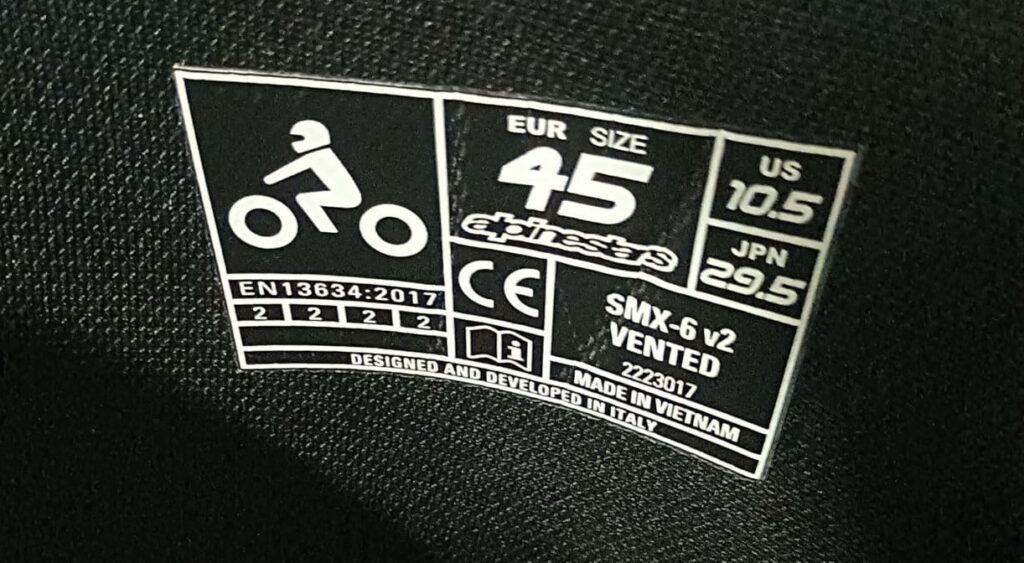
Start with CE certification. The EN 13634 standard is what you’re looking for — it tests ankle protection, sole penetration resistance, and abrasion resistance. Level 1 is the minimum acceptable for touring; Level 2 offers meaningfully better protection and is worth the modest price premium at the upper end of each boot category.
Ankle protection is the most critical element. Internal ankle armour — built into the boot structure rather than sitting as a removable insert — tends to stay in position better during an impact. Check the toe box reinforcement and heel cup too. A solid heel cup prevents the foot from sliding backward in a frontal impact, which is one of the most common injury mechanisms in motorcycle accidents. Finally, look for a proper shift pad on the left boot and a sole with enough grip to handle wet cobblestones without turning into an ice rink.
Waterproofing
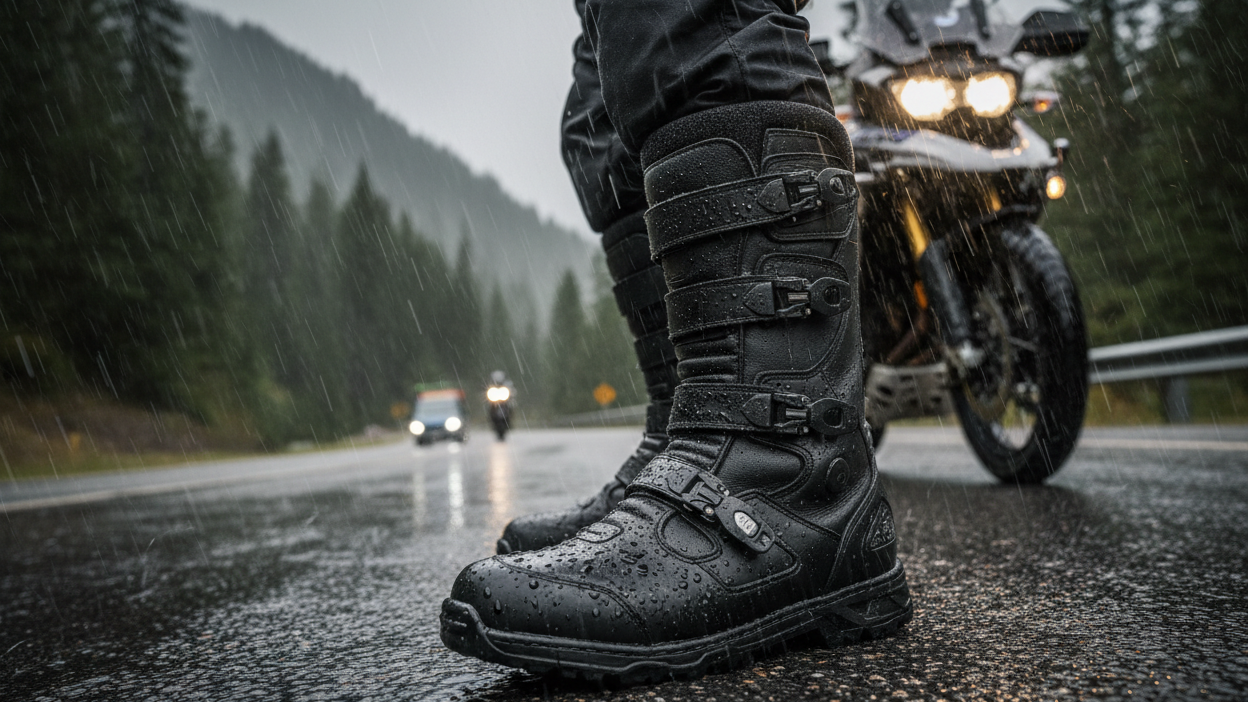
Gore-Tex is the gold standard for waterproof membranes in motorcycle touring boots and genuinely outperforms most proprietary alternatives in sustained wet conditions. That said, even Gore-Tex has limits — no boot stays completely dry after several hours of heavy rain and standing water. What a good membrane does is extend that threshold significantly.
One honest trade-off: waterproof boots are less breathable. In Mediterranean summer heat, a fully sealed Gore-Tex boot becomes uncomfortable fast. If you’re touring warm climates in summer, a ventilated boot with a separate waterproof oversock or gaiter might serve you better than a sealed boot that bakes your feet all day.
Waterproofing also degrades. Treat your boots with a DWR (durable water repellent) spray every few months of active use and the membrane will perform far longer.
Walkability and Comfort
This is where many otherwise excellent motorcycle boots fall down for touring specifically. A rigid sole that gives great feel on the pegs becomes a problem after two kilometres on foot around a historic town. Look for a sole with genuine flex — pick the boot up and bend it. If it barely moves, it’ll be uncomfortable for extended walking.
Lacing systems, zips, and BOA dials all have their merits. Traditional lacing gives the most precise fit adjustment but takes time to put on and can work loose. Full-length zips are fast and convenient but add a potential failure point. BOA dial systems are increasingly common in premium touring boots and offer excellent adjustability with no laces to catch or come undone — worth considering if you’re trying boots on at the shop but also mandatory to try on since the BOA dial system can change how the boot closes around your ankle.
Budget a proper break-in period for any new motorcycle touring boots. Leather boots especially need 200–300 km of riding and a fair amount of walking before they conform to your foot. Never start a long tour in boots you bought the previous week.
Durability
Full-grain leather remains the most durable upper material for touring boots, ages well, and can be repaired and maintained over many years. Textile and synthetic uppers are lighter and often cheaper, but they don’t respond as well to the abrasion of repeated touring use. Some premium boots offer resolable soles — worth checking, because the upper often outlasts the sole on quality boots and resoling costs a fraction of replacement.
Types of Motorcycle Touring Boots
Adventure / Dual-Sport Boots
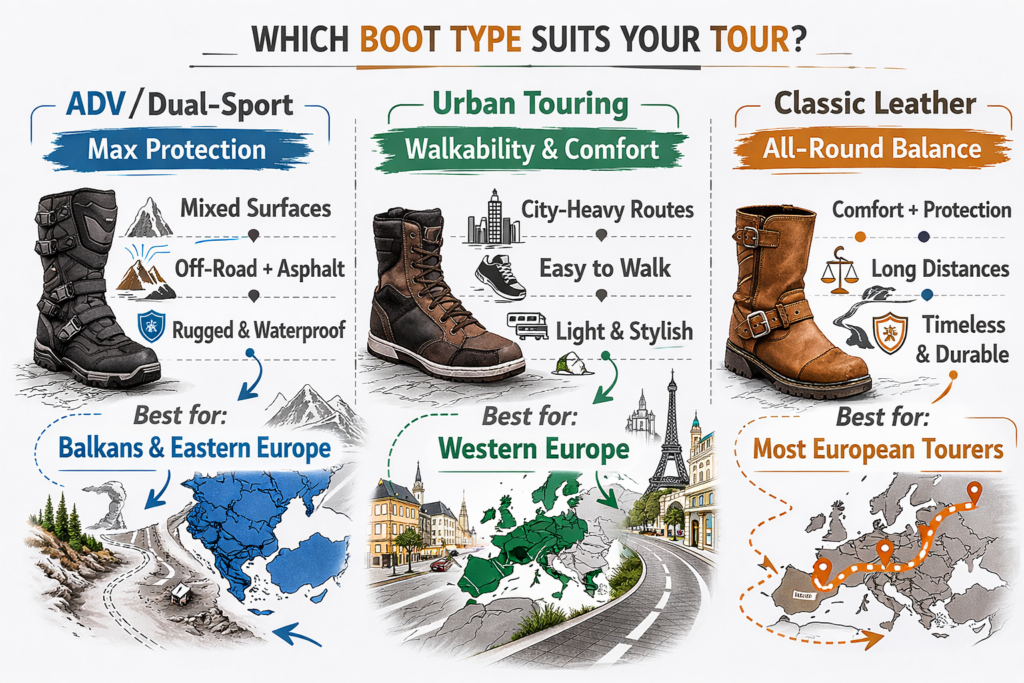
Higher cut, more substantial ankle armour, and built to handle mixed surfaces including gravel and dirt. The trade-off is walkability — ADV boots are not comfortable for extended time on foot, and they look conspicuous in smarter restaurants or city settings. For riders doing Balkan touring, Eastern European routes, or any itinerary with unpaved sections, the extra protection is worth the compromise.
I learned this lesson the hard way in northeast Albania, deep in the kind of terrain where the nearest paved road is four hours away and “trail” is a generous description. My bike went down and my foot got caught between the frame and a boulder — I broke a couple of toes and badly bruised my ankle. Not a pleasant afternoon. But the ADV boots absorbed the bulk of the impact, and the orthopaedic surgeon who later looked at the X-rays was pretty clear that without proper protection that injury would have been significantly worse. Buy the boots before you need them.
Urban Touring Boots
Lower profile, designed to look like regular leather boots or sturdy shoes, with motorcycle protection built discreetly into the structure. Highly walkable, socially versatile, and far less conspicuous off the bike. The trade-off is real though — ankle protection is typically lower than ADV or classic touring boots, and waterproofing is often less robust. These suit riders who spend significant time in cities and prioritise blending in and walking comfort over maximum crash protection.
Classic Leather Touring Boots
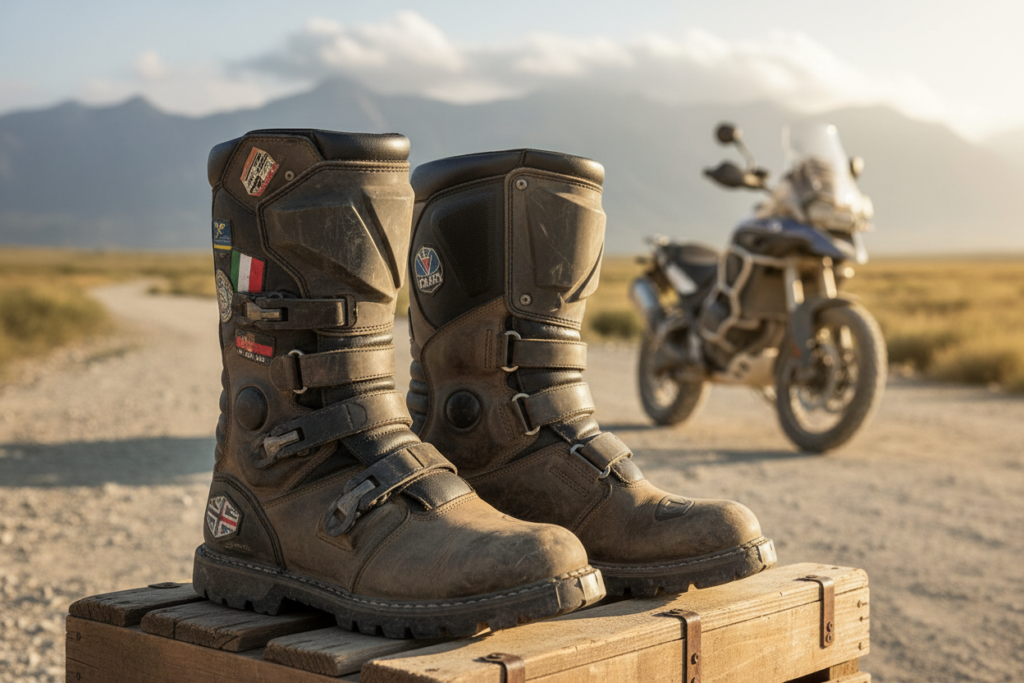
The mid-height, full-grain leather touring boot is the right choice for the majority of long-distance European tourers. Enough ankle protection to take seriously, genuine waterproofing in quality models, resolable soles, and walkability that improves significantly once broken in. Brands like Sidi, Forma, and Alpinestars all produce solid options in this category across multiple price points. These are the boots most experienced tourers end up settling on after trying the alternatives.
How to Get the Fit Right
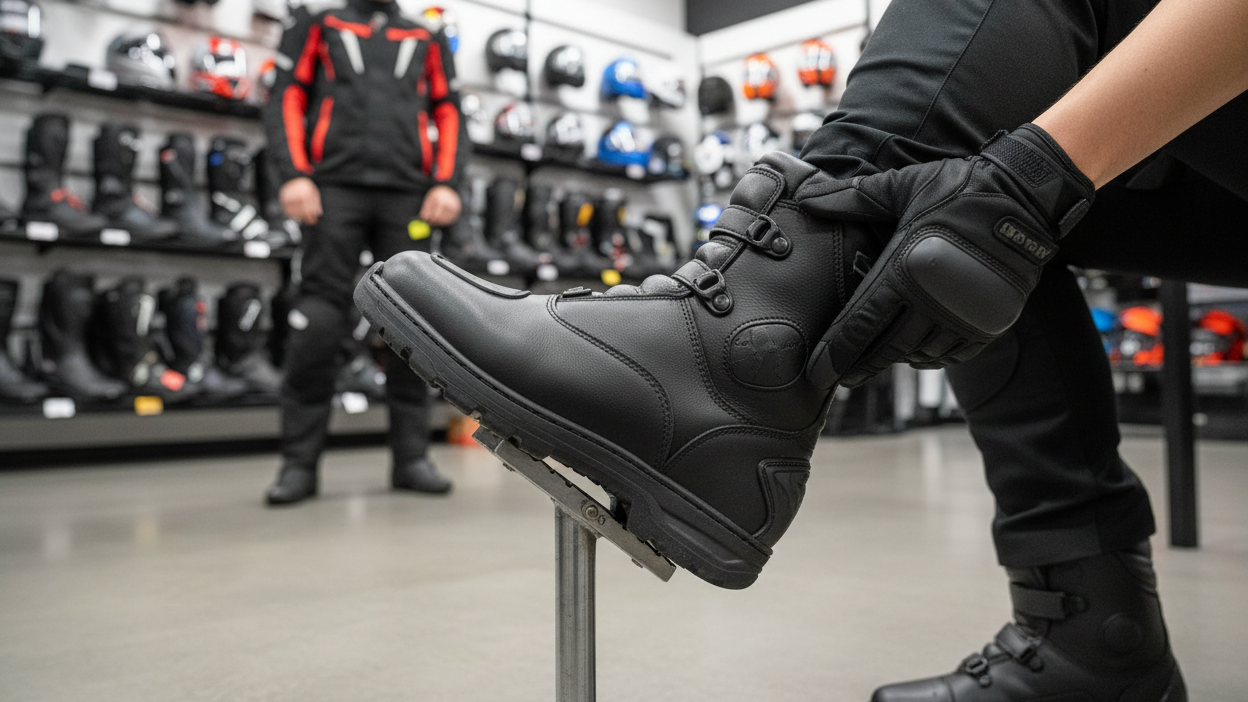
Motorcycle touring boot sizing frequently runs differently from standard shoe sizing — sometimes a full size, sometimes half a size. Always try before you buy where possible, and bring the socks you actually tour in. A thin dress sock gives you a very different fit from a mid-weight merino touring sock, and your fit assessment needs to reflect reality.
The heel-slip test matters: put the boot on, lace or zip it up properly, and lift your heel inside the boot. A small amount of movement is normal; significant slipping means the boot is too large and your heel will be working against the material all day. Check toe clearance too — your longest toe should have around a thumb’s width of space, because feet swell during long riding days and a boot that fits perfectly in the shop can become painfully tight by mid-afternoon.
I once bought a pair of touring boots that felt genuinely perfect in the shop — right size, no pressure points, comfortable straight away. First ride out, blisters. It’s a trap that’s easy to fall into because a static fit in a shop tells you almost nothing about how a boot behaves under real conditions. Since then I always wear new boots for at least three hours around the house before they go anywhere near the bike. It sounds excessive until you’re two days into a tour with raw heels and no alternatives.
Waterproofing in Practice — What to Actually Expect
No motorcycle touring boot stays dry indefinitely in sustained heavy rain. The realistic threshold for a quality Gore-Tex boot is around two to three hours of constant rain before water finds its way in via the collar or seams. For multi-day wet weather touring — spring in the Alps, for example — a waterproof gaiter worn over the boot collar adds a meaningful extra layer of protection.
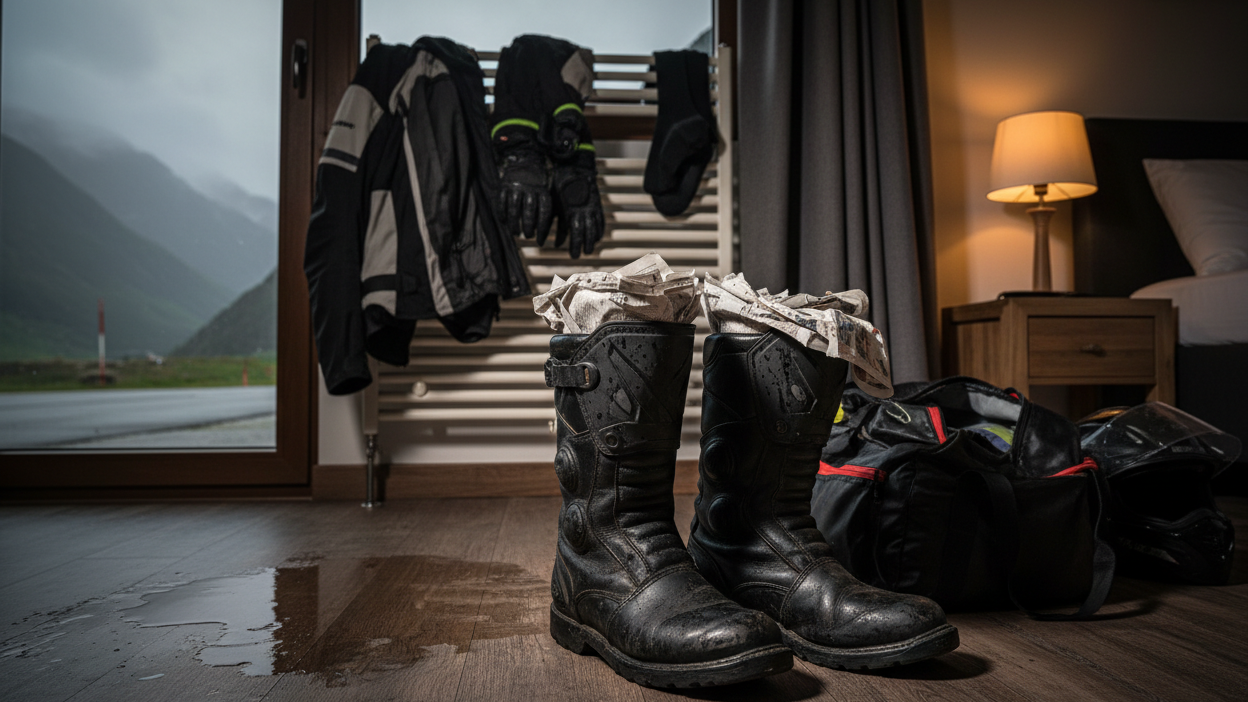
Drying boots on the road is a skill in itself. Stuff them loosely with newspaper or a microfibre towel overnight to draw moisture out. Never put them near a direct heat source — a radiator or campfire heat will crack leather and delaminate waterproof membranes faster than anything. If you have access to a boot dryer at a hotel, use it on the lowest setting.
Budget Guide — What You Get at Each Price Point
- Under 150 €: Entry-level CE certification, basic waterproofing that won’t survive sustained rain, shorter lifespan. Acceptable for occasional touring but you’ll outgrow them quickly.
- 150–250 €: The sweet spot for most tourers. Genuine CE Level 1 or 2 certification, reliable waterproof membranes, walkable soles, and a lifespan of three to five years with reasonable care. Start here.
- 250–400 €: Premium materials, Gore-Tex membranes, resolable soles, and serious protection standards. Worth the investment for riders who tour regularly — the cost per kilometre over five years is very reasonable.
- 400+ €: Top-tier construction from brands like Sidi and Alpinestars. Maximum protection, maximum durability, maximum everything. Justified for daily riders and anyone putting serious distance on annually.
Second-hand touring boots can be good value — check sole wear, inspect the waterproof membrane by running water over the boot and watching for immediate soak-through, and look closely at stitching around the toe box and heel where stress concentrates.
Matching Your Boot to Your Tour Style
The right motorcycle touring boots for a Balkan loop are not necessarily the right boots for a city-heavy Western Europe tour. Balkan and Eastern European touring means rougher road surfaces, occasional gravel, and fewer high-end shops if something goes wrong — prioritise durability and protection. For Alpine touring in spring, waterproofing and ankle support are non-negotiable.
Warm climate touring in the Mediterranean summer is where the waterproof trade-off becomes most relevant. A fully sealed Gore-Tex boot in 35°C heat is genuinely uncomfortable. Consider a lighter, more ventilated boot and accept that you’ll use a gaiter or simply get wet feet if it rains — which in Mediterranean summer is uncommon anyway.
Conclusion
There is no single perfect motorcycle touring boot. Every option involves a trade-off between protection, walkability, and weather resistance, and the right balance depends on where you ride, how long you ride each day, and how much time you spend off the bike. What’s not a trade-off is buying quality — a decent pair of motorcycle touring boots at 150–250 € will serve you far better over three seasons than two pairs of budget options at 80 € each.
Break them in before you go. Seriously. The number of touring riders who debut brand new boots on day one of a long trip and spend the first week in pain is depressingly high. Wear them around the house, on short rides, walking the dog. By the time you set off, they should feel like an old friend.
What boots are you currently riding in, and what would you do differently? Drop it in the comments — there’s always someone about to buy their first pair who’ll benefit from the experience.