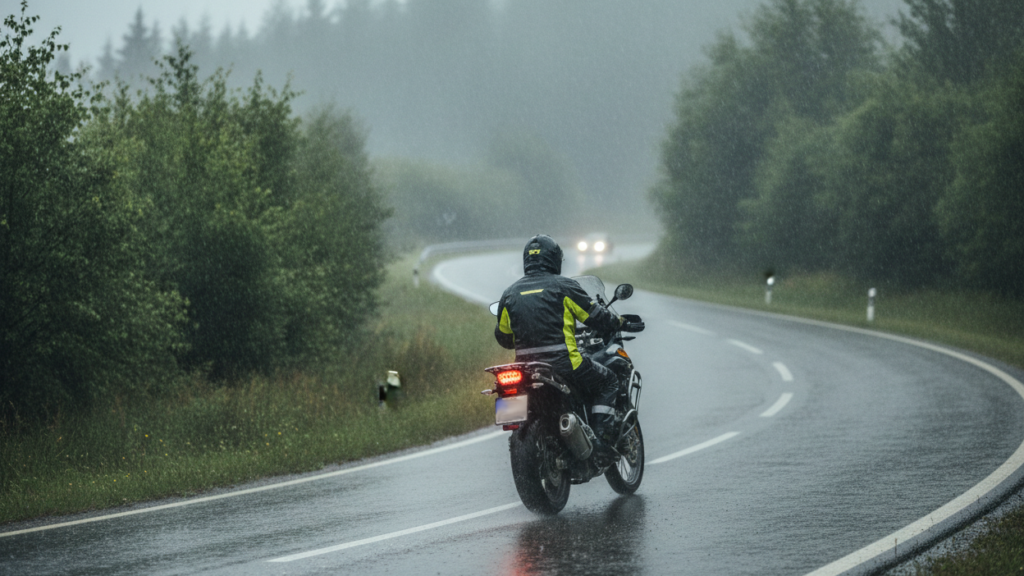
Let me be straight with you: no motorcycle rain gear keeps you completely dry. Not Gore-Tex, not fully taped seams, not the most expensive suit in the catalogue. What good gear does is extend the threshold — the point at which water wins — from twenty minutes to several hours. On a European tour, that difference is everything. It’s the difference between finding shelter before you’re soaked through and arriving at your next stop shivering with three hours of wet riding still ahead of you.
Rain on a European motorcycle tour is not a question of if. It’s a question of when and how prepared you are when it arrives. I’ve been caught in summer storms in the Balkans, in sustained Atlantic drizzle on the French coast, and in full alpine downpours on passes that had been perfectly clear thirty minutes earlier. The riders who handle it best are never the ones with the most expensive gear — they’re the ones who understand how their system works and where its limits are. This guide will get you there. Interested in how to conquer the challenges of spring touring? – Check out this post!
Understanding Waterproof Ratings — What the Numbers Actually Mean
The waterproofing world loves technical language that sounds precise but rarely gets explained clearly. Here’s what actually matters when you’re reading gear specs.
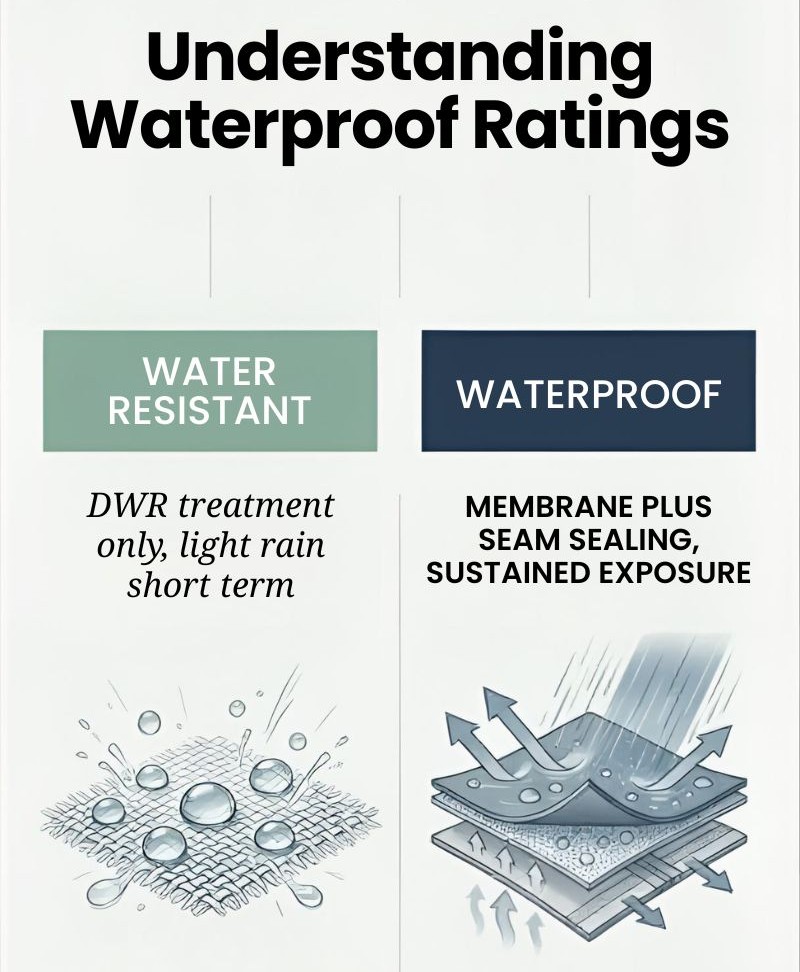
Hydrostatic head rating measures how much water pressure a fabric can resist before it lets water through, expressed in millimetres. Anything below 5,000mm is water resistant at best. Genuine touring rain gear starts at 10,000mm. Gore-Tex and premium proprietary membranes typically rate at 20,000mm or above. In practical terms, the difference shows up in sustained heavy rain — lower-rated fabrics let water through at the seams and high-pressure points like shoulders and knees long before premium membranes do.
DWR — durable water repellent — is the outer treatment applied to the face fabric of waterproof gear. It’s what makes water bead up and roll off rather than saturating the outer layer. DWR degrades with use, washing, and UV exposure. When your jacket starts looking wet even though the membrane is intact, the DWR has worn off. This is fixable with a spray treatment — don’t mistake it for the membrane failing.
Seam sealing is where many budget waterproof garments cut corners. Fully taped seams seal every stitch hole in the garment. Critically taped seams seal only the main structural seams. No seam sealing means water enters through every needle hole in the fabric in sustained rain — unacceptable for touring. Always check before buying.
Motorcycle Rain Jackets — Your First Line of Defence
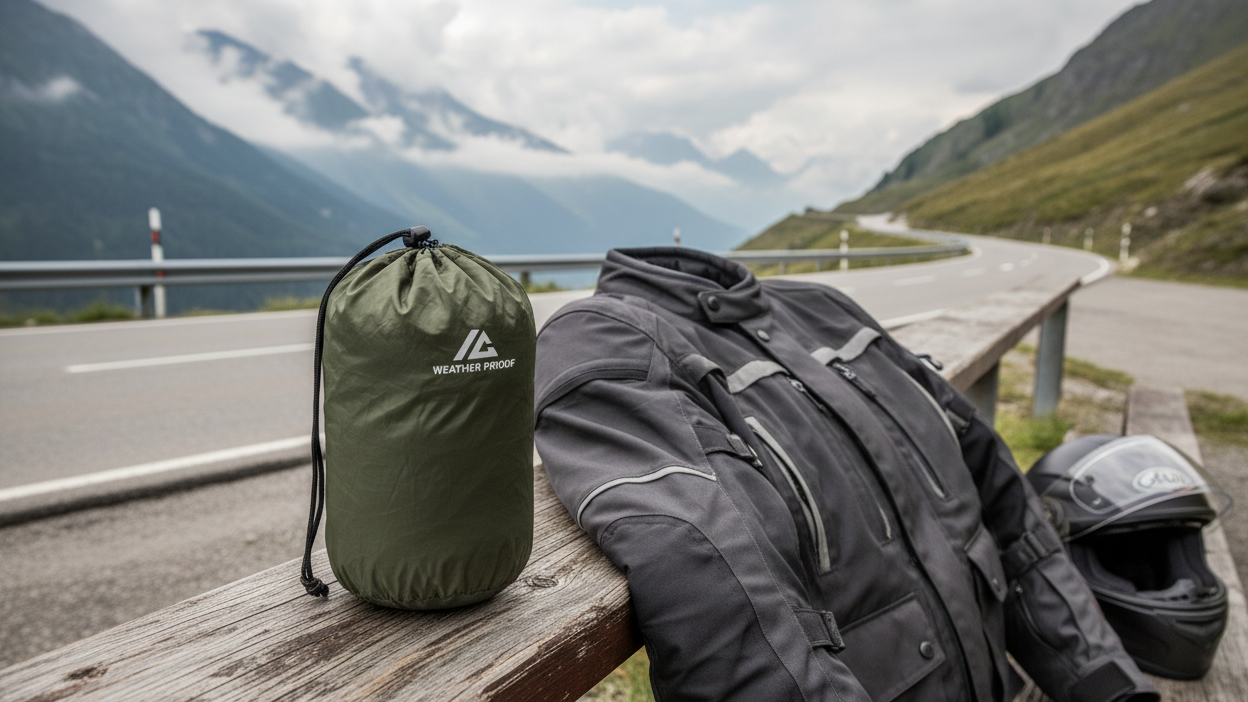
Built-in Waterproof Liner vs. Separate Rain Jacket
Most mid-range and premium motorcycle jackets come with a removable waterproof liner. It’s convenient — one garment covers multiple conditions — but the performance trade-off is real. Integrated liners sit against your mid-layer rather than on the outside of the jacket, which means water soaks the outer shell before hitting the membrane. In light rain this is fine. In sustained heavy rain the saturated outer fabric adds weight and the liner works harder than it should.
A separate packable rain jacket worn over your riding jacket is the better performing option for serious touring. The membrane faces the rain directly, seams are fewer, and when it’s not raining the jacket compresses into a bag the size of a water bottle and lives in your tank bag or top case. The downside is the extra layer bulk and the couple of minutes spent pulling it on at the roadside. For multi-day touring in unpredictable weather — spring in the Alps, Atlantic coast riding, Balkans shoulder season — the performance advantage is worth it.
What to Look for in a Touring Rain Jacket
Fit is the first thing to check. Try the rain jacket over your actual riding jacket, with arms extended as if on the bars. Sleeves that pull up above the wrist in riding position are a common and expensive mistake — water runs straight down your arm and into your glove. Collar height matters too: a low collar that gaps at the neck in wind is a significant weak point. Cuff seals should overlap your glove gauntlet, not sit under it.
High visibility options — yellow, orange, bright red — are worth considering for motorcycle rain gear specifically. Rain reduces visibility dramatically for other road users, and a bright rain jacket adds meaningful safety margin in poor conditions.
Waterproof Motorcycle Pants — The Most Overlooked Part
Riders spend weeks researching rain jackets and buy whatever pants are on sale. It’s one of the most consistent mistakes in touring kit. A jacket that keeps your upper body dry while your legs are soaked through means you’ll be cold, uncomfortable, and miserable within the hour — the body loses heat rapidly through wet legs regardless of how dry your torso is.
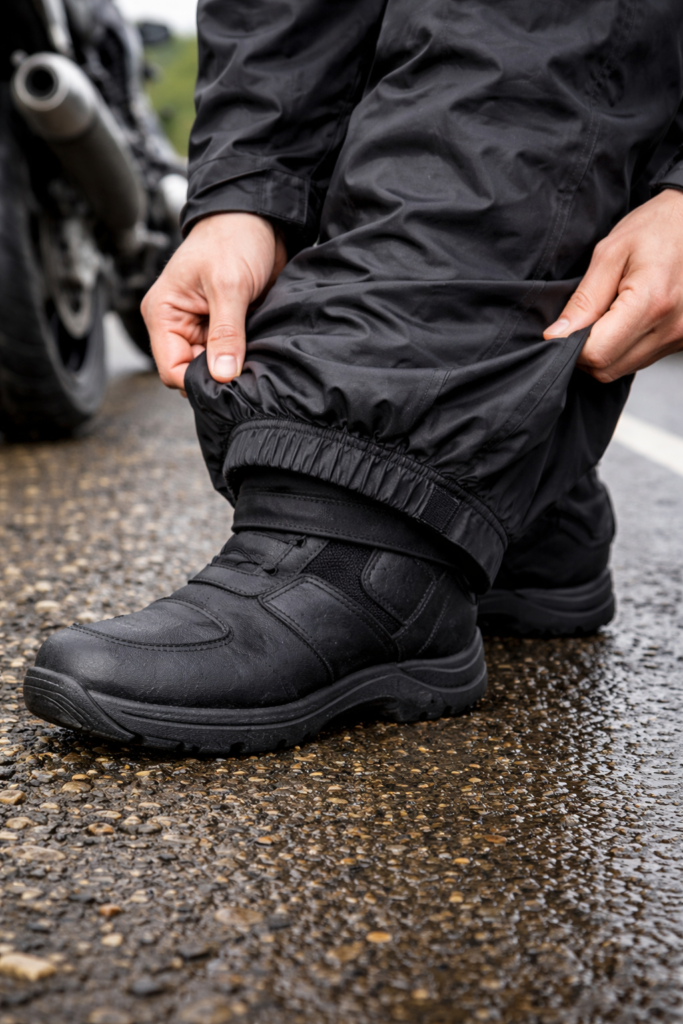
Over-pants worn over riding trousers are the most practical solution for touring — pull them on at the roadside in thirty seconds, off again when the rain passes. The critical detail is the ankle interface. Over-pants that don’t seal at the ankle funnel water straight into your boots regardless of how waterproof the boots are. Look for ankle cuffs that tighten over the boot with a velcro tab or elastic seal.
Fit over your riding trousers is worth checking carefully. Over-pants sized for slim jeans won’t pull over armoured riding trousers without a fight — size up if necessary and check the fit before you’re standing at the roadside in the rain trying to pull them on.
Gloves — The Hardest Problem in Motorcycle Rain Gear
Gloves are where every motorcycle rain gear system eventually fails, and it’s worth being honest about why. Waterproof gloves work well when they get wet on the outside. When water finds its way inside — through the cuff gap, through seam failure, or through sustained immersion — they stop drying. A waterproof glove that’s wet inside at the end of day one stays wet through day two and day three. In cold rain that becomes a serious comfort and safety issue.
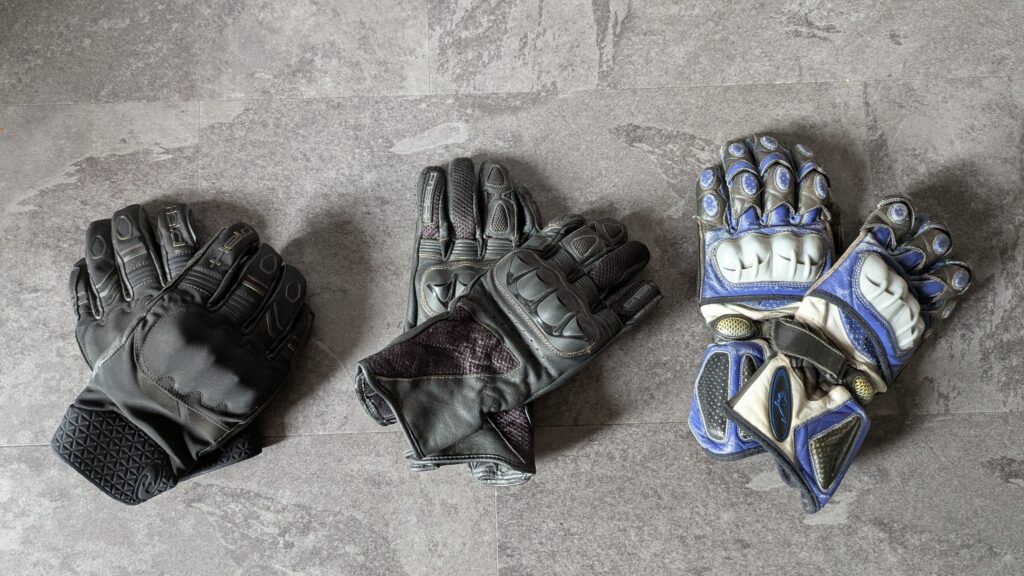
The only real solution for multi-day touring in wet conditions is carrying two pairs. A waterproof touring glove for the rain, and a second pair — lighter, non-waterproof — for when the first pair is drying overnight. Overmitts worn over standard gloves are an alternative worth considering: they seal at the cuff more effectively than most gloves and can be removed quickly when conditions improve, leaving a dry glove underneath.
Heated gloves change the equation significantly in cold wet conditions. The combination of warmth and waterproofing makes sustained rain riding genuinely manageable rather than merely survivable. If you’re touring in spring or at altitude regularly, they’re worth the investment.
Boots and the Rain — Completing the System
Even the best waterproof motorcycle boots have a threshold — typically two to three hours of sustained heavy rain before water finds the collar or seam. A gaiter worn over the boot collar extends this significantly and costs almost nothing. It’s one of the highest value-to-weight additions in any touring kit.
The ankle gap — where over-pants meet boot collar — is where most lower-body wet weather systems fail. Over-pants that seal over the boot exterior, combined with a gaiter underneath, close this gap effectively. Waterproof socks are a useful backup for riders who tour in non-waterproof boots or in warm climates where sealed boots are too hot. They won’t survive sustained immersion but handle light rain and splashing well.
For more in depth information’s on how to choose your perfect boot you can follow my guide here.
Layering for Wet Weather — The Full System
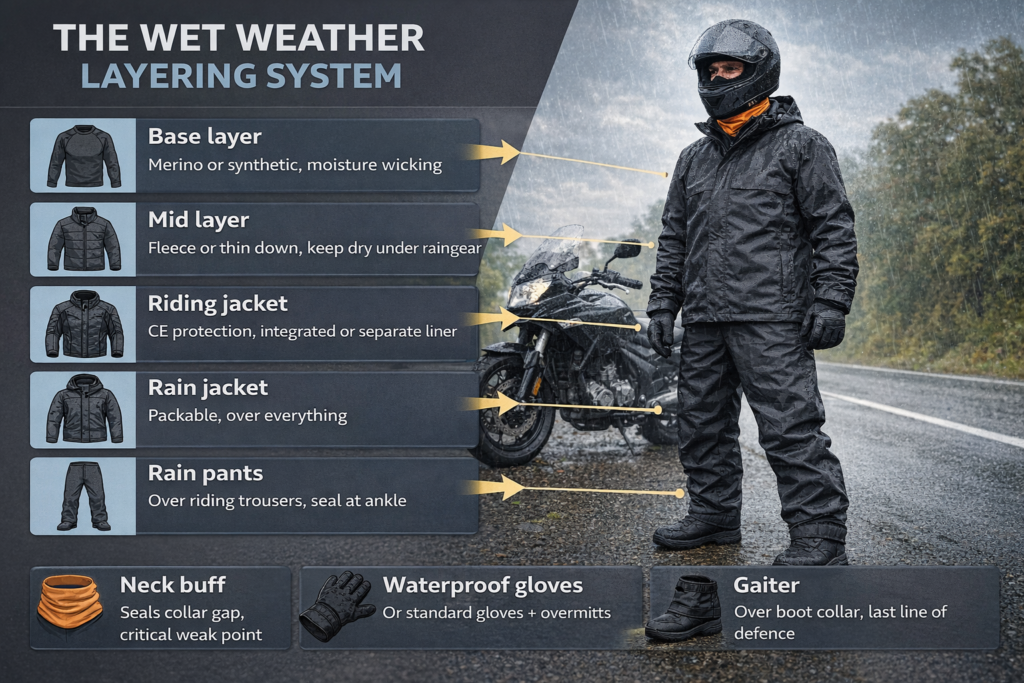
Good motorcycle rain gear is a system, not a collection of individual pieces. The weakest link — whether that’s a gapping collar, unsealed ankle, or saturated mid-layer — determines how long you stay comfortable, not the strongest component.
The neck and collar area deserves particular attention. The gap between jacket collar and helmet base is where wind-driven rain enters most reliably. A neck tube or buff pulled up over the jacket collar seals this gap completely and weighs almost nothing. It’s one of those small additions that makes a disproportionate difference on a long wet day.
Base layer choice matters more in rain than in dry cold. Cotton is the enemy — it absorbs water, holds it against your skin, and destroys any warmth the system is trying to maintain. Merino wool stays warm when wet and manages moisture effectively. Synthetic base layers dry faster. Either is correct. Cotton is always wrong.
Keep your mid-layer — fleece or thin down — dry under your rain gear. Once insulation gets wet it loses its thermal value rapidly. If your rain jacket is failing and your mid-layer is getting damp, stop and reassess rather than pushing on and getting progressively colder.
The Nockalmstraße taught me this the hard way. Perfect sunshine at the valley, full storm by the summit — and because I thought it would pass quickly, I never stopped to layer up. By the top I was soaked through, my mid-layer had stopped working, and I was cold with hours still to ride. A roadside hotel let me change into a dry mid-layer and finally insert my rain liner properly. For the rest of the wet afternoon I stayed completely dry. Five minutes at the roadside earlier would have saved the entire situation — and it’s exactly why an over-jacket you can pull on in sixty seconds beats an integrated liner every time.
Packable Emergency Rain Gear — The Backup System
Even riders with fully waterproof jackets should carry a packable rain layer. Waterproof jacket membranes degrade over time, DWR treatments wear off between re-waterproofing sessions, and a sudden storm in 35°C Mediterranean heat is a different problem from a sustained alpine downpour. A lightweight packable over-jacket and over-pants that compress to roughly the size of a water bottle between them adds minimal weight and provides genuine insurance.
Budget packable options vary enormously in quality. The key things to check: seam sealing (no seam sealing is useless), hood that actually covers a helmet or folds away completely, and cuff seals that work over gloves. Anything under 30 € is almost certainly critically taped at best. The 50–80 € range delivers genuine waterproofing in a packable format that earns its place in a tank bag along side the rest of your gear.
Maintaining Your Motorcycle Rain Gear
Re-waterproofing treatment is the most neglected maintenance task in motorcycle touring kit. Nikwax Tech Wash cleans waterproof membranes without stripping DWR — use it instead of standard detergent, which destroys waterproof treatments faster than rain does. Follow with Nikwax TX. Direct or Grangers Performance Repel to restore the DWR outer treatment. Do this at the start of each touring season and after any extended wet weather period.
Never dry waterproof gear on a direct heat source. A hotel room radiator running at full heat will delaminate a Gore-Tex membrane and crack leather reinforcements. Hang gear at room temperature, stuff boots loosely with newspaper to draw moisture out, and allow everything to dry completely before packing away for storage.
Rain Gear by Region — What Europe’s Weather Actually Demands
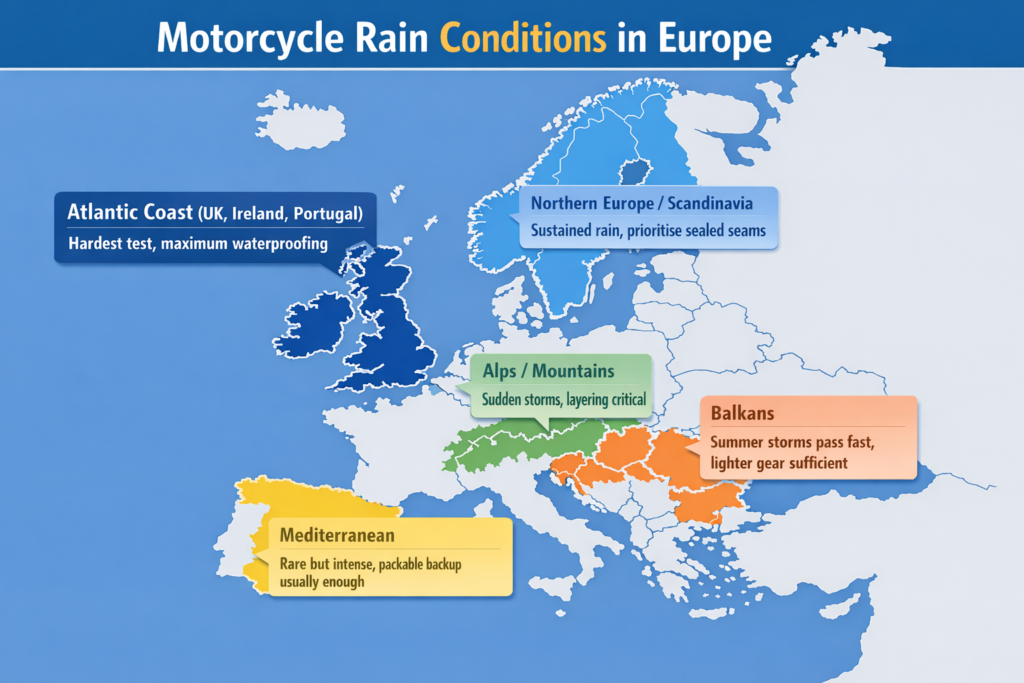
The Atlantic coast — Portugal, western France, Ireland, and the UK — is the hardest test for any motorcycle rain gear system. Rain here is sustained, frequent, and wind-driven. Maximum waterproofing, fully taped seams, and a gaiter system are not optional on this routing.
Northern Europe and Scandinavia demand similar standards with the addition of cold — wet and 8°C is a different challenge from wet and 18°C, and insulation under rain gear becomes critical.
The Alps and mountain passes are characterised by sudden storms that arrive with little warning and pass within the hour. A fast-access packable system — somewhere you can reach it without unpacking — serves better than a heavy sealed suit that takes time to put on.
The Balkans in summer produce intense but short-lived thunderstorms. Light packable rain gear handles the majority of situations, and the rain is warm enough that getting slightly wet isn’t the emergency it would be in Scotland in October.
The Mediterranean in summer is the one region where packable backup gear rather than a serious rain system is usually sufficient. Rain is infrequent, brief, and warm. Carry something, but don’t let it dominate your packing decisions.
Final Thoughts
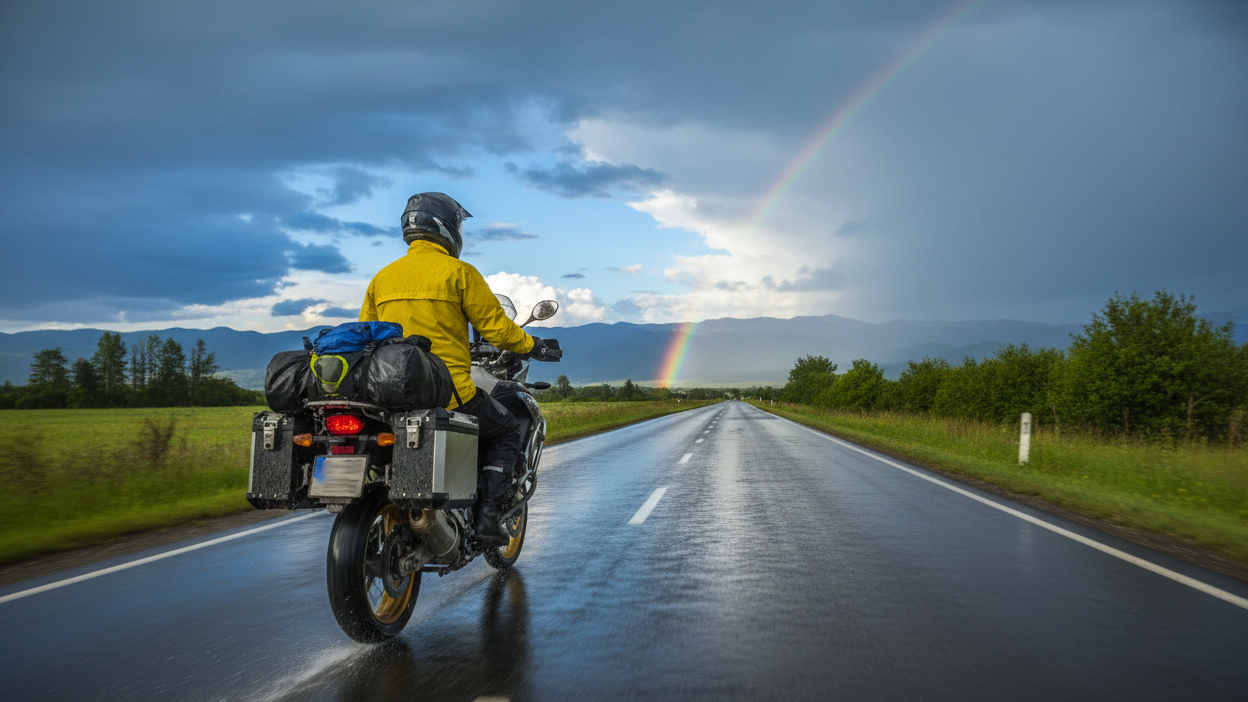
Good motorcycle rain gear is not about staying completely dry — that’s not a realistic goal on a multi-week European tour. It’s about staying comfortable long enough to finish the day, find shelter, or simply enjoy the fact that you’re riding through a summer storm in the mountains while everyone else is sitting in a traffic jam somewhere else.
Build a system rather than buying individual pieces. Maintain it regularly. Know where its limits are before you’re standing in a layby trying to work it out in the rain. And carry that packable backup layer regardless of what the forecast says — European weather has no obligation to be accurate.
What’s your current wet weather setup and what would you change about it? Drop it in the comments — there’s always a rider planning their first long tour who’ll benefit from knowing what works in practice.