Europe has a reputation as an expensive place to travel. And for most tourists — flights, hotels, restaurants, guided tours — that reputation is largely deserved. But budget motorcycle travel in Europe operates by different rules. A rider with a tent, a camping stove, and a flexible itinerary can move through the same continent for a fraction of what a conventional tourist spends, accessing roads and places that never appear on any package holiday itinerary. Budget motorcycle travel in Europe is not a compromise version of touring. The roads that cost nothing to ride are frequently the best ones on the continent.
This guide covers everything that determines what you actually spend on a European motorcycle tour: accommodation strategies, fuel costs, food, toll roads, vignettes, country-by-country cost differences, and the mindset that separates riders who stretch their budget across a full season from those who run out of money in week two. Whether you’re planning your first budget tour or looking to extend an existing one, the approach is the same — spend deliberately, be flexible, and put the money where it actually improves the ride.
How to Create Your Motorcycle Trip Budget — build the numbers before you leave, not on the road
What Does Budget Motorcycle Travel in Europe Actually Cost?
The honest answer is: it depends almost entirely on where you sleep. Accommodation is the single biggest variable in any touring budget, and a rider who wild camps four nights out of seven spends dramatically less than one who books hotels every night regardless of how carefully they manage every other cost.
With that context, here are realistic daily budget ranges for budget motorcycle travel in Europe:
- Bare minimum: 25–35 €/day — wild camping most nights, self-catering all meals, avoiding toll roads and paid attractions. Achievable but requires consistent effort and works better in countries where wild camping is legally tolerated or rarely enforced — research the specific rules before each country on your route.
- Comfortable budget: 40–60 €/day — mix of camping and cheap private rooms, one proper meal out per day, occasional attraction entry. The sweet spot for most budget tourers and genuinely sustainable for weeks at a time.
- Managed mid-range: 70–100 €/day — budget hotels most nights, regular meals at local restaurants, no significant self-catering. Comfortable but not technically budget touring — more accurately described as cost-conscious touring.
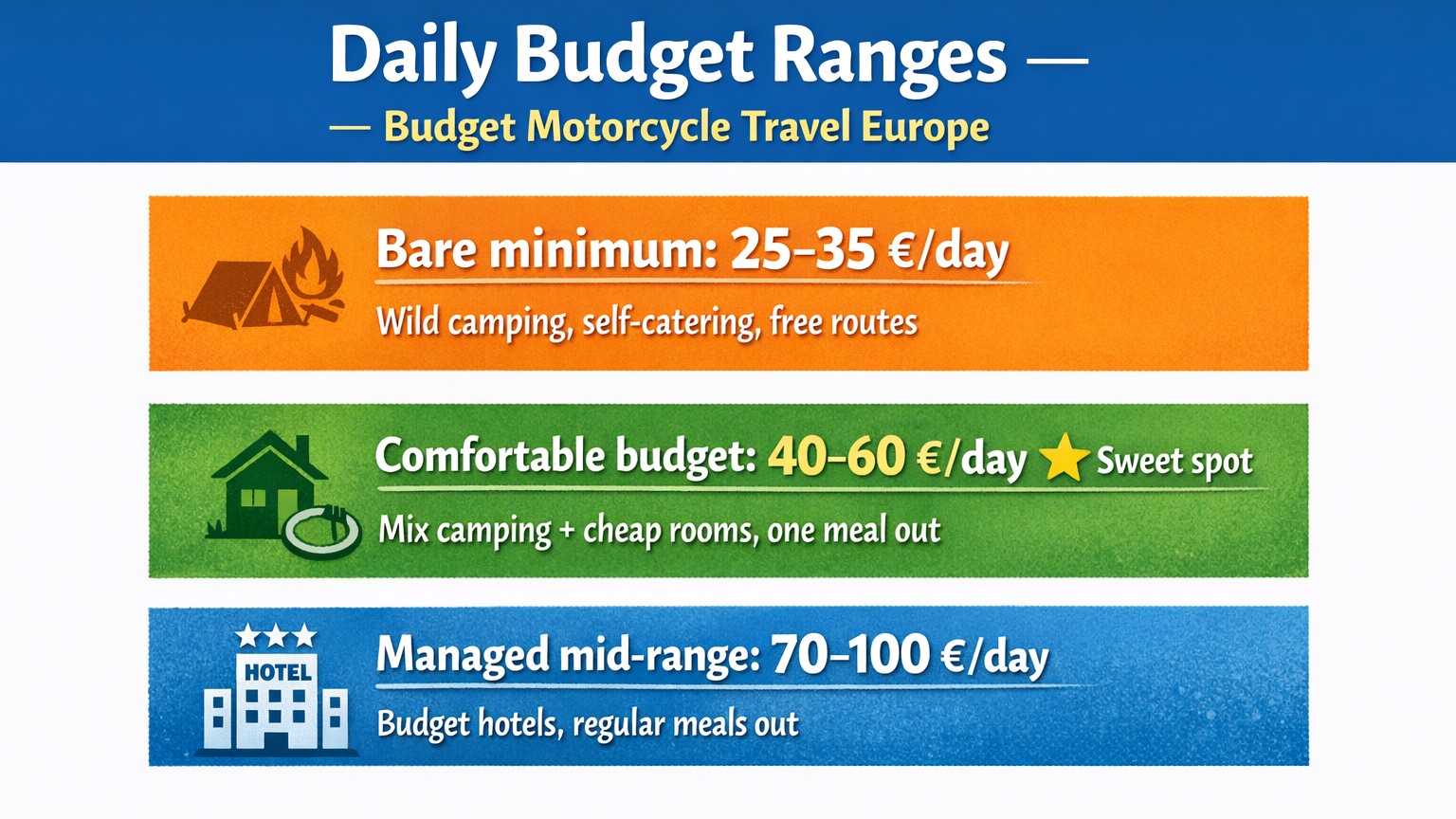
These figures cover accommodation, food, and fuel. They don’t include gear, bike maintenance, insurance, or major ferry crossings — costs that exist regardless of daily spending and are better calculated separately before you leave.
The regional difference is enormous and cannot be overstated. A comfortable budget day in Albania or Bosnia costs roughly what a bare minimum day in Switzerland or Norway does. Routing your tour to weight time in cheaper regions is the single most effective budget decision you can make.
The regional cost difference hit me most clearly on a tour that crossed from Croatia into Albania within the same week. In Croatia I paid 25 € for a campsite — a patch of grass, a cold shower block, and the privilege of sleeping next to a generator that ran until midnight. Two days later in Albania, 25 € got me a private hotel room with a hot shower, a comfortable bed, fresh towels, and a breakfast that set me up for the entire day. Same money, completely different experience. It’s the single best argument for weighting your itinerary toward the cheaper regions — your budget goes further, and the riding gets better at the same time.
The Cheapest Countries for Motorcycle Touring in Europe
Not all European countries are created equal from a budget perspective. Here’s an honest cost tier breakdown based on realistic daily spending for a solo rider at comfortable budget level:
Tier 1 — Exceptional value (25–45 €/day): Albania, Bosnia and Herzegovina, Kosovo, North Macedonia. These are the budget motorcycle travel Europe destinations that genuinely surprise riders the first time. Full meals for 5–8 €, private rooms for 15–25 €, fuel prices below the European average, and some of the most dramatic and empty riding roads on the continent. Albania in particular offers a daily budget that feels almost impossible by Western European standards.
Tier 2 — Good value (40–65 €/day): Romania, Bulgaria, Serbia, Montenegro, Greece outside the main islands. Slightly higher than Tier 1 but still dramatically cheaper than Western Europe. Romania and Bulgaria have seen prices rise in recent years but remain excellent value. Montenegro edges higher near the coast in summer but the interior stays affordable.
Tier 3 — Moderate (55–80 €/day): Croatia, Slovenia, Hungary, Czech Republic, Poland, Portugal. Croatia has become noticeably more expensive since Euro adoption in 2023, particularly on the Dalmatian Coast in summer. Slovenia punches above its size on cost but rewards the extra spending with world-class roads. Portugal remains the budget outlier of Western Europe — particularly in the interior and the Alentejo region.
Tier 4 — Expensive (80–120 €/day): Italy, Spain, France, Germany, Austria. Not impossible on a budget but requires consistent effort. Italy rewards budget riders who avoid the obvious tourist centres and eat like locals. France’s toll road system adds significantly to daily costs if you don’t plan free route alternatives carefully.
Tier 5 — Budget-busting (100 €+/day): Switzerland, Norway, Denmark, Iceland. Switzerland has no short-term motorway vignette — you pay 40 CHF for the year whether you use it for a day or twelve months. Norway is simply expensive across every category. Both are spectacular riding destinations that work better as short additions to a longer tour than as primary budget destinations.
The strategic insight: the cheapest countries in Tier 1 and Tier 2 also have the most adventurous and least crowded riding roads. Budget motorcycle travel in Europe and great riding are not in conflict — they point in exactly the same direction.
Budget Accommodation for Motorcycle Tourers
Accommodation is where budget touring is won or lost. A rider who manages accommodation costs effectively can afford to spend freely on fuel, food, and experiences. One who books hotels every night without thinking is budget touring in name only.
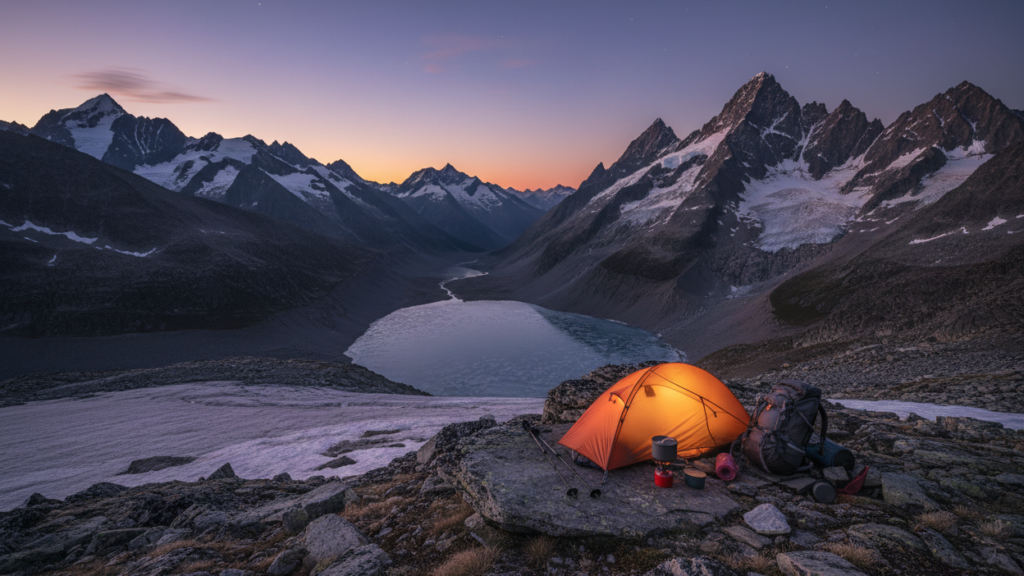
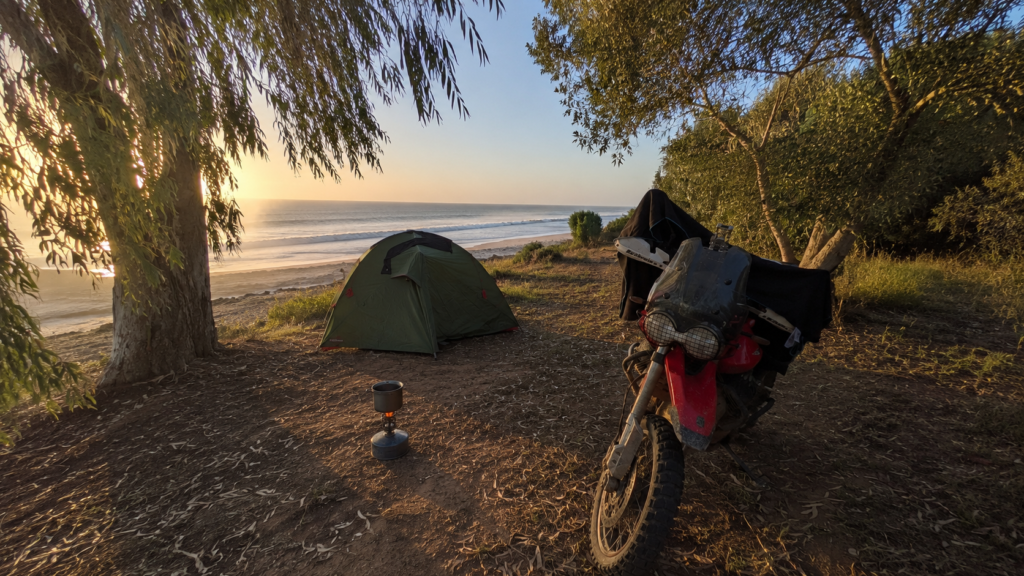
Wild camping is the zero-cost option and the foundation of serious budget motorcycle travel in Europe. Legal in Scandinavia under allemansrätten, tolerated in rural areas across much of the continent, prohibited on paper but rarely enforced in genuinely remote locations. The key rules everywhere: arrive late, leave early, leave no trace, and choose locations invisible from roads and houses.
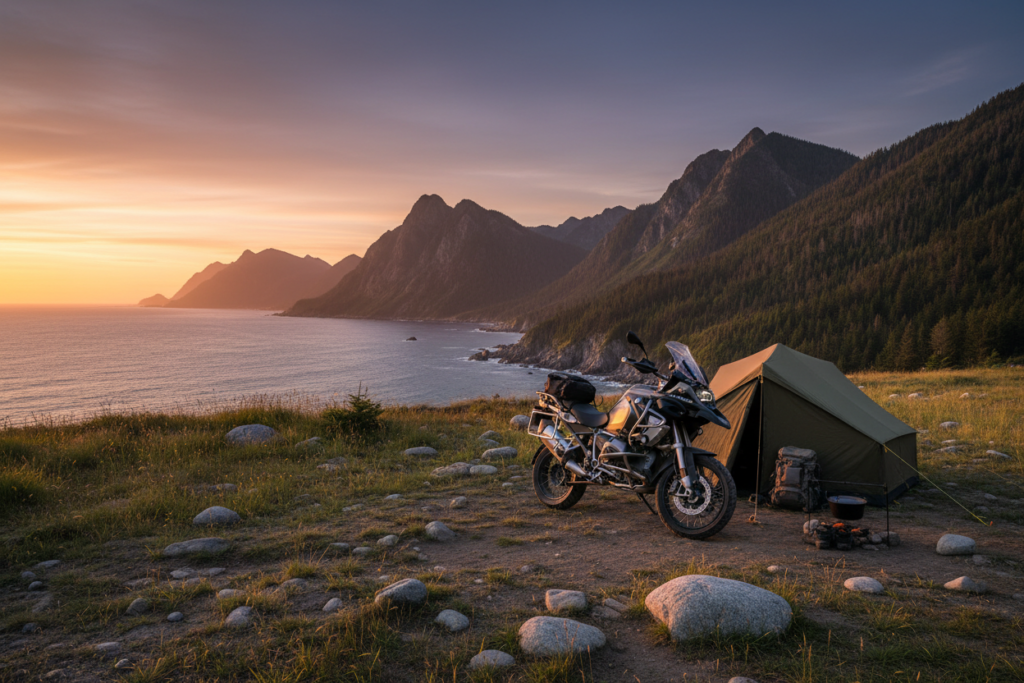
Established campsites run 10–25 € per night across most of Europe and provide security, facilities, and often a social atmosphere that wild camping doesn’t. For a bike with luggage, the ability to leave gear locked to the bike overnight without anxiety is worth the cost on its own. Many campsites across Europe charge under 10 € for a motorcycle and tent, particularly in rural areas and less-touristed regions.
Hostels are significantly underused by motorcycle tourers and represent excellent value at 15–30 € per night for a dorm bed in most European cities. The social environment suits solo riders well, and many city hostels have secure courtyards or parking arrangements for motorcycles if you ask directly.
Budget hotels and private rooms — known as sobe in Croatia, penzión in Central Europe, and pension across much of the continent — typically run 30–60 € for a private room and represent the most comfortable budget option. Booking direct rather than through platforms saves 15–20% in most cases. A quick conversation with the owner about a direct booking discount is almost always worth having.
How to Find Cheap Accommodation for Motorcycle Touring in Europe — full breakdown of every option
Warmshowers is a hospitality network originally built for cycle tourers but welcoming to motorcycle tourers in many regions. Free stays with local hosts, genuine cultural exchange, and often the most memorable nights of a tour. Requires advance planning and a willingness to engage — not a fallback option, but a deliberate choice that pays dividends.
Monasteries and pilgrimage accommodation remain one of the least-known budget options across Europe. Many monasteries offer simple accommodation for donations or minimal fees. The experience is unlike anything a hotel provides and the locations are frequently extraordinary.
On the Slovakia trip I spent one night in a monastery in Bratislava — ten minutes from the town centre, one third of the price of the hotels immediately surrounding it. It was also the cleanest and most comfortable accommodation of the entire trip. The room was simple, quiet, and well-maintained in a way that budget hotels often aren’t. Worth asking about monastery accommodation in any city where it exists — it’s rarely advertised and almost always worth it.
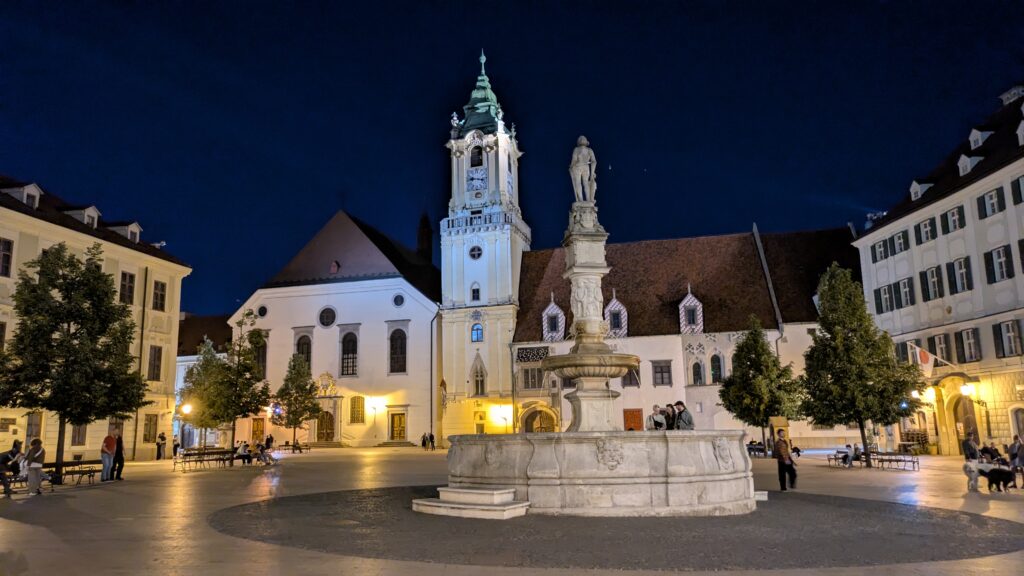
The most effective accommodation strategy for sustained budget motorcycle travel in Europe combines these options deliberately: two or three nights wild camping or at cheap campsites per week, one or two nights in a cheap private room for a proper sleep and shower, and occasional hostel nights in cities. The weekly average drops significantly without sacrificing comfort entirely.
Fuel Costs and How to Minimise Them
Fuel is the most visible daily cost but rarely the largest one. A typical 650–800cc touring bike consuming 5–6 litres per 100 km costs roughly 7–10 € per 100 km at current European fuel prices. On a 200 km riding day that’s 14–20 € — significant but manageable within any of the daily budget tiers above.
Fuel prices in much of Eastern Europe and the Balkans—particularly Bosnia and Herzegovina, Bulgaria, and Romania—are typically 10–20% lower than in most Western European countries. Filling up before crossing from a cheap country to an expensive one is an obvious but frequently forgotten saving.
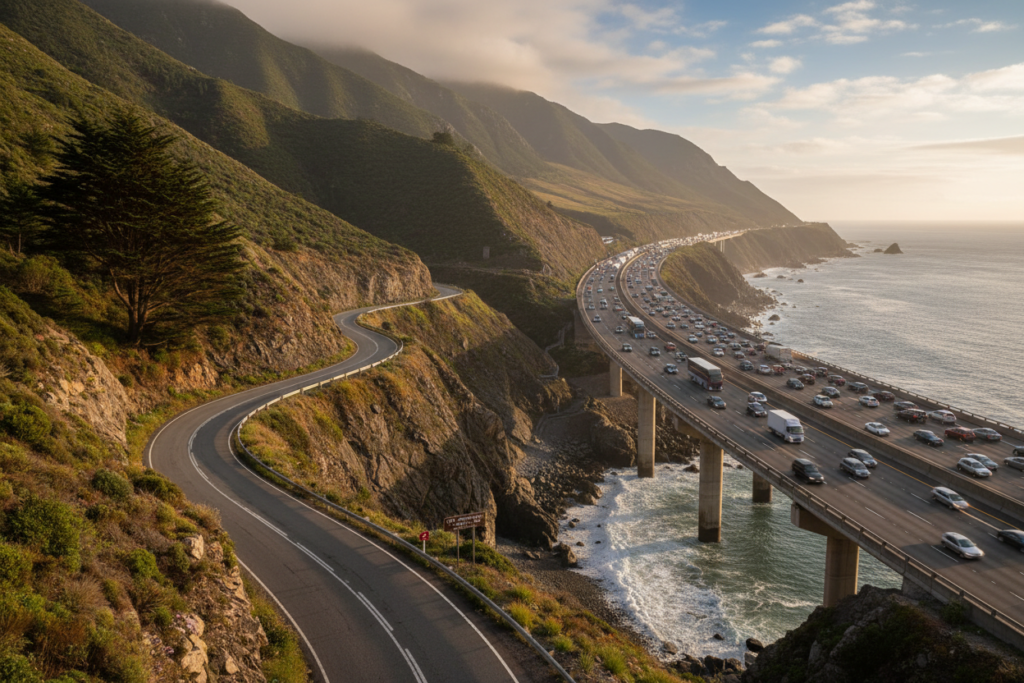
The motorway trap is where fuel costs escape control. Motorway service station fuel in France, Italy, and Germany runs 10–15% above the price at independent stations just off the route. Combined with toll costs, riding the autoroute across France costs dramatically more than riding the equivalent distance on national roads — which are also better riding.
On the return from ACT Italy, I took the motorway for several stretches to cover ground faster. It worked for time, but the toll costs and the higher fuel prices at motorway stations added up quickly over two days. The irony wasn’t lost: the sections I remembered from that return leg were the brief stretches where I left the motorway — a hill town visible from the slip road, a river crossing on a back road I took by accident. The motorway got me home faster and cost more in every sense.
Riding style affects consumption more than most riders expect. Motorway cruising at 130 km/h burns significantly more fuel than relaxed mountain road riding at 60–80 km/h. The cheapest riding is also the most enjoyable — the budget argument and the riding quality argument consistently point in the same direction.
Eating Well on a Motorcycle Tour Budget
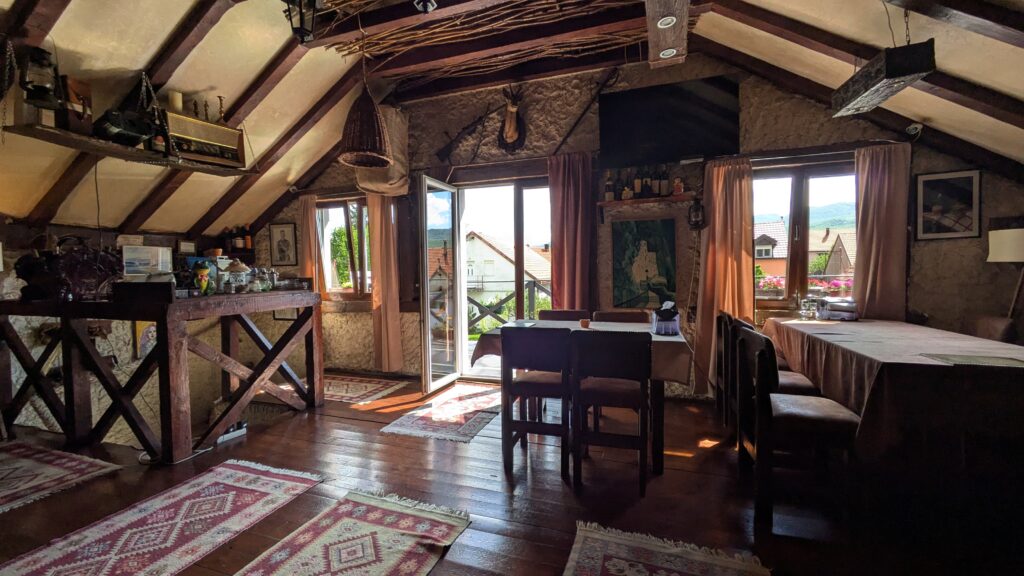
Food budget comes down to one simple principle: eat where locals eat, not where tourists eat. The two are often separated by fifty metres and a factor of three on price.
The grocery store strategy works well for breakfast and lunch. Most European supermarkets sell fresh bread, local cheese, cured meats, fruit, and yoghurt at prices that make a packed lunch cost 3–5 € per person. Combined with a coffee at a local bar rather than a tourist café, a morning routine that costs 6–8 € total is achievable almost anywhere in Europe.
The one restaurant rule: budget one proper sit-down meal per day at a local restaurant and self-cater the rest. This gives you the cultural experience and the decent meal without the cost of eating out three times daily. In the Balkans, a full meal at a konoba or local tavern runs 8–12 €. In Portugal, the menu do dia — a set lunch of three courses with wine — costs 10–12 € at most inland restaurants. In northern Italy, many bars serve aperitivo: buy a drink — typically 8–15 € —and you’ll often get complimentary snacks or even a generous buffet. In cities like Milan and Turin, some aperitivo spreads are substantial enough to replace dinner. These local food cultures are the budget motorcycle tourer’s best friends.
Cooking at campsites with a compact stove changes the economics of multi-night stays significantly. A simple pasta or rice meal costs 2–3 € in ingredients and takes fifteen minutes. Over a two-week tour with several camping nights, the saving over restaurant meals every evening runs to 100 € or more.
Toll Roads, Vignettes, and Hidden Costs
Toll and vignette costs catch budget tourers off guard more than almost any other expense. Here’s what to expect country by country:
- Austria: 3.80 € for a 1-day or 5.10 € for a 10-day motorcycle vignette — excellent value, buy at the border
- Switzerland: 40 CHF annual vignette only — no short-term option exists, plan accordingly
- Slovenia: 8.00 € for 7 days — reasonable for the riding quality
- Hungary: 7.80 € for 1 day or 9.80 € for 10 days
- France: per-use tolls — a full Paris to Nice run on the autoroute costs approximatley around 70 € in tolls alone. Free route alternatives add time but save significantly and provide far better riding
- Italy: per-use tolls similar to France — the A1 from Milan to Rome costs approximately 50 € in tolls. The SS1 coastal road is free, slower, and incomparably better riding
- Croatia: per-use tolls, no vignette. The coastal D8 is toll-free
The recurring theme: toll-free secondary roads are almost universally better motorcycle riding than the motorways they parallel. The budget argument and the riding quality argument point in exactly the same direction.
Gear and Maintenance on a Budget
Gear is a pre-tour cost rather than a daily one, but the decisions you make before leaving affect your budget significantly. Second-hand motorcycle gear offers genuine savings on jackets, trousers, and luggage — items where the safety standards are verifiable and wear is visible. Helmets are the exception: never buy a second-hand helmet where the impact history is unknown.
End of season sales — September through November across most European retailers — offer 30–50% reductions on current season gear. Timing a gear purchase to coincide with clearance sales rather than buying in spring at full price saves 100–200 € on a jacket alone.
Maintaining your own bike is the single largest mechanical cost saving available to any budget tourer. Chain maintenance, oil changes, and brake pad inspection are all within reach of a rider with basic mechanical confidence. A mechanic anywhere in Europe is generally resourceful and affordable — but getting there with a failing chain because you didn’t check it before leaving is expensive in time and stress regardless of where you are.
The most expensive budget mistake in gear is false economy on the things that matter most. Cutting costs on tyres, brakes, or protective gear is not a budget decision — it’s a risk decision dressed as a financial one. On camping equipment the same logic applies.
On my first trip I went cheap on almost everything, including the tent. I wanted to try touring and didn’t want to spend heavily before I knew it was for me. On the third night it rained. The tent’s seams didn’t hold — water came in steadily, soaked the sleeping bag, soaked everything inside it. The weather stayed unstable for the rest of the trip and I spent the remainder in hotels, paying far more per night than a decent tent would have cost in the first place. The cheap tent saved me perhaps 80 € upfront and cost me several hundred in hotel bills over the following ten days. Buy less and buy better — or spend the trip managing the consequences of not doing so.
Free and Low-Cost Activities Along the Route
The best things about motorcycle touring in Europe are free. Most mountain passes cost nothing to ride. Coastal roads charge no admission. Historic town centres, village squares, and viewpoints are accessible to anyone on two wheels with a tank of fuel.
National park entry fees vary enormously and are worth researching before routing. Plitvice Lakes National Park (Croatia) charges 10–40 € per adult depending on the season, with peak summer admission costing 25–40 €. The Durmitor National Park in Montenegro charges a modest 5 € vehicle. Entry fees across Europe range from nothing to significant — check the specific park before building it into the route, since some of the most dramatic riding destinations charge very little or nothing at all.
Museum free days exist across most of Western Europe — most national museums in France, Italy, and the UK offer free entry on the first Sunday of each month or equivalent. A quick search before arriving in a city costs nothing and occasionally saves 15–20 € per person.
Wild swimming in rivers, lakes, and non-resort beaches is one of the genuine pleasures of summer motorcycle touring and costs nothing. The Soča River in Slovenia, the river beaches of Bosnia, the mountain lakes of Montenegro and Albania — these are experiences that no resort package reaches and no amount of money substitutes for.
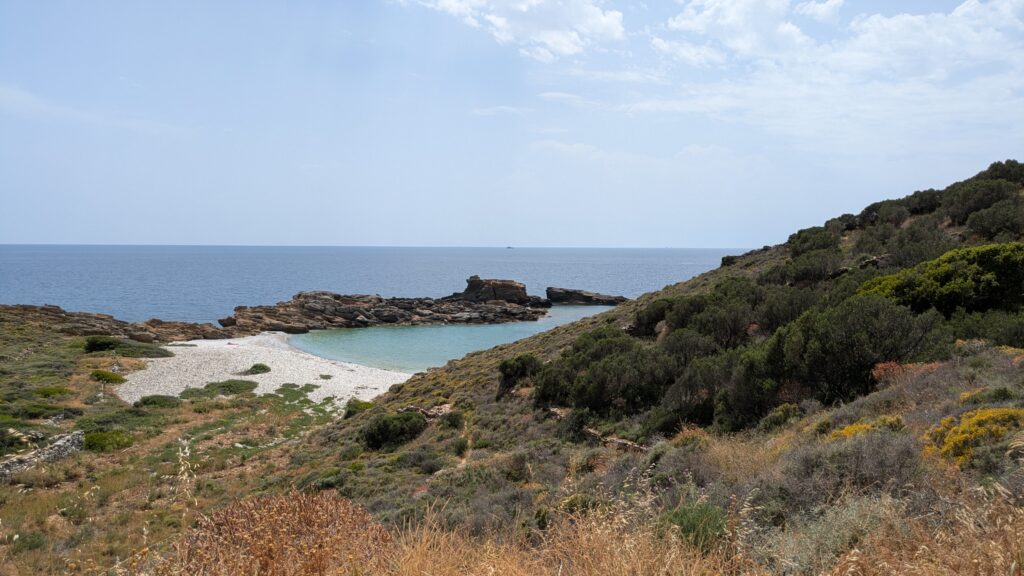
On a particularly hot day on the Mani Peninsula in Greece, I came around a corner and found a small lagoon — completely empty, nobody else in sight. I stopped, swam, and spent twenty minutes in cold water on a day when the tarmac had been radiating heat for hours. It cost nothing and is one of the clearest single memories from that trip.
Budget Mindset — How Experienced Tourers Think About Money on the Road
The most common budget mistake is false economy: buying the cheapest possible gear, skipping maintenance, and choosing accommodation purely on price — then spending more fixing the consequences than the original saving was worth. The experienced budget tourer spends freely in two areas: safety and sleep. A good night’s sleep in a decent room every third or fourth night maintains the physical and mental condition that makes long touring sustainable.
Flexible itinerary is one of the most underused budget tools available. Shoulder season pricing — May, June, or September instead of July and August—typically reduces accommodation costs by 20–50% across Europe’s most seasonal destinations. Last-minute accommodation negotiated directly with owners in quieter periods regularly yields 20–30% below listed prices. The rider with a loose plan and a flexible timeline consistently spends less than one locked into fixed dates.
Slow travel saves money in ways that aren’t immediately obvious. Fewer kilometres per day means less fuel. More time in one place means fewer accommodation moves, deeper local knowledge of where to eat cheaply, and the kind of unhurried pace that is, paradoxically, what most riders are actually looking for when they plan a motorcycle tour.
My first trip through Greece on Derviša taught me the most important budget mindset lesson I know. I’d planned the tour around the ancient sites — Olympia, Nafplio, Meteora, the museums in Korinth, Patras, and Ioannina. I dutifully paid every entry fee along the way. By the end of the first week I’d spent close to 150 € on admissions alone, averaging one or two sites per day with the riding fitted around them.
The sites were impressive. But the moments that actually stayed with me cost nothing. The road to the Cape Lefkatas Lighthouse, where the sea dropped away on both sides of the peninsula and there was nowhere else to look. A mountain road in the Peloponnese where ruined columns were visible on a hillside below — no signpost, no entry fee, just history sitting in the landscape the way it does across Greece if you’re moving through it slowly enough to see it. A village square where I stopped for coffee and ended up staying two hours.
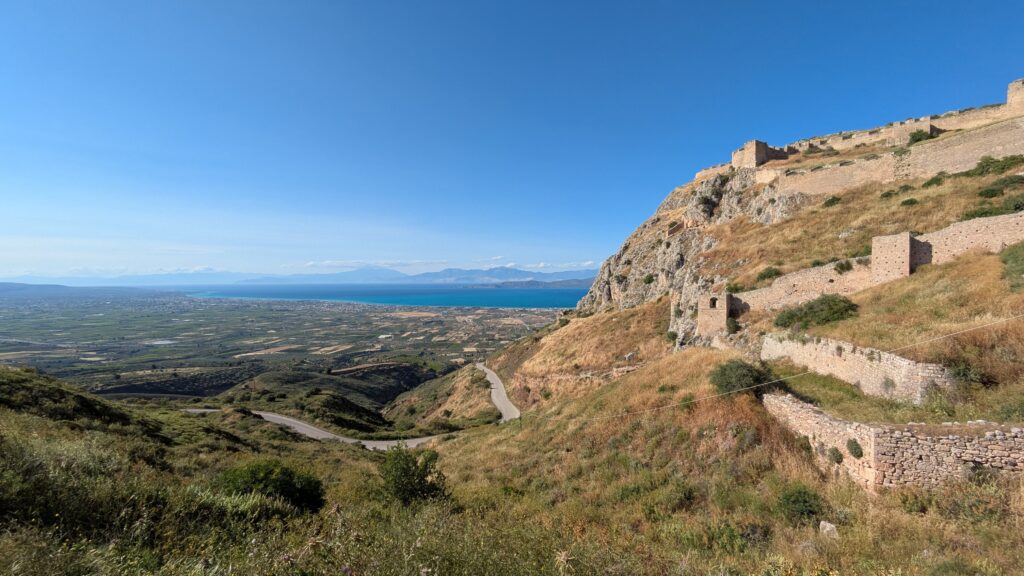
Greece’s ancient history is everywhere and most of it is visible for free from a motorcycle on the right road. The paid sites add context. The riding through the landscape is the experience.
Country Cost Quick Reference
| Country | Daily Budget | Fuel Cost | Accommodation | Vignette / Toll |
|---|---|---|---|---|
| Albania | 25–45 € | Low | 15–30 € | None |
| Bosnia | 30–50 € | Low | 15–35 € | None |
| North Macedonia | 30–50 € | Low | 15–30 € | Per use |
| Romania | 35–55 € | Low-medium | 20–40 € | None |
| Bulgaria | 35–55 € | Low-medium | 20–40 € | None |
| Montenegro | 45–80 € | Medium | 25–50 € | None |
| Croatia | 55–80 € | Medium | 30–70 € | Per use |
| Slovenia | 55–90 € | Medium | 35–65 € | 8.00 € / 7 days |
| Portugal | 50–75 € | Medium | 30–60 € | Per use (some) |
| Czech Republic | 50–75 € | Medium | 25–55 € | None |
| Hungary | 50–75 € | Medium | 25–55 € | ~10 € / 10 days |
| Italy | 70–110 € | Medium-high | 40–80 € | Per use |
| France | 75–110 € | Medium-high | 45–85 € | Per use |
| Austria | 75–110 € | Medium-high | 45–80 € | 5.10 € / 10 days |
| Switzerland | 100–150 € | High | 70–120 € | 40 CHF / year |
Spend Deliberately, Ride Further
Budget motorcycle travel in Europe is not about deprivation or endless compromise. It’s about spending deliberately — putting money into the things that genuinely improve the experience and cutting costs where the saving doesn’t hurt. A wild camping spot above a Montenegrin canyon is a better night than most hotel rooms in Europe. A 7 € meal at a Bosnian konoba is a better lunch than anything available at a motorway service station for twice the price.
The cheapest touring regions in Europe are also the most rewarding to ride. The roads are emptier, the scenery is less curated, and the sense of genuine discovery that drew most of us to motorcycle touring in the first place is still intact. Budget and great riding are not in conflict — they are, consistently and reliably, the same thing.
Start with a realistic daily target. Track it loosely. Adjust as you go. Build more time into the itinerary than you think you need — slow travel is cheap travel. And the best stops on any tour, as the lagoon on the Mani Peninsula and the empty village square in Greece will confirm, are the ones that cost nothing and weren’t planned at all.
By Fritz