A commuter helmet has to survive twenty minutes, twice a day. A touring helmet has to survive eight hours in the saddle, day after day, in whatever weather the road throws at it. Those are different problems, and buying for the first while actually needing the second is how riders end up with a helmet that fits perfectly in the car park and turns into a headache by lunchtime.
This guide covers what actually changes when distance becomes the priority: certification, fit, weight, ventilation, and knowing when the helmet you already own has quietly stopped doing its job.
Why Touring Helmets Need Different Priorities
Everything a short ride tolerates gets amplified over distance. A slightly heavy helmet is a non-issue for twenty minutes and a genuine problem for hour six. A bit of wind noise disappears into a five-minute commute and turns into a headache by the time you’ve covered 300 kilometres. Ventilation that felt adequate in the shop gets tested properly the first time you’re stuck in stationary traffic in July with the engine idling underneath you.
None of this means touring helmets need better protection than commuter helmets — the certification bar is the same either way. It means the comfort factors that barely register on a short ride become the actual deciding factors once distance and time are part of the equation.
Certification Standards: What They Actually Mean
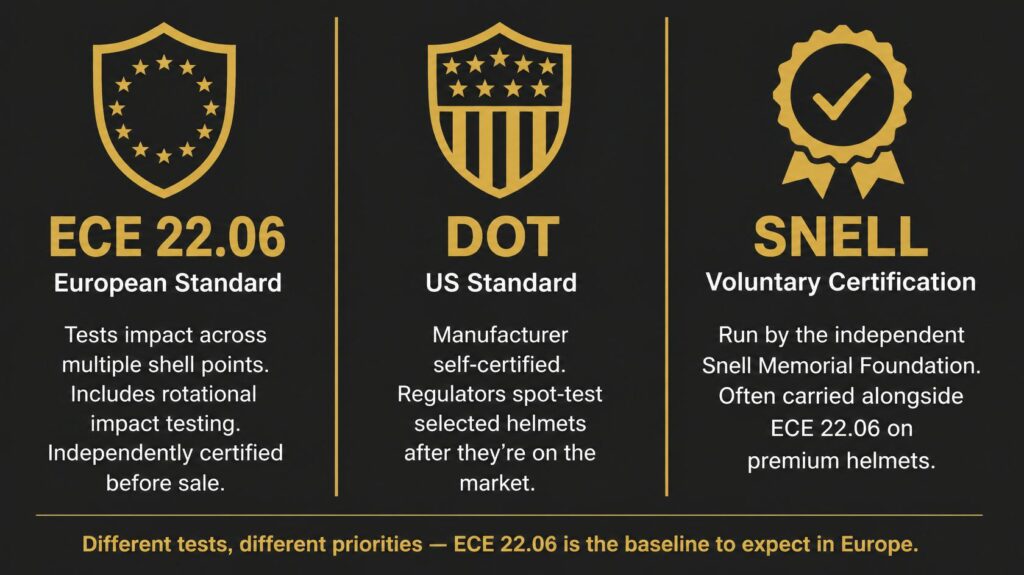
ECE 22.06
The current European standard, and the one that matters most if you’re riding in Europe. It tests impact across multiple points on the shell rather than a single reference point, and includes rotational impact testing that older standards didn’t cover. If you’re buying a new motorcycle helmet in Europe today, ECE 22.06 is the standard you should expect to see.
DOT
The US standard. Manufacturers self-certify compliance with DOT requirements, while regulators conduct post-market compliance testing on selected helmets rather than certifying every model before it goes on sale — which relies more heavily on manufacturer compliance than the European approval system. Relevant mainly if you’re buying gear in the US or importing a helmet from there.
SNELL
A voluntary certification run by the independent Snell Memorial Foundation. Many premium helmets carry both ECE 22.06 and Snell certification, although the two standards use different test protocols and priorities. A helmet meeting both has passed an additional, genuinely independent certification process on top of the legal minimum.
Helmet Types for Touring: Full Face, Modular, Adventure
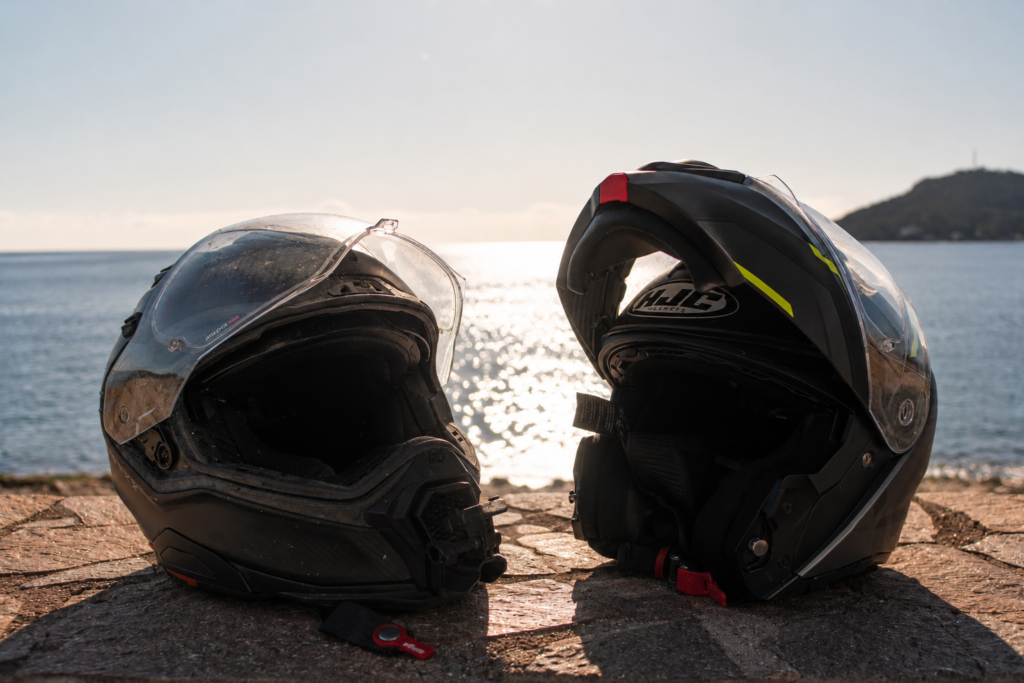
Full face helmets give you the most protection and the least compromise on wind noise and weather sealing — the trade-off is convenience. Modular (flip-up) helmets let you open the chin bar without removing the whole helmet, which matters more than it sounds like it should. Adventure helmets add a peak visor and usually a larger eye port, built with off-road use in mind but increasingly worn on the road too.
There isn’t one correct answer here — I own two different types for two different kinds of riding, and neither one replaces the other.
My daily commuter helmet is a flip-up, and I genuinely love it for one reason that has nothing to do with performance: I wear glasses, and a modular helmet means I don’t have to take them off every time I put the helmet on or take it off. On tour, I ride my Nexx X.WED 3 instead — an adventure helmet — and I appreciate the flexibility it gives me on longer trips. But I miss the flip-up’s convenience in exactly the moments you’d expect: border crossings, short breaks, stopping to ask for directions. Every one of those is easier with a chin bar that opens. What I’ve come to accept is that convenience costs weight, and on long, hot days I’m glad my touring helmet isn’t carrying that extra bulk. There’s no single best type here. Ask yourself what you’re actually riding most, and which situations you hit most often — that’s what should decide your priorities, not a spec sheet.
Fit Over Shell Shape: The Most Important Decision
Helmet shells come in different internal shapes — round, intermediate oval, long oval — regardless of the size printed on the box. A helmet that’s technically your size but wrong for your head shape will create pressure points that only show up after real time in the saddle, not after five minutes in a shop mirror.
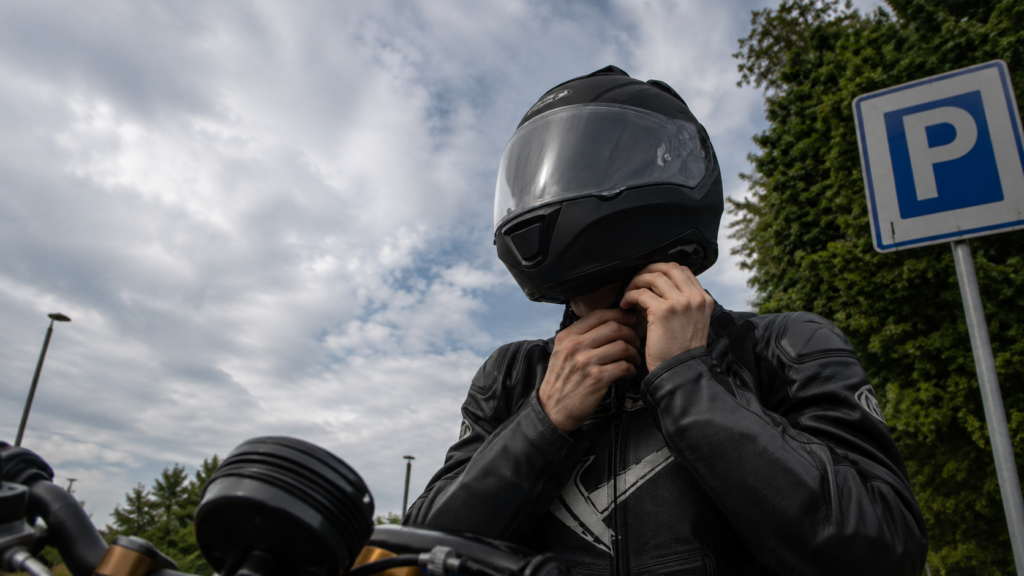
I once test rode a Schuberth E2 because I wanted a flip-up helmet for touring. In the shop, the fit was close to perfect, and I genuinely thought I’d found my next helmet. On the test ride, I noticed it creeping upward slightly — I’d guess from my jacket collar pushing against it — until the chin strap started pressing against my throat. I didn’t buy it. What fits perfectly standing still in a shop can develop a small issue on the road that’s still enough to ruin the ride. If you can test ride a helmet before buying, do it in your actual riding gear. If you can’t, get out on the bike with it as soon as possible after the purchase, while you can still return it.
Weight and Comfort for Multi-Day Touring
A few hundred grams feel like nothing when you first put a helmet on. They stop feeling like nothing somewhere around hour six with a headwind pushing against your helmet on an open stretch of highway, when neck fatigue starts compounding with every gust. This is where the weight-versus-features trade-off from the last section comes back — a peak visor, an integrated drop-down sun visor mechanism, and a bigger chin bar all add grams that a stripped-down street helmet doesn’t carry. Neither choice is wrong; it’s just worth weighing deliberately rather than by accident.
Visor, Ventilation, and Noise: The Touring-Specific Considerations
Visor
Pinlock inserts prevent fogging far more reliably than anti-fog sprays, and are worth having on any helmet you’ll wear through a full day of temperature changes. Clear visors matter more on tour than most riders expect, precisely because of changing light — a tinted or photochromic visor that’s fine at midday becomes a real problem at dawn or dusk, exactly when visibility already gets harder. Most touring helmets solve this properly with an integrated drop-down sun visor: keep a clear main visor for the ride, and flip the internal sun shield down only when the sun’s actually a problem, not every time you’re worried it might be.
Ventilation
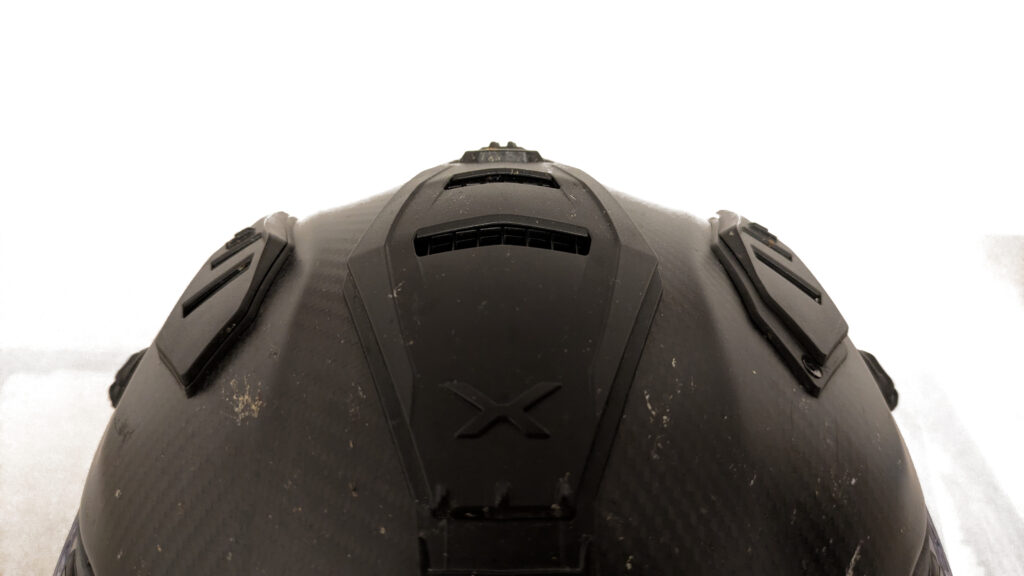
Look for adjustable intake and exhaust vents, not just a couple of fixed holes, and check where the intake air actually gets routed once it’s inside — a helmet that vents at the forehead but does nothing for the back of your head just moves the sweat around rather than clearing it. A working chin vent matters almost as much: without one, fogging builds up along the bottom of the visor exactly when you slow down to check a junction or clear a border crossing, which is the worst possible moment for blurred vision. Climate changes the calculus, too. Vents you can actually close, not just open, are what make a helmet work across all conditions.
Noise
Noise has never bothered me much personally — my own X.WED 3 isn’t a quiet helmet at all, thanks to the large eye port and longer chin bar that let in more wind and sound than a dedicated street helmet would. But I’ve ridden enough different helmets to know the difference between brands is real, and if you’re noise-sensitive, it’s worth taking seriously before you buy. Manufacturer dB figures aren’t much help here — there’s no standardised testing protocol, so numbers from different brands aren’t actually comparable. Independent tests from motorcycle magazines are a far more reliable guide than anything printed on the box.
When to Replace Your Helmet
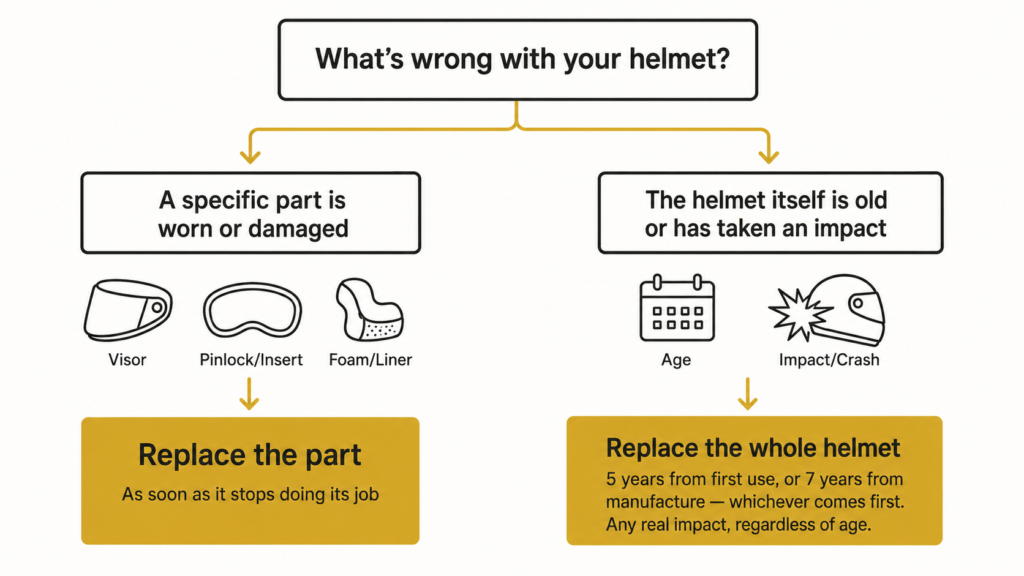
Replacing a Part
Visors scratch. Pinlock inserts wear out. On more expensive helmets, even the foam liner can sometimes be replaced on its own. The rule here is simple: replace the part as soon as you notice it’s not doing its job properly — a scratched visor that’s starting to scatter oncoming headlights at night doesn’t need to wait for your next full helmet purchase.
Replacing the Whole Helmet
Manufacturers and independent safety researchers are consistent on this: replace your helmet every 5 years from when you started using it, or 7 years from its manufacture date, whichever comes first — regardless of how it looks on the outside. The EPS liner that absorbs impact energy hardens and loses effectiveness over time even without ever being dropped, and the outer shell degrades from UV exposure in ways that aren’t always visible. A helmet that’s taken any real impact needs replacing immediately, no matter its age — the internal damage isn’t something you can assess by looking at the shell.
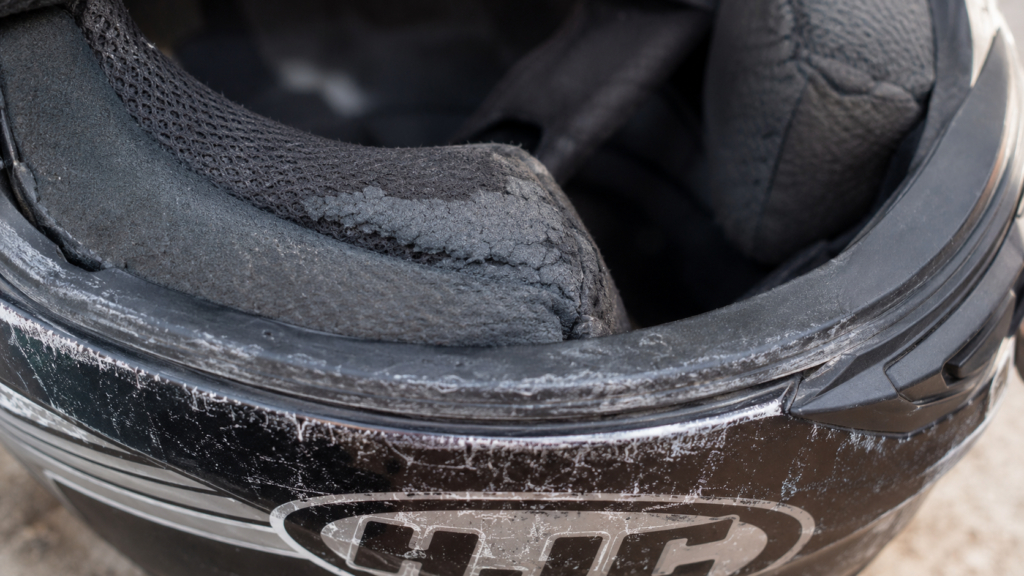
Going through my old gear to work out what was still usable, I laid out three helmets side by side: my first one, around twelve years old, one about four years old, and my Nexx X.WED 3, brand new at the time. The difference in material condition wasn’t subtle. The oldest helmet felt genuinely brittle next to the other two — not damaged, not cracked, just noticeably harder and less forgiving to the touch. That’s what the five-year rule is actually describing, and it’s easy to dismiss until you’ve felt the difference yourself.
Budgeting for a replacement — full helmet or a single part — is easier if it’s planned rather than a surprise before a trip. It fits into the same pre-trip cost planning as anything else you’re upgrading before departure.
Fritz’s Current Helmet: What I Ride In and Why
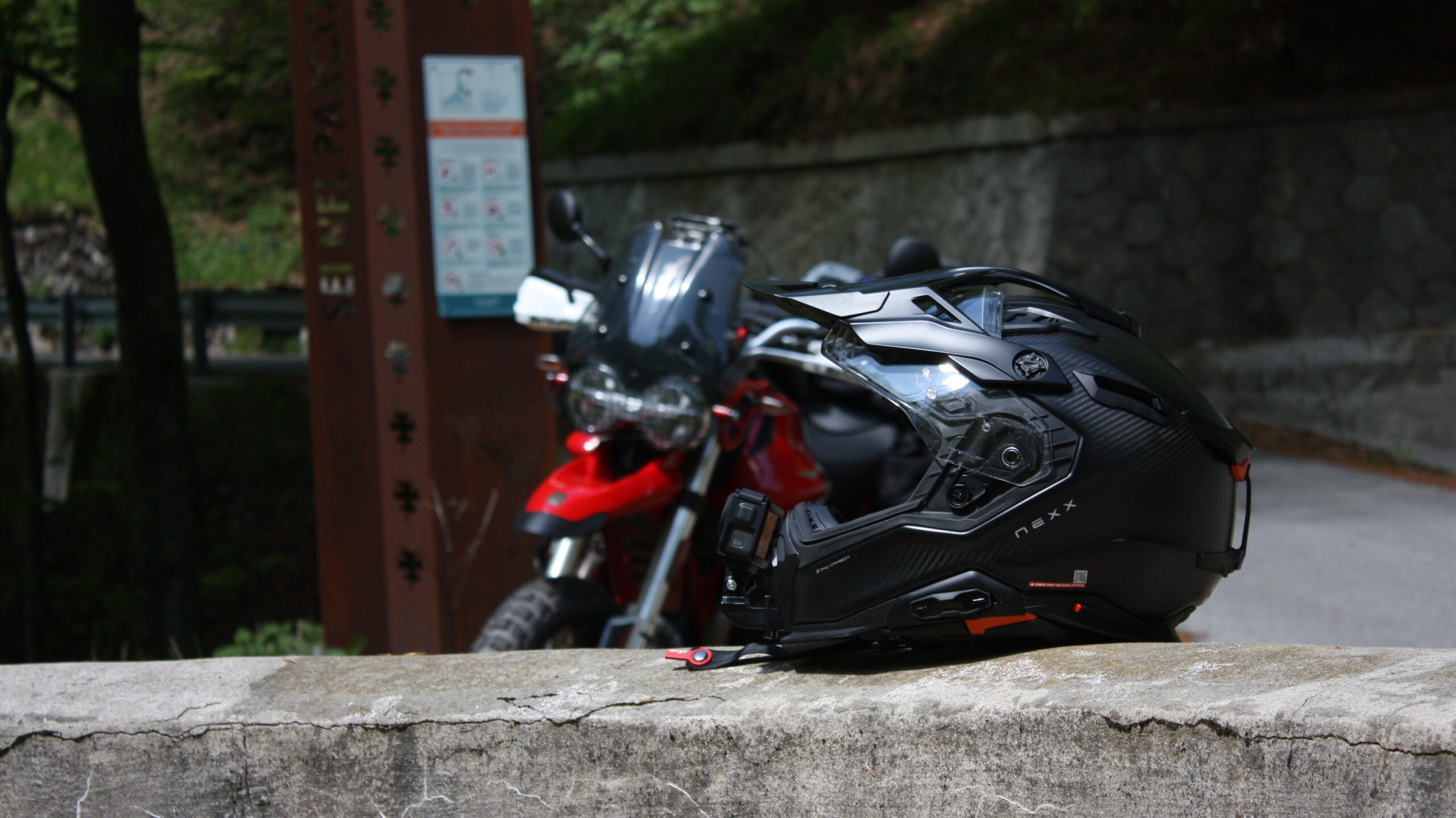
I currently ride in a Nexx X.WED 3, carbon shell, and the decision behind it comes down to one word: dual-purpose. It works as a genuine street touring helmet with the sunshield removed — enough ventilation, no drag issue at speed. It also works off-road, thanks to the large visor opening for a wide field of view, strong ventilation, and a removable sunshield that’s typical of off-road-oriented helmets. What actually won me over wasn’t any single feature — it was having one helmet that covers every kind of touring I do, adjustable on the road itself. Remove the sunshield before a highway stretch, put it back on for gravel.
It’s not without trade-offs. It’s heavier than a dedicated off-road helmet, and louder than a dedicated street touring helmet — the large eye port and the attempt to keep weight down both work against noise. I’ve accepted both trade-offs because the flexibility matters more to me than either one. That’s the same question this whole guide keeps coming back to: not which helmet is objectively best, but which trade-offs you’re actually willing to live with, given what you ride and how you ride it.
A helmet doesn’t work on its own, either. It has to seal properly against whatever collar sits underneath it — the same join point that turned a perfect-in-the-shop Schuberth into a helmet I couldn’t ride comfortably.
Boots deserve the same fit-first thinking a helmet does, and for the same reason: what feels right standing in a shop can turn into a real problem after actual hours in the saddle.
Motorcycle Touring Boots — how to choose the right pair for street and off-road
Helmet, jacket, trousers, gloves, boots — five categories that work as one system, not five separate purchases. The full decision framework for prioritising and budgeting across all five lives in its own guide.
The helmet is one line on a much longer list of what actually goes on a trip.
Motorcycle Trip Packing List: The Complete Guide — what to bring and how to pack it
By Fritz