Packing for a motorcycle trip isn’t a checklist exercise. It’s a compression problem and a priority problem at the same time. Everything you bring has to earn its place against limited space, limited weight, and the very real chance that you’ll be digging through your bags tired, in the rain, looking for the one thing you need right now.
This guide covers what actually goes in the bags and why: the emergency kit, the tool roll, clothing that earns its place through layering, navigation and electronics, how your luggage system shapes the way you pack into it, food and water on the road, and where documents actually live day to day.
Riding Gear Comes First
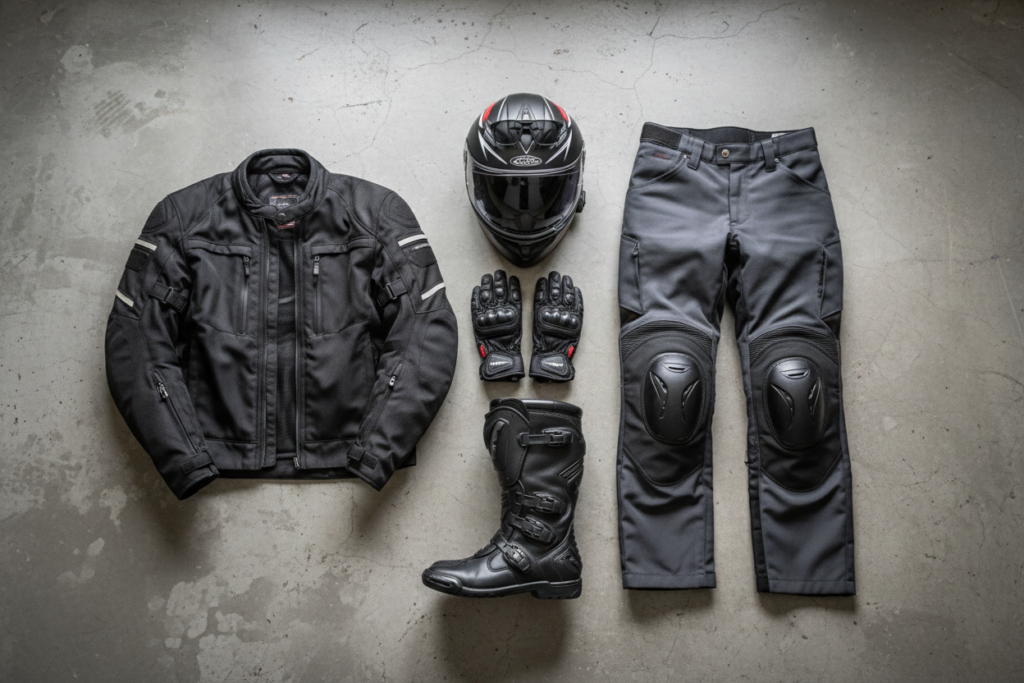
Before anything that goes in a bag, there’s what you’re already wearing: helmet, jacket, trousers, gloves, boots. This is the foundation of any packing list, and it deserves more attention than a paragraph here can give it. Fit, weather range, and break-in time all matter more for riding gear than for anything you’ll pack away — gear you wear for ten hours a day has a different bar to clear than gear you only reach for occasionally.
This guide deliberately doesn’t go deep on riding gear. The decisions involved — helmet standards, jacket weather systems, boot support — deserve a dedicated breakdown of their own.
The Emergency Kit
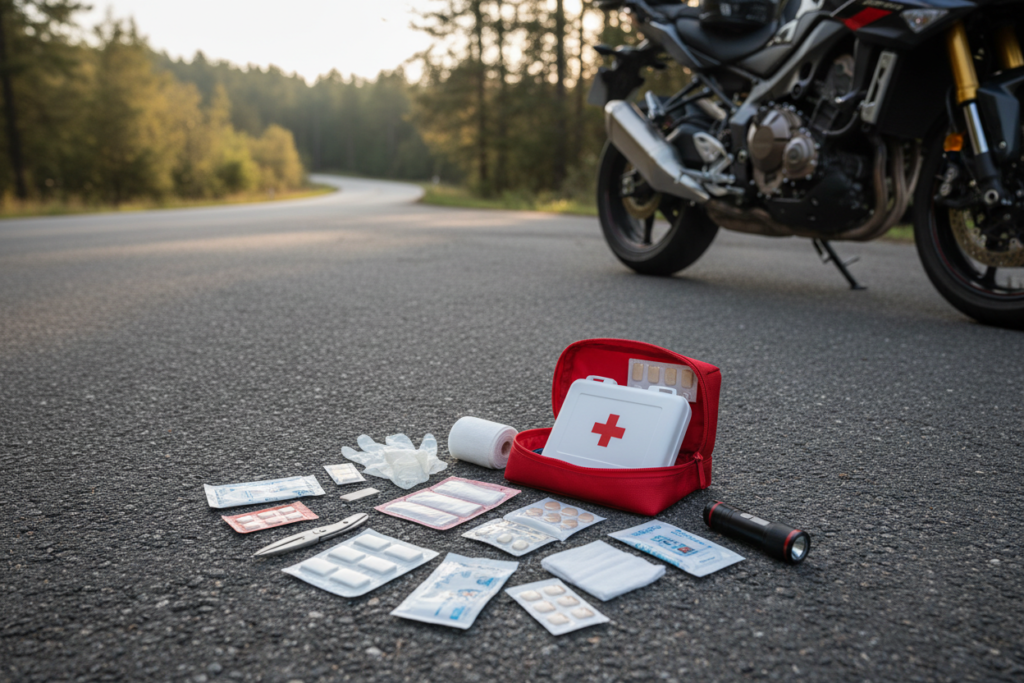
A motorcycle emergency kit isn’t the same as a car kit, and it shouldn’t be packed like one. The bulky car first aid kits sold at most shops are built for a glovebox, not a pannier. A compressed motorcycle-specific first aid kit — the kind sold in a small soft pouch rather than a hard case — has everything you actually need without the wasted volume.
Alongside the first aid kit: medication for pain, something for allergic reactions, a wound sterilizer, something for diarrhea and electrolyte replacement, and a tick remover. A high-visibility vest stays packed for roadside situations where being seen matters more than being stylish. For communication and power, a satellite communicator with presaved messages and contacts removes any dependency on phone signal in genuinely remote sections — alongside a power bank, a small solar panel for longer stretches without charging access, and a flashlight.
The Thing Most Riders Forget
Everyone packs for the flat tyre and the cut on a finger. Almost nobody packs for ticks — and FSME, the tick-borne encephalitis risk, is a real concern across large parts of Europe, not a fringe worry. Every roadside stop puts you in tick territory more than most riders realize: a break for a photo, something to eat, or just stretching your legs after a few hours in the saddle.
I’ve used my tick card at least twice in the last year. Both times were ordinary stops — nothing that felt remotely risky in the moment. A tick remover takes up almost no space in the kit. Leaving it out because it feels unlikely to matter is exactly the kind of thinking that catches up with you eventually.
The Tool Roll — General Kit
The tool roll is a strange item to pack. Most trips, it never gets opened. But the one time you need it, you’re glad it’s there — and that asymmetry is exactly why most riders end up carrying more than they strictly need. I’m no exception.
What I always carry regardless of which bike I’m riding: a roll with the most common sockets and a ratchet, a set of Allen keys, two 15mm wrenches, and a small set of screwdriver bits with a handle.
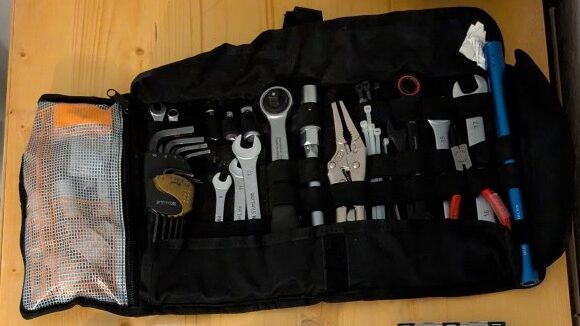
The two 15mm wrenches are specifically for mirrors. They loosen more often than you’d expect — usually from resting a helmet on them during a break, which puts more leverage on the mirror stem than anyone designs for. It’s a small, unglamorous fix, but it’s one of the most-used tools in the roll precisely because it solves a problem that happens constantly rather than rarely.
This is the general kit — the tools that make sense no matter which bike is under you. What changes between bikes is the spares: which fuses, which fasteners, what’s actually worth carrying for Derviša versus Ludmila versus Isolde. That’s specific enough to deserve its own post rather than a paragraph here.
Clothing — The Layering Lesson
Underwear, socks, and a couple of functional t-shirts are the obvious baseline — pack enough for the trip length plus a buffer, in quick-dry fabric if you’re camping or doing laundry on the road. That part barely needs explaining. The part that actually shapes how much you carry, and how comfortable you are doing it, is the layering system on top of that baseline: a base layer, a mid layer for warmth, and a waterproof or windproof outer shell. Three pieces, each doing a specific job, combining to cover a wide range of weather without needing a separate item for every condition.
The instinct on a first trip is to pack for every possible occasion — riding gear, casual clothes, something for the evening, something warm, something for rain. The lesson is almost always the same: most of it never gets worn.
On my first trip through Italy, I packed clothes for every occasion I could imagine — riding days, evenings at a restaurant, sitting around camp. It clicked after the trip, going through what had actually been worn versus what had just taken up space. The clearest example was a separate jacket for evenings. I never wore it. I wore the base layer of my motorcycle jacket almost exclusively — at camp, at a restaurant, and on cold riding days when I needed the extra layer underneath. One piece of gear doing the work I’d packed two separate items for.
The lesson scales beyond one jacket: every item that can serve two purposes — riding and off-bike, warm-day and cold-day — earns double the value for the same weight and space. Single-purpose items need a genuinely strong reason to make the cut.
Navigation and Electronics
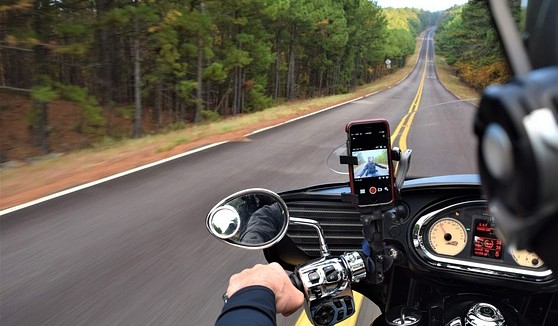
Some form of reliable navigation is non-negotiable — whether that’s a smartphone, a dedicated GPS unit like the Garmin touring range, or a combination of both. My current setup is an old smartphone I don’t worry about damaging from vibration, mounted on a sturdy bracket. That setup wasn’t where I started, and a dedicated GPS unit with proper weatherproofing is a perfectly valid alternative if you’d rather not risk a phone at all.
Worth separating from the navigation question entirely: a second phone, kept purely as a backup, gives you a way to call for help even if your main device is dead, broken, or acting as the GPS itself. It doesn’t need to be anything special — an old handset with a charged battery and a SIM is enough. That’s about communication redundancy, not navigation, and it’s worth having regardless of which navigation setup you choose.
When the Pouch Becomes the Problem
I started with an ordinary waterproof, airtight GPS pouch — the kind sold specifically for motorcycle phone mounting. It worked fine in moderate conditions. What it didn’t account for was heat.
The phone overheated inside the sealed pouch on a hot day in the Apennines, shutting down navigation completely. I was on backroads with no clear sense of where I actually was, working from memory and instinct until I found a junction with a signpost. The pouch had done exactly what it promised — kept water out — but airtight also means no airflow, and that trade-off cost me real navigation time on a day I couldn’t afford to lose it.
An older phone you’re not precious about, mounted without a sealed enclosure, solves the overheating problem directly. It’s a less elegant setup than a dedicated waterproof case, but it’s the one that actually works through a full riding day in summer heat.
How Your Luggage Shapes the Way You Pack
This isn’t about choosing between hard panniers and soft luggage — that decision deserves its own full breakdown, and I’ve already written it.
Hard Panniers vs Soft Luggage: Pros and Cons for Motorcycle Travel — for the system decision itself
What matters here is different: once you’ve chosen a system, that system changes how you pack into it — not just how much fits, but what fits, where it goes, and how disciplined you end up being about what makes the cut.
Shape Changes What Fits
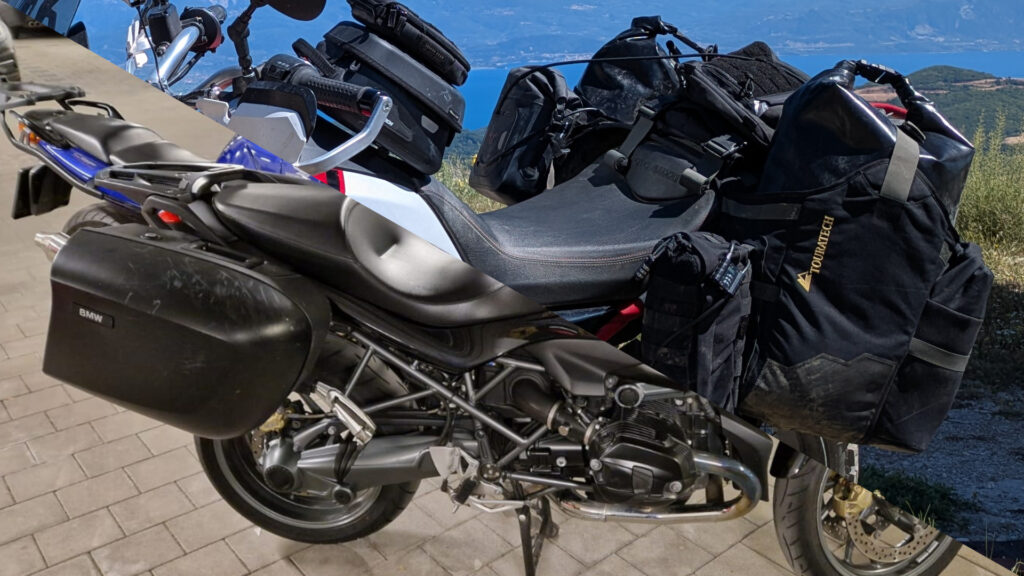
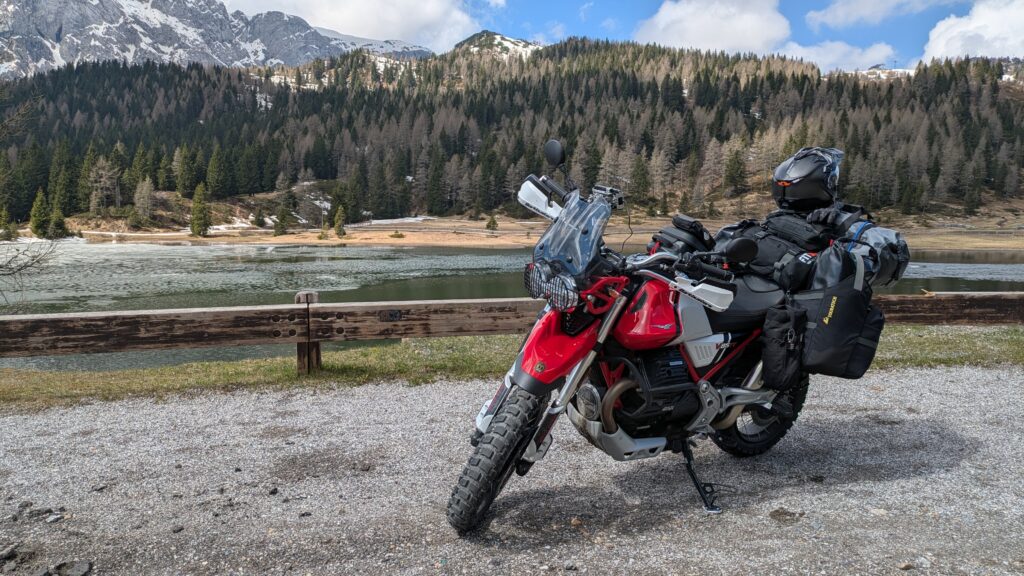
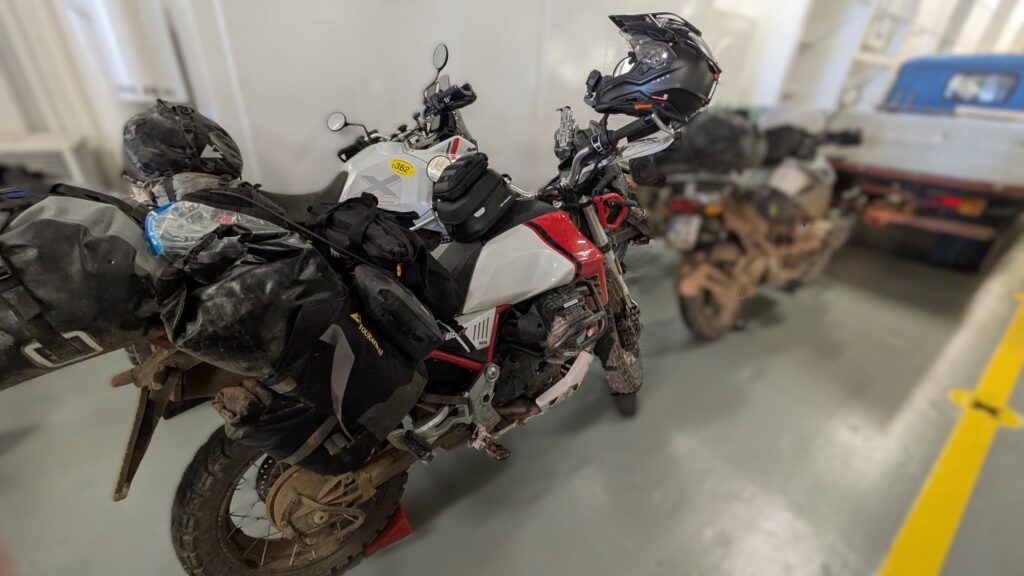
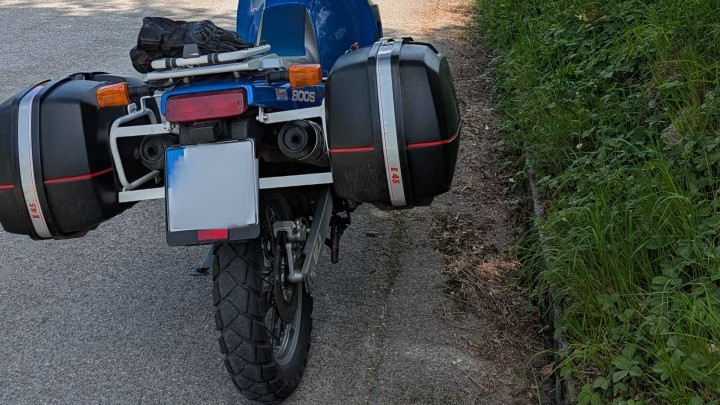
Hard cases — Ludmila’s and Isolde’s — have a rigid, square form. Something long and thin simply won’t go in, no matter how you angle it, even if the total volume is technically enough. Derviša’s soft luggage behaves more like a sea bag: long and narrow, and surprisingly forgiving of awkward shapes. You can stuff a lot into that shape that a rigid box would reject outright.
This also changes weight distribution. Soft luggage lets you layer items on top of each other, which means you can actively shift weight by changing what sits where. Hard cases load mostly along one axis — once something’s in, there’s limited room to adjust the bike’s balance by repacking.
Access Philosophy — Bottom of the Bag vs Anywhere, Anytime
Hard cases give you something close to full access to everything, anytime — open the lid, take what you need. Soft luggage doesn’t offer that same luxury. Whatever goes in first sits at the bottom, and getting to it later usually means partially unpacking everything on top. The practical result: if something goes in the bottom of a soft bag, you’d better be confident you won’t need it until you’re fully unpacking that night.
The Discipline Soft Luggage Forces
Hard cases stay the same external size no matter what’s inside — half-full or completely packed, the bike’s profile doesn’t change. Soft luggage expands with every item added. That creates a quiet incentive: pack less, and the bag stays smaller and lighter. Pack more, and you’re carrying the bulk whether you need it or not.
I set out on a two-week trip with Derviša and had to turn back after 200 km because of an oil leak. After returning home I transferred everything from Derviša’s soft luggage into Ludmila’s hard cases — and the hard cases were only half full. What struck me wasn’t how much space was left. It was realizing how much I’d already trimmed my kit down specifically to keep the soft luggage from getting bulky. The hard cases, by comparison, were sitting there at half capacity but still taking up their full, fixed bulk on the bike regardless. Two completely different relationships with the same amount of gear.
Food and Water on the Road
This section covers what to carry day to day while riding — hydration and food for the road itself. Full camping cooking setups, stoves, and cookware belong to a different guide.
Best Motorcycle Camping Gear for European Tours — for tents, sleep systems, and cooking equipment
A reliable hydration setup and some non-perishable food for the gaps between meals matter more than people expect, particularly outside the cities where shop hours can’t be assumed.
When the Stores Are Closed
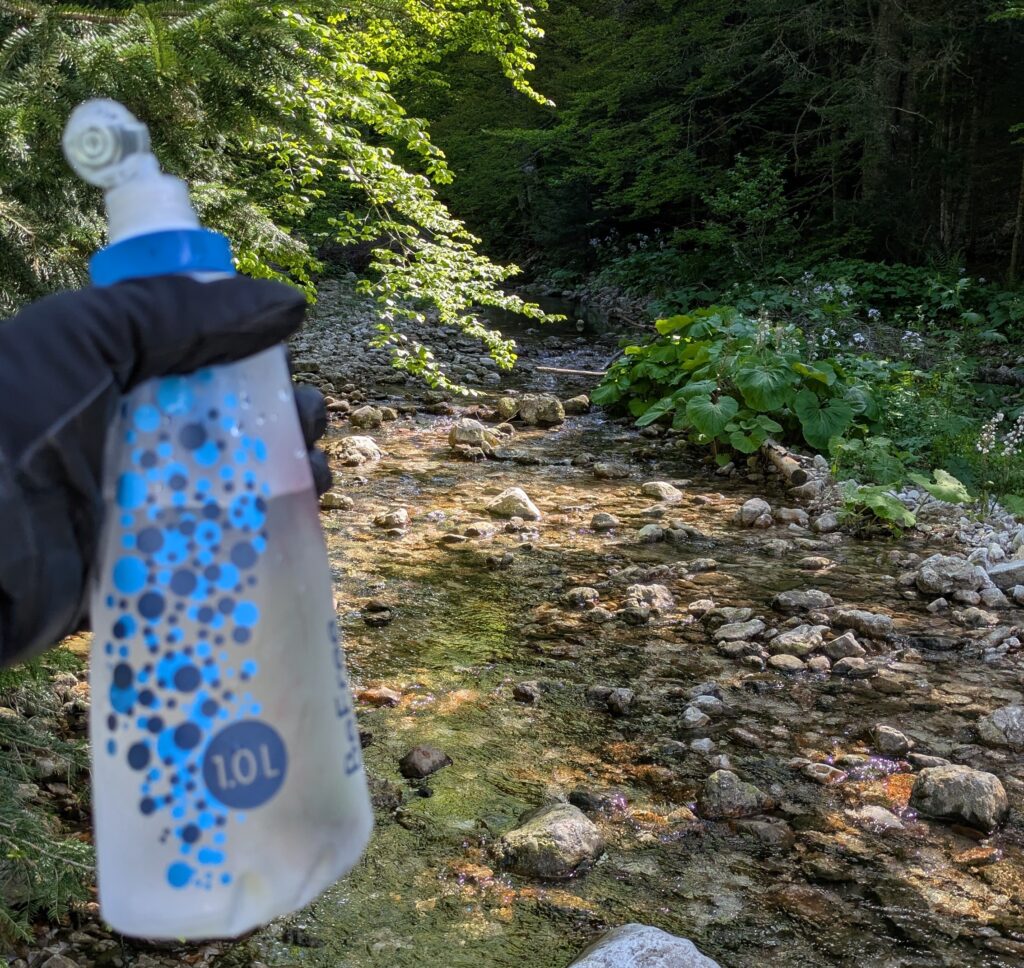
I was glad to have a water filter with me in Italy. Outside the bigger towns, most stores close between roughly 13:00 and 16:00. After passing two or three villages with shutters down and no open shop in sight, I filtered water from a cattle water reservoir instead of waiting it out or risking dehydration on a hot riding day. The water might well have been fine without filtering it — but knowing for certain, rather than just hoping, is worth carrying the extra weight for.
Where to Keep Your Documents
This isn’t about which documents to bring — registration, insurance, licence, the full list is covered in the planning guide.
How to Plan a Motorcycle Trip: The Complete Guide — for the full document checklist
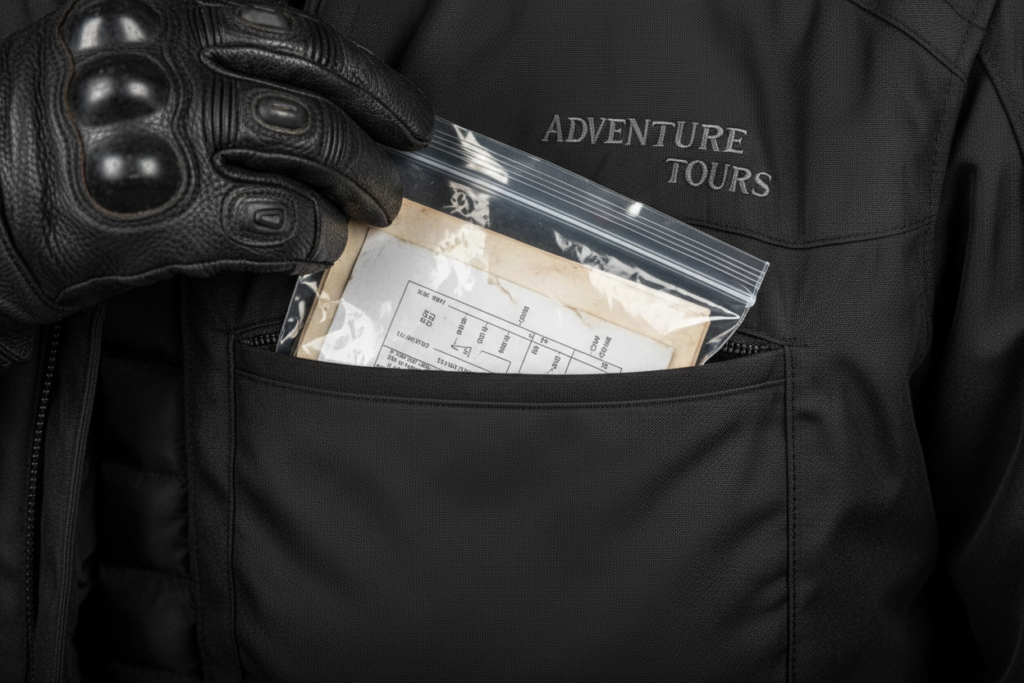
What matters here is where they physically live on the bike day to day. I carry multiple copies in different locations, every copy sealed in a waterproof zip-lock bag. The inner pocket of my jacket holds the primary copy — the most convenient spot for border crossings, since it’s accessible without taking gear off. A second copy goes into the backpack or tank bag, depending on the bike and whether a tank bag is fitted that trip — also fast to reach. A third copy goes deeper into the luggage, reserved for the worst case: losing track of the other two. Additionally scan all important documents and email them to yourself so you can access them from any internet connection.
I’ve packed documents this way from the start, and it’s worked without incident so far — which is exactly the point of redundancy. The system doesn’t need a failure story to justify itself; it needs to be in place before one happens
Pack From Experience, Not From a List
None of this came from a generic checklist. The tick card came from two real stops. The mirror wrenches came from a mirror that kept loosening. The phone setup came from getting lost in the Apennines. The way I pack Derviša versus Ludmila came from an oil leak that cut a trip short. The water filter earned its place outside closed shops in Italy.
That’s the actual test for anything that makes it into the bags: not whether it looks complete on a list, but whether it’s already proven its worth on the road. For the gear this guide didn’t cover in depth — riding gear, full camping equipment, bike-specific spares, the luggage system decision itself — the dedicated guides linked throughout go further.
You might start with a checklist from the internet — this one included. That’s fine. What matters is what happens after the first trip: refine it, cut what didn’t get used, add what you wished you’d had. Do that enough times and the list stops being generic. It becomes tailored to how you actually ride, and every trip after that — whether it’s two days or two weeks — gets a little easier to pack for.
By Fritz