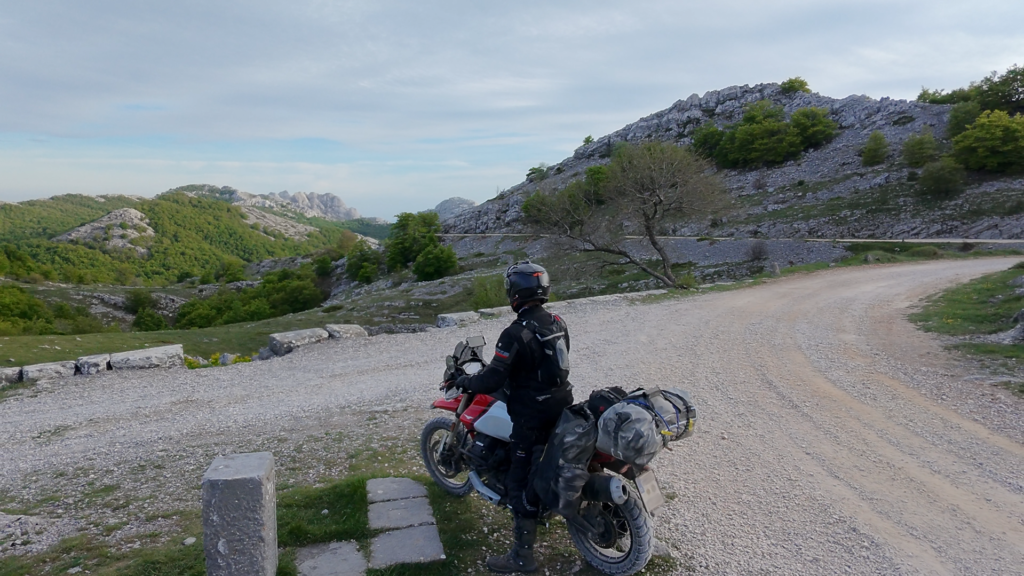
The camera kit I started with on my first serious trip was a smartphone and a DJI Action 3. That was it. The Italy TET and ACT with Vittoria — the Honda Transalp — got documented on two devices that together weigh less than a litre of water and fit in a jacket pocket. It was enough to begin. It was also enough to show me, clearly, what was missing by the time the trip was over.
That’s the honest starting point for motorcycle travel photography: you don’t need to figure out the kit before you go. You need to go, see what the trip couldn’t capture, and let that shape what comes next. What follows is what four trips have taught me about building a photography kit around a motorcycle — not instruction from someone who has it figured out, but an account of someone still working it out.
The Kit — What I’m Using and What Each Tool Actually Does
The current kit has four tools. They cover different jobs and none of them cover those jobs perfectly — which is about where any honest account of work-in-progress photography gear should start. What follows is what each one does in practice, not on a spec sheet.
DJI Action 3 — The Helmet Camera
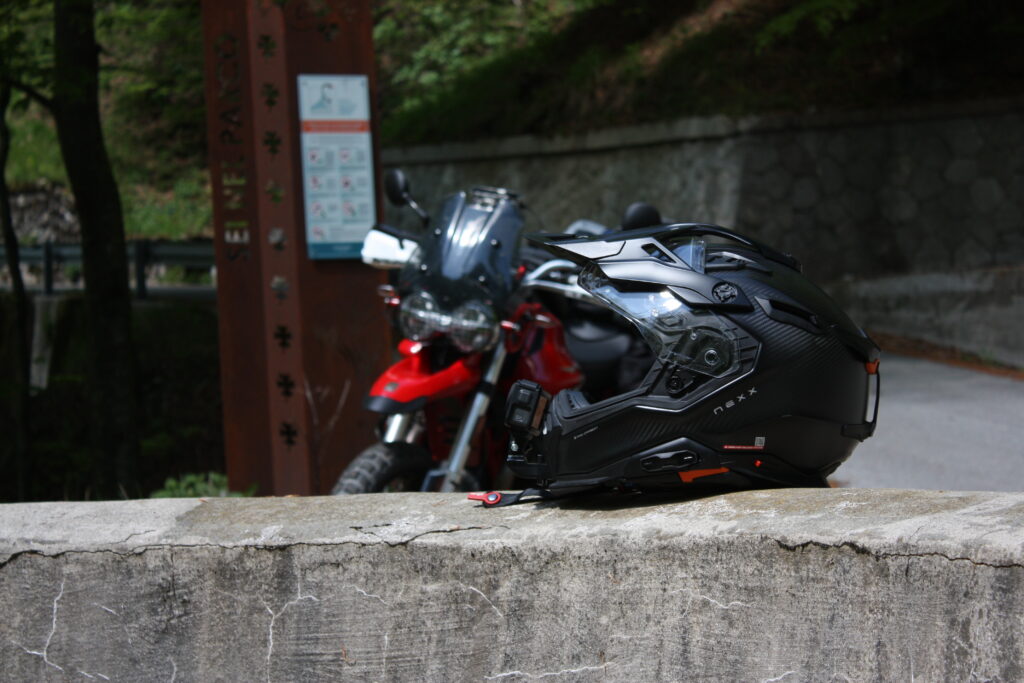
The Action 3 is the riding camera. It goes on the chin of the helmet and stays there for most of the riding day — that position gives the closest thing to what the eye sees without the fish-eye distortion of a top mount, and natural head movement makes the footage feel like someone is riding rather than observing from outside.
I experimented with mounting it on the crashbars of Vittoria , which produces useful footage from a lower angle with the road ahead in a different perspective. On Derviša the transverse V-twin makes crashbar mounting impractical — the engine fills the space where the mount would go. A handlebar mount got tried and abandoned: forward-facing is largely redundant with the chin mount, and backward-facing shots need a specific purpose I haven’t identified yet.
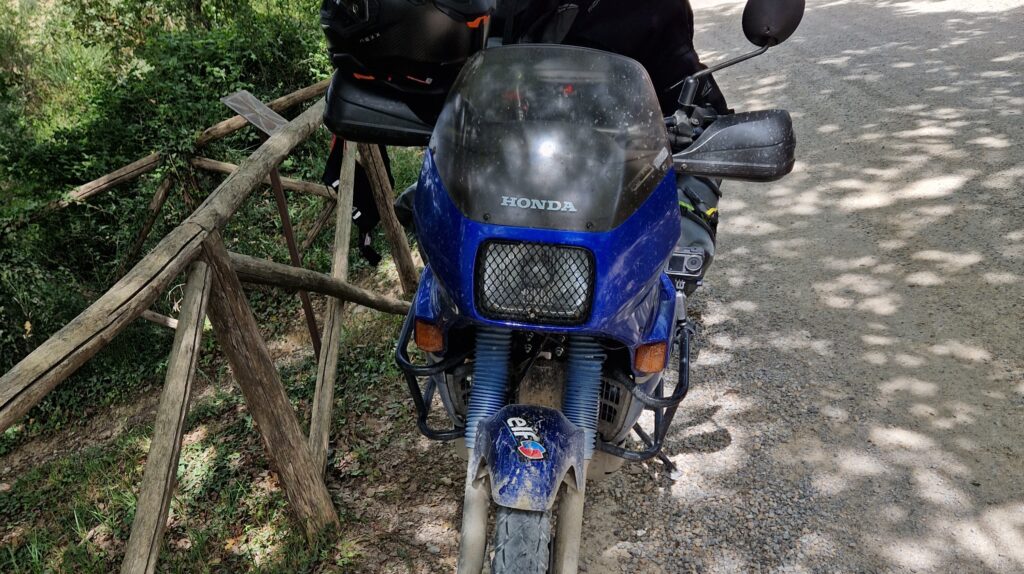
This is a video-first tool. Stills from the Action 3 work for quick documentation but the dedicated camera handles anything where the quality of the still actually matters. The Action 3’s job is to run while riding and capture what the trip looked and felt like in motion.
DJI Neo — The Drone
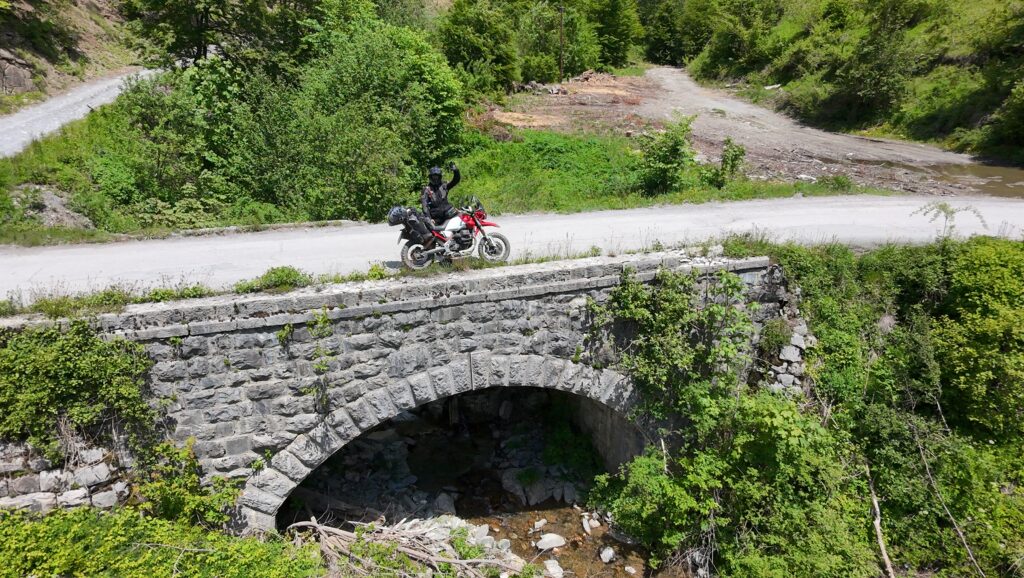
Aerial perspective is the thing no ground-level camera can replicate — a mountain road visible from directly above, a coastal section from fifty metres up, a slow-speed pass filmed from the side at altitude. The Neo opened all of that up, and that alone justifies its place in the kit.
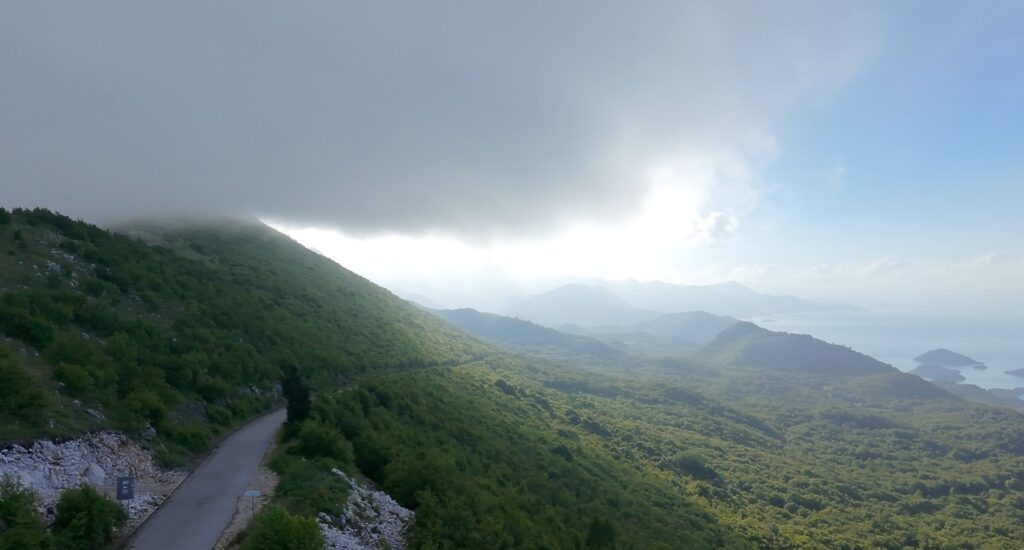
The limitations are real and worth knowing before buying: the Neo’s size means it has a wind ceiling — meaningful gusts make it unstable and unflyable. It can’t follow riding at pace, which limits riding footage to slow passes and static aerial shots. Still image quality falls short of the phone in most conditions. And automated flight modes need to be understood before activating them near terrain where a mistake has permanent consequences.
The accessible size is its real advantage for learning. Easy to carry, easy to get in the air, enough to understand what drone footage actually requires before committing to something more capable. The upgrade path is clear. When it makes sense is still being worked out.
EOS 450D with 18–55mm Kit Lens — The Dedicated Camera
An entry-level DSLR from 2008, used across multiple trips and day rides. It does the job it was designed for — larger sensor than the phone, optical zoom, manual control over exposure settings. The 18–55mm kit lens covers most of what motorcycle travel photography requires: wide enough for landscape shots with the bike in frame, long enough for road compression shots from a viewpoint.
The ceiling is becoming visible. Adjusting aperture or shutter speed produces a result, but the feedback loop is slow — the optical viewfinder shows the scene before the settings are applied, not after, which means understanding why a setting worked or didn’t requires reviewing the shot rather than seeing it in real time. And the size means it stays in the pannier more often than it should, because getting it out takes three minutes that a quick stop doesn’t always have.
It will be replaced. A smaller mirrorless with live preview through an EVF — seeing the exposure before the shutter fires — is what comes next. The 450D has taught me what I’m looking for in a way that buying the mirrorless first wouldn’t have.
Pixel 7a — The Always-Available Baseline
The camera that gets used most often because it costs nothing in setup time. It’s in the jacket pocket, it’s out in thirty seconds, and for anything where capturing the moment matters more than how it looks technically, it’s the right tool. Quick stops, weather that doesn’t allow the DSLR to come out, a composition that needs to be framed before the light changes — the phone handles all of it without a second thought.
Modern phone cameras are genuinely good. Not a compromise when the conditions suit them, and the conditions suit them more often than gear guides tend to admit.
How the Kit Was Built — One Trip at a Time
The Italy trip with Vittoria — smartphone and Action 3 only — showed what the minimum kit could and couldn’t do. The riding footage worked well enough. The stills told the story of the trip but not in a way that felt finished by the end of it. That gap was clear enough to act on.
The EOS 450D came after Italy as the first step toward deliberate still photography rather than documentation. It brought more control and more friction simultaneously. Getting it out of the pannier takes time that not every stop has, and the results for a while weren’t reliably better than the phone — because the phone was making automatic decisions that manual settings, still being learned, couldn’t consistently beat. The friction turned out to be the point: it forced engagement with settings the phone handles invisibly, which is the only way to understand them.
The DJI Neo drone arrived for the Balkans trip with Derviša and opened up a perspective on the routes that nothing else in the kit can replicate. A mountain road seen from above is a different thing from a mountain road seen from the saddle — both are true, both are worth capturing, and until the drone arrived only one of them was possible. It also introduced the most demanding learning curve of any addition: understanding what conditions it can and can’t fly in, what the automated modes actually do, how to get it in the air and back down efficiently without losing riding time.
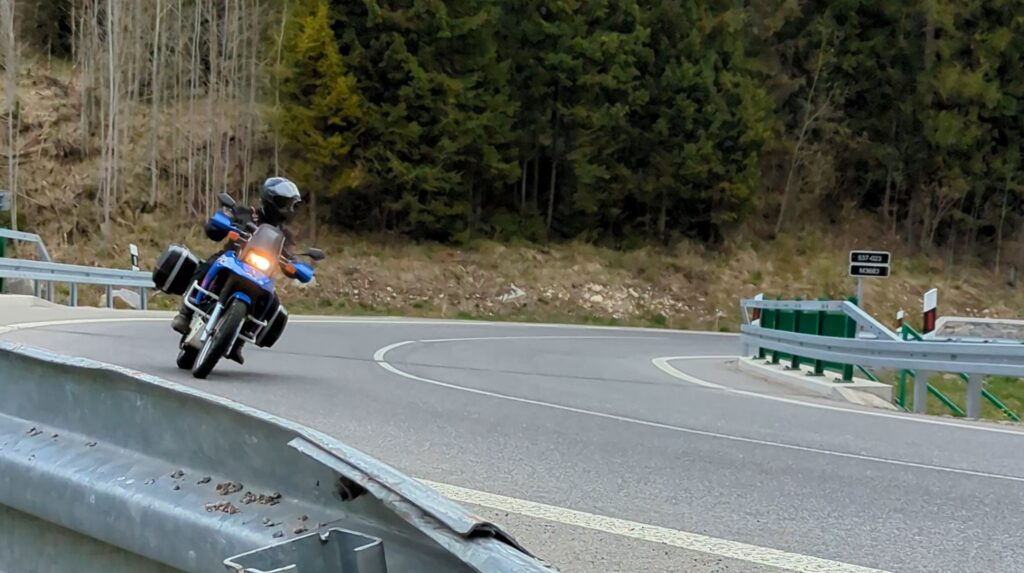
The two tripods came on the Slovakia trip with Ludmila. A small one that lives in the tank bag, and a larger one with flexible feet — the kind that wraps around a tree branch, a fence post, a road sign. A smartphone mount fits both, which means the DSLR and the phone work with either. What that combination made possible was something the kit had been missing since the first trip: the bike and the rider in the same frame, without asking anyone else to hold the camera. Self-timer riding sequences, fixed-position shots from a specific height and angle repeated across different locations, long exposure testing at dusk. It changed what the tripods are for — not just stabilisation, but a consistent compositional tool.
The most recent addition is the DJI Mic. It hasn’t been used on a trip yet. The gap it’s meant to address — audio quality for video content that built-in microphones can’t match in wind — is understood. Whether it solves that problem in practice is still to be found out.
What Actually Made a Difference — and What Less Than Expected
The drone opened up shots that simply don’t exist at ground level. A road switchbacking up a mountainside looks like a road from a bike. From fifty metres up it looks like the thing it actually is — a line drawn through a landscape. That shift in perspective is the single most significant thing the kit has gained across four trips, and it came from one addition.
The limitations described in the Neo section are real, but they don’t change what aerial perspective produces when conditions allow it. They define when to get the drone in the air — which is itself a skill that develops with use.
The tripods made a quieter but more consistent difference. Not every trip produces a moment where the drone earns its place. Every trip has moments where a fixed camera position — the bike in a specific part of the frame, consistently, across different lighting — produces shots that hand-holding can’t. Self-timer riding sequences, long exposure testing at dusk, holding a composition while the light changes. The flexible-feet tripod mounting to a roadside tree or a sign is the specific capability that made it worth carrying over a standard fixed tripod.
The DSLR was the addition that performed least as expected — not because the camera is bad, but because the expectation was wrong. Adding a dedicated camera doesn’t immediately produce better results than the phone. The phone’s automatic processing is making decisions that a photographer still learning manual settings can’t consistently beat. The DSLR’s value is in forcing those decisions to be made consciously — aperture, shutter speed, ISO — until the understanding develops that the phone obscures. It’s a learning tool as much as a camera, and judged as a learning tool it has done exactly what it should.
Every tool has a setup cost, and that cost shapes when each one actually gets used as much as any technical capability does. A tool that requires significant time to deploy gets deployed less — which affects what gets captured on a stop that has limited time. That trade-off is worth thinking about before buying anything that adds friction to the moment between seeing a shot and taking it.
Protecting and Backing Up the Kit
Vibration is the real risk for dedicated cameras on a motorcycle, and it’s easy to underestimate until something goes wrong. The DSLR lives in a padded insert inside the pannier — not loose, not wrapped in a jacket as a substitute for actual padding. The Action 3, phone, and drone handle vibration without special treatment, but the DSLR needs the insert regardless of what it costs in pannier space. Weather is the second concern: a dry bag inside the pannier adds a layer for longer rain sections, because the Action 3 is waterproof and the DSLR is not.
SD cards are worth thinking about before a long trip rather than after a card failure mid-route. Multiple smaller cards distributed across devices is more useful than one high-capacity card — a single failure costs a portion of the trip rather than all of it. Card speed only matters if your camera actually needs it: 4K video and high-speed burst shooting have specific minimum requirements worth checking for your specific camera. For most touring photography, any Class 10 card is sufficient.
Field backup becomes necessary on longer tours. A short trip can run on multiple cards until home without losing much sleep over it. A multi-week tour through multiple countries needs cards copied to a portable drive at accommodations — losing a card halfway through a six-week trip is a different problem than losing one on a weekend ride. For motorcycle travel, an SSD is the better choice over a traditional HDD: lighter, no moving parts, and significantly more resistant to the vibration that is a constant presence in any pannier. The weight difference matters when luggage space is already under pressure.
Charging across the kit is simpler than it looks: the phone, Action 3, and DJI Neo all use USB-C, which means one cable covers three devices. The DSLR uses a dedicated charger. On wild camping sections without mains power, a 20,000 mAh power bank covers the USB devices for a couple of nights before needing a recharge itself.
What’s Still Missing
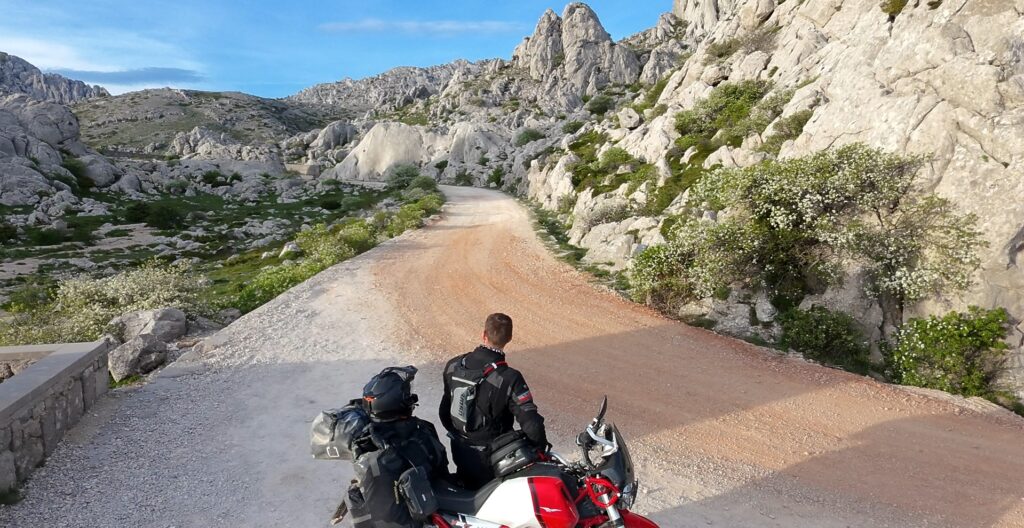
The EOS 450D has given as much as it can. A mirrorless with an EVF that shows the exposure before the shutter fires would change how settings get learned and applied — the feedback loop that the optical viewfinder doesn’t provide. Smaller than the current DSLR, video-capable, faster to reach for on a short stop. That’s what the next camera looks like. When that purchase makes financial sense is the only open question.
A more capable drone would add stability in wind and the ability to follow riding at pace. Whether the Neo’s current ceiling becomes a consistent frustration rather than an occasional one is what determines when that upgrade makes sense — and that answer is still accumulating evidence across trips.
The DJI Mic is the most recent addition and the least tested. On a still day, the Action 3’s built-in audio is adequate. On a riding day with wind noise, it isn’t. Whether the mic solves that problem in practice is the question the next trip will answer.
The kit built across four trips is still being built. Each trip clarifies something the previous one left unclear — which mount works for which bike, which conditions the drone can and can’t handle, when the DSLR earns its place over the phone. The answers keep getting more specific, and the photography keeps developing alongside them.
By Fritz