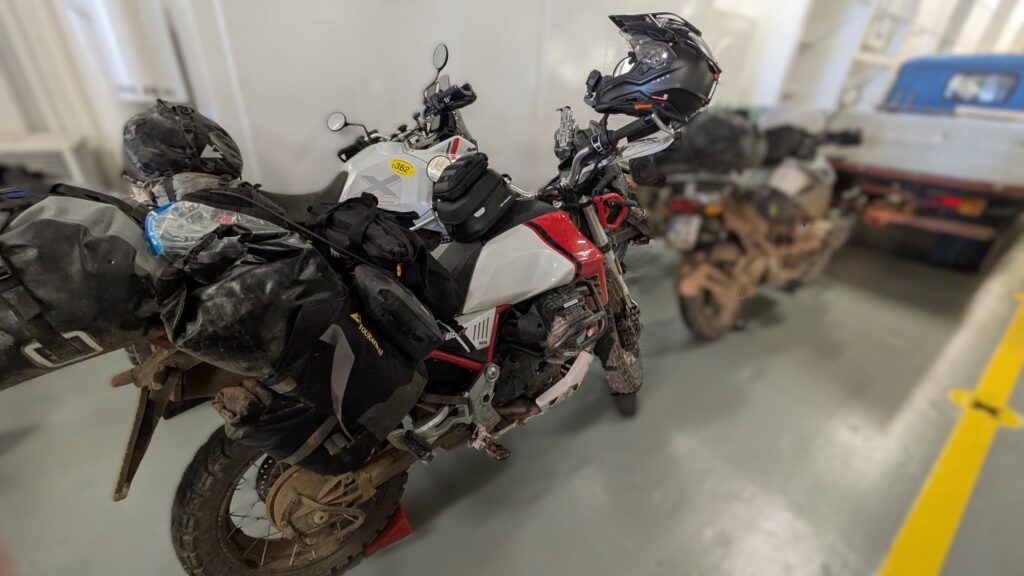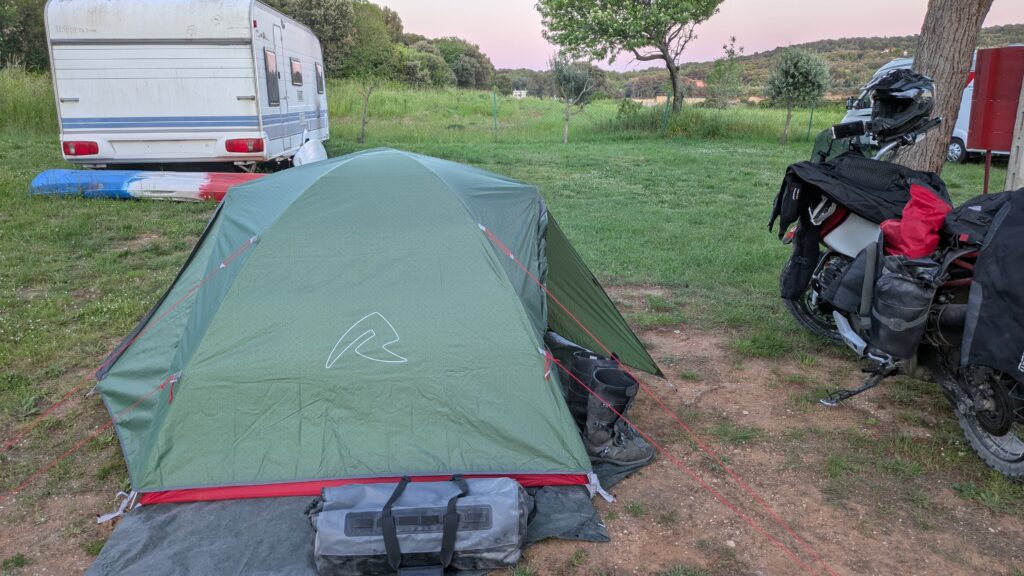
The luggage gets all the attention. Riders spend weeks researching panniers — capacity, waterproofing, lock quality, material — and then strap them to the bike with whatever mounting solution came in the box or was cheapest online. The mounting system that keeps 20 kg of touring kit on the bike at 130 km/h on an Austrian motorway, through vibration, rain, and mountain pass corners, is treated as an afterthought. It shouldn’t be.
Motorcycle luggage mounting determines how securely your kit stays attached, how your bike handles when loaded, how quickly you can remove panniers in a city, and how long the system lasts before something cracks, loosens, or fails entirely. The right mounting system is almost always bike-specific, almost always worth more than you initially want to spend, and almost always the thing riders wish they’d invested in properly the first time rather than the second. This guide covers every mounting system type, how to choose between them, and how to keep them working across years of touring.
Why Motorcycle Luggage Mounting Deserves More Attention
Mounting system failure has consequences that range from inconvenient to dangerous. A pannier that detaches at speed becomes a road hazard for riders behind you and removes 10 kg of ballast from one side of the bike simultaneously — the handling implication of sudden asymmetric unloading is not subtle. A top case that works loose over a long motorway section affects aerodynamics and adds unwanted movement to the rear of the bike at speed.
Beyond safety, poor motorcycle luggage mounting affects handling from the moment you set off. Weight mounted high — a heavy top case loaded beyond its recommended limit — raises the centre of gravity and makes the bike feel top-heavy in slow-speed manoeuvres. Weight mounted unevenly between left and right panniers creates a permanent lean in one direction that becomes tiring over long distances. Getting the mounting system right is the foundation of a well-handling loaded touring bike.
The false economy of cheap universal mounting solutions reveals itself quickly. A generic rack that doesn’t integrate cleanly with the bike’s subframe introduces flex and vibration stress at the mounting points. Over a long tour — particularly on rougher Balkan or Eastern European roads — this stress accelerates metal fatigue at the frame interface. Bike-specific mounting systems are designed to the subframe’s geometry and load tolerances. The price difference is real. So is the performance difference.
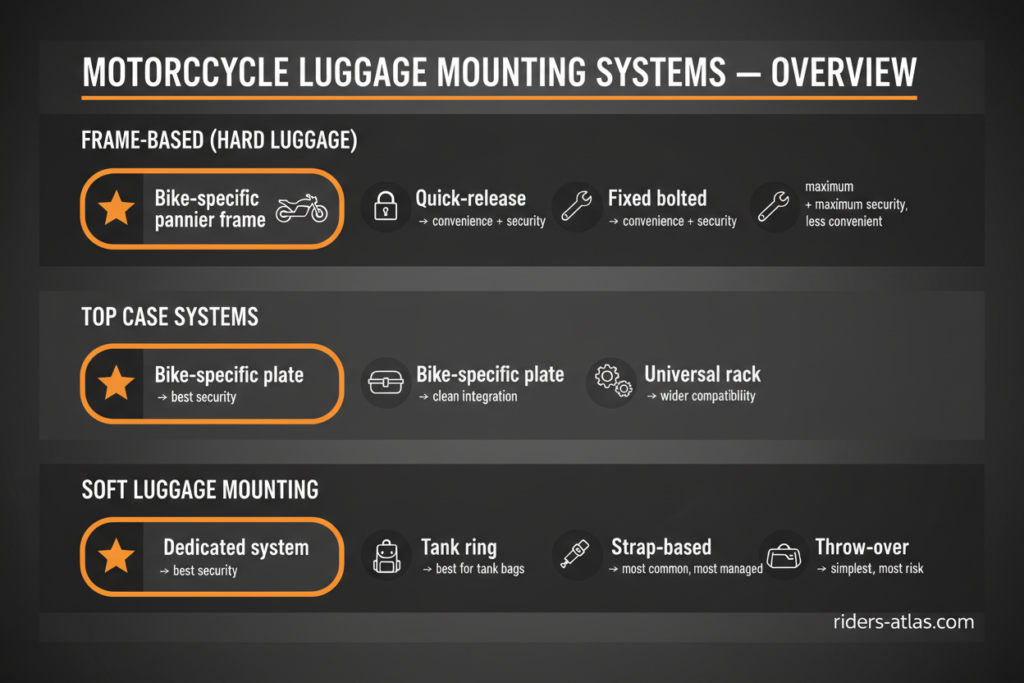
Frame-Based Mounting Systems — The Foundation of Hard Luggage
Dedicated Pannier Frames and Racks
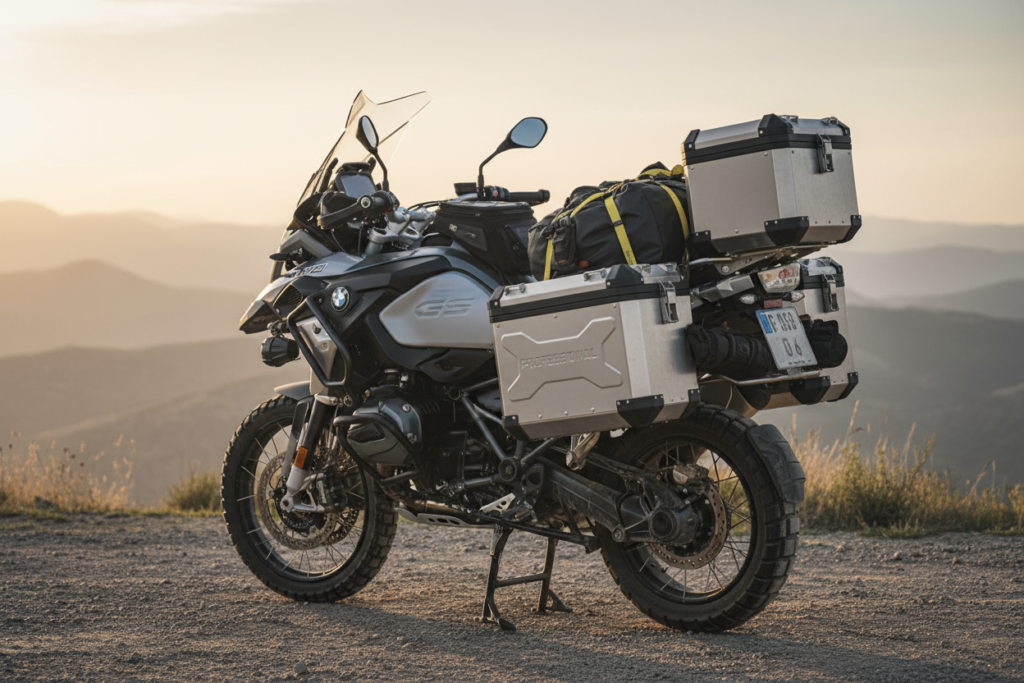
A dedicated pannier frame is a bike-specific metal frame that bolts to the motorcycle’s subframe, providing rigid mounting points for hard panniers on both sides. It is the most secure, most integrated, and most recommended motorcycle luggage mounting solution for any rider doing serious long-distance touring.
The major manufacturers — SW-Motech, Givi, Touratech, and Hepco & Becker — all produce bike-specific frames for most popular touring motorcycles. SW-Motech’s EVO system and Givi’s Monokey system are the most widely available across Europe. Touratech focuses on the premium ADV end of the market with frames designed specifically for rough-road use. Hepco & Becker’s Lock-It system offers strong integration between frame and pannier.
Frame materials divide between steel and aluminium. Steel frames are heavier but more resistant to impact damage — a dropped bike on a steel frame typically bends rather than cracks. Aluminium frames are lighter and resist corrosion better, but crack rather than bend under significant impact. For rough roads, and mixed-surface riding, steel’s impact tolerance is worth the weight penalty.
Fitting a bike-specific pannier frame is within reach of any rider comfortable with basic mechanical work — a socket set, a torque wrench, and the manufacturer’s fitting guide covers most installations. Allow two to three hours for a first-time fitting. Professional fitting at a dealer costs 50–100 € and makes sense if torque specifications and thread preparation aren’t familiar territory. Cost range for a quality bike-specific pannier frame: 150–400 €.
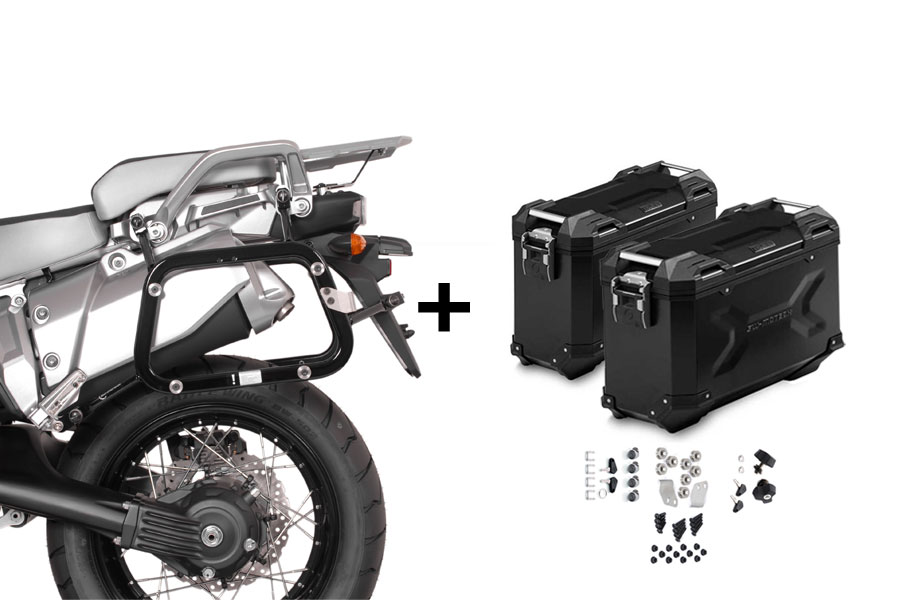
Quick-Release Systems
Quick-release motorcycle luggage mounting — where panniers click onto the frame and release with a lever or button, no tools required — is the quality-of-life feature that most experienced tourers wish they’d prioritised from the start. The ability to remove both panniers in under sixty seconds changes urban touring completely: panniers off in a city, bike parked normally, no security anxiety about contents left on the street.
The security question around quick-release is reasonable and worth addressing directly. A quality locking quick-release system — where the pannier locks to the frame with a key — is as secure as a bolted system in practice. The SW-Motech EVO, Givi Monokey, and Hepco & Becker Lock-It systems all offer keyed locking that requires the key to release the pannier. An unlocked quick-release is less secure than a bolted system — always lock it.
Cross-brand compatibility between quick-release systems is essentially nonexistent. An SW-Motech EVO frame requires SW-Motech EVO panniers. A Givi Monokey frame requires Givi Monokey panniers. Mixing systems produces either a non-functional combination or an insecure one. Decide on your system before buying either the frame or the panniers.
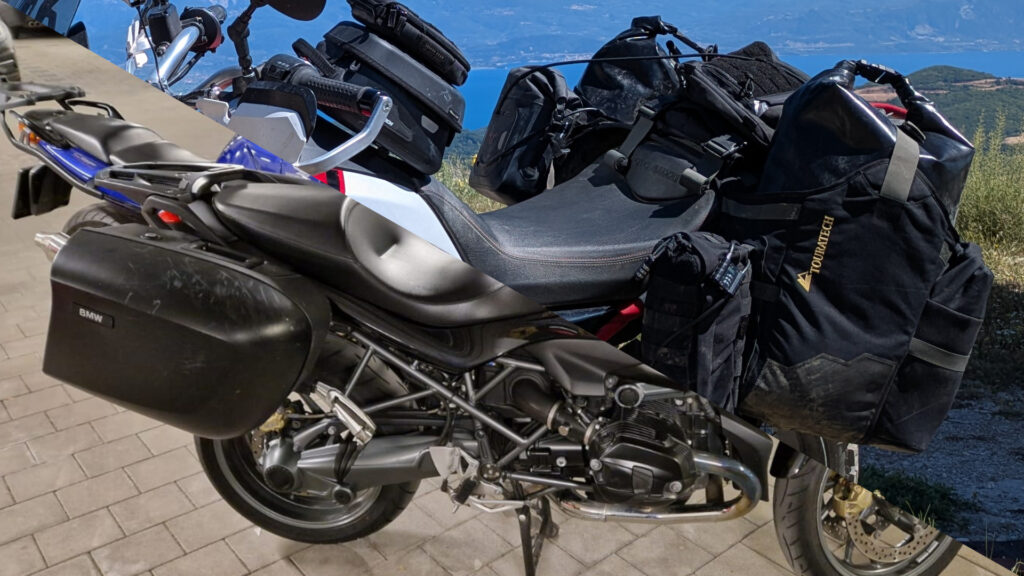
The difference became clear to me when I compared a Givi Monolock system on a rack frame i have on my Suzuki to the OEM hard panniers on my BMW — panniers that lock directly to the bike’s frame with no separate rack required. What had previously been a multi-step process of unlocking, lifting, and storing a rack that went nowhere became a single click. In cities especially, the ability to remove both panniers in under a minute and leave a clean, narrow bike on the street is a convenience that sounds minor until you’ve done it both ways. Having tried Givi Monolock on a rack, various saddlebag setups, and OEM direct-mount, the gap in daily usability is not subtle.
Fixed Mounting Systems
Bolted pannier attachment — where the pannier fixes directly to the frame with bolts rather than a quick-release mechanism — offers marginally greater security and slightly simpler construction at the cost of convenience. Removing panniers requires tools and time. For riders doing long tours with minimal urban stops, the inconvenience is acceptable. For riders who move between city and open road frequently, fixed mounting becomes frustrating quickly.
Top Case Mounting Systems
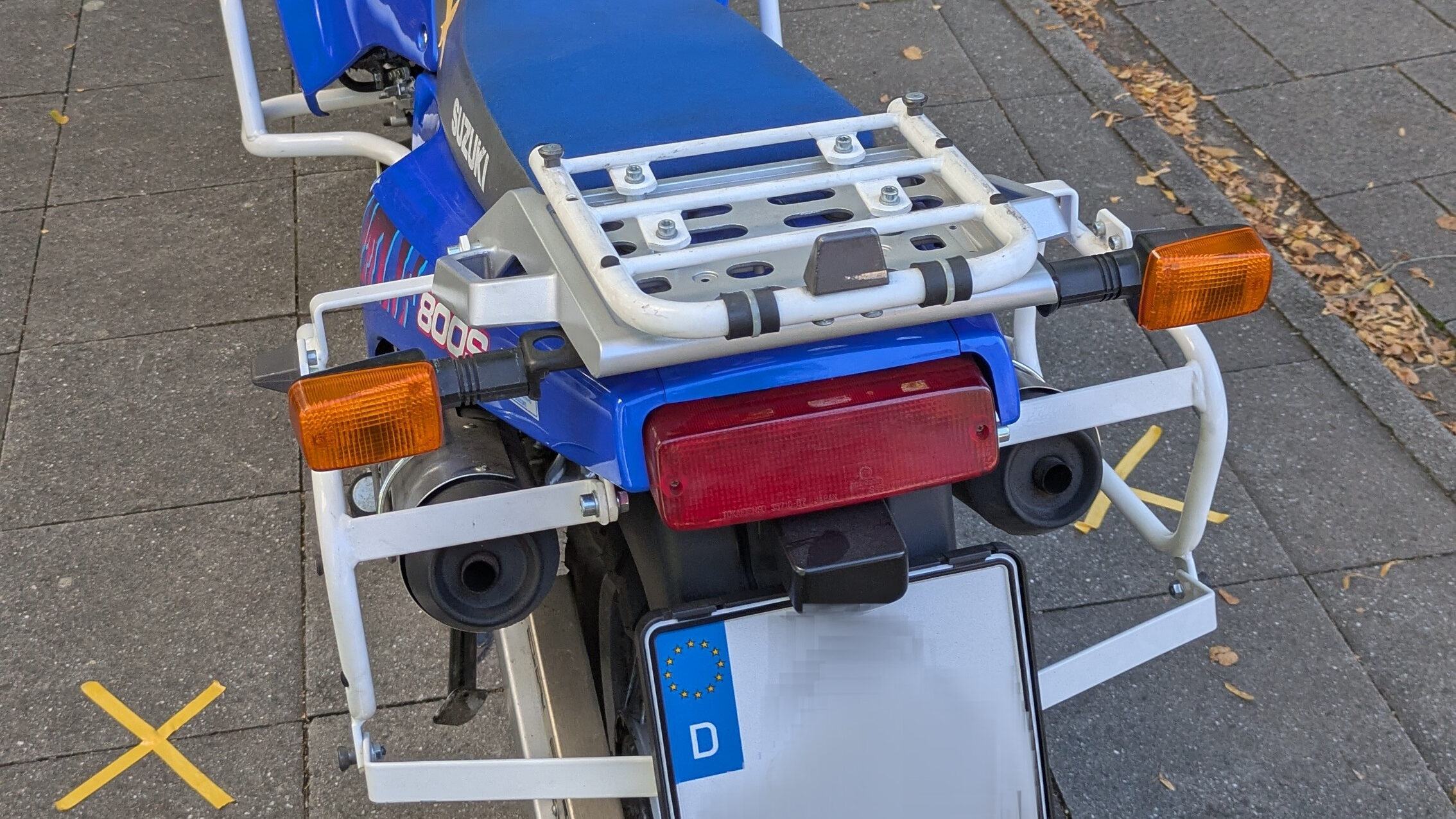
Top Case Plates and Racks
A top case plate — a bike-specific fitting plate mounted above the rear seat — provides the interface between the motorcycle and a top case. Quality top case plates integrate cleanly with the bike’s rear bodywork, distribute load across the subframe rather than concentrating it at a single point, and provide a secure keyed lock between plate and case.
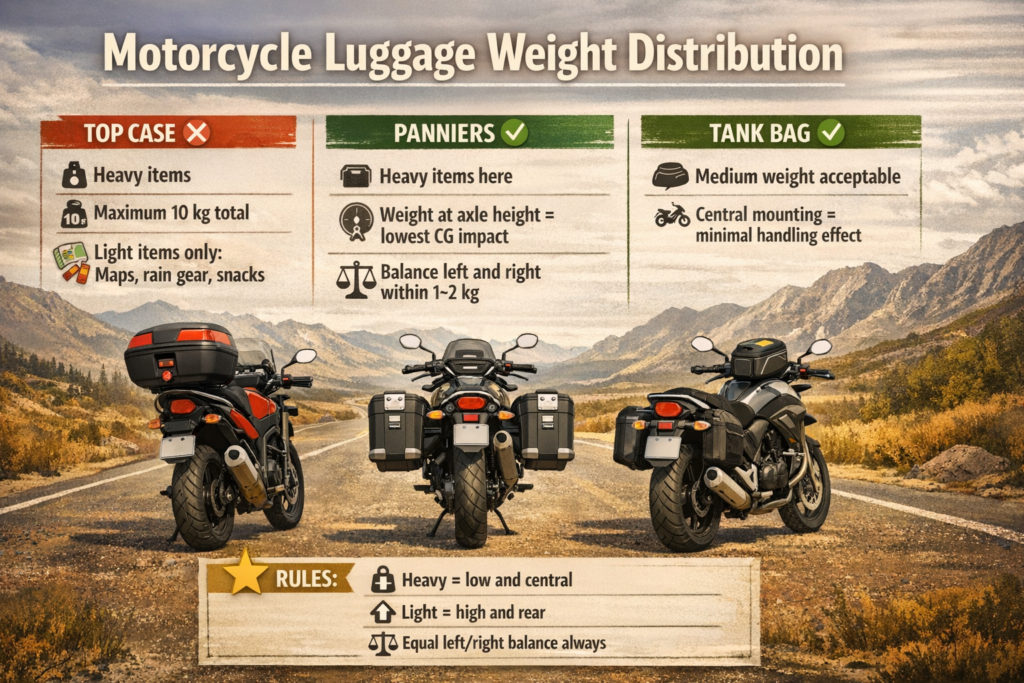
The weight limit marked on any top case plate is a genuine engineering limit rather than a conservative suggestion. Exceeding it consistently causes stress cracking at the mounting points and can damage the bike’s subframe over time. The standard recommendation — maximum 10 kg in a top case — reflects the leverage effect of weight mounted high and at the rear. Distributing heavier items into panniers rather than the top case is always the right approach for handling and mounting longevity.
Cost range for a quality bike-specific top case plate: 80–200 €. The Givi Monokey and Monolock systems are the most widely available — Monokey for larger cases and heavier loads, Monolock for smaller cases and lighter touring use.
Top Case Lock Systems
All quality top case mounting systems provide a keyed lock between the case and the plate — the case cannot be removed without the key. Givi’s Monokey and Monolock systems use the same key as the panniers in a matched set, which simplifies the key situation considerably on a long tour. SW-Motech top case plates are compatible with multiple top case brands, providing more flexibility in case selection.
Soft Luggage Mounting — Straps, Clips, and Systems
Strap-Based Soft Luggage Attachment
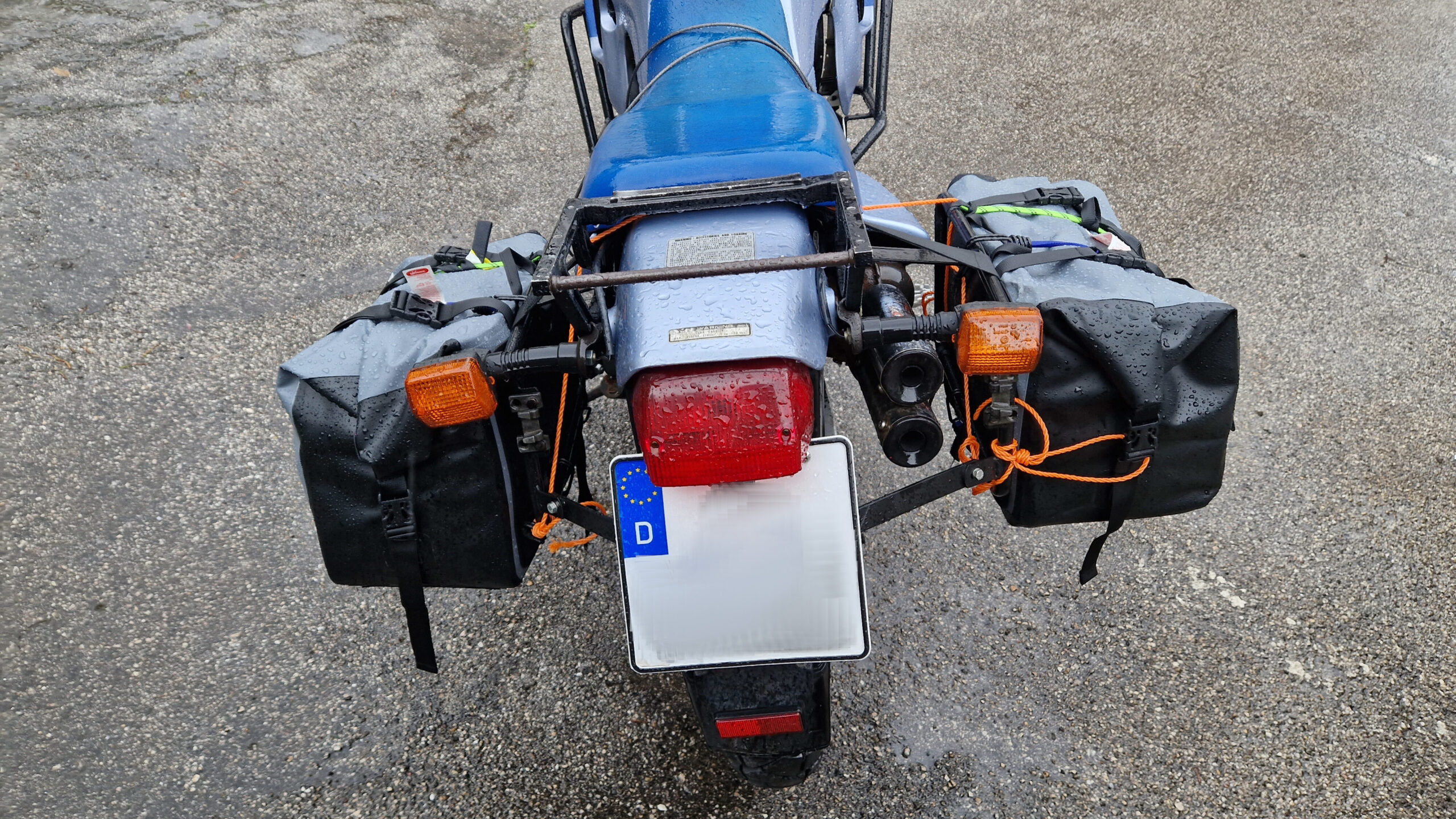
Strap-based motorcycle luggage mounting — wrapping straps around the subframe, seat rails, and grab handles — is the most common and least secure method of attaching soft luggage to a motorcycle. It works. It works better with attention and discipline than most riders give it. And it works significantly less well than a dedicated mounting system for anything beyond short trips.
The fundamental problem with strap systems is vibration-induced loosening. Straps that are tight at the start of a riding day are measurably looser after 200 km of motorway vibration. The solution is routine: check strap tension every morning before riding and after every fuel stop. It takes ninety seconds and prevents the progressive migration of soft luggage toward the exhaust or rear wheel that causes most strap-mounting failures.
Anti-slip matting — a sheet of rubberised non-slip material placed between the luggage base and the seat or rack — is the most underrated addition to any strap-based motorcycle luggage mounting system. It prevents the lateral migration that straps alone can’t fully control and costs almost nothing. If you use strap-mounted soft luggage, use anti-slip matting underneath it.
Dedicated Soft Luggage Systems
The step above strap attachment is a dedicated soft luggage system where the bag is designed for specific mounting points on the motorcycle — seat straps engineered for the exact geometry of a touring seat, tail loops that attach to specific subframe points, or tank rings that provide a permanent quick-attach interface for tank bags.
The tank ring system is worth specific mention for tank bag mounting. A permanently fitted tank ring — a low-profile ring that bolts to the fuel cap area and remains on the bike — provides a click-on, click-off interface for compatible tank bags that is faster, more secure, and more vibration-resistant than any magnetic or strap-based tank bag mounting. Magnetic tank bags work adequately on steel fuel tanks and fail immediately on aluminium and plastic tanks. A tank ring works on everything and removes in seconds.
Throw-Over Saddlebags
Throw-over saddlebags — soft bags that drape over the rear of the seat with a bag on each side — are the simplest and cheapest motorcycle luggage mounting solution and the one that requires the most careful management in practice. The primary risk is exhaust proximity: a throw-over bag that migrates rearward on a long day’s riding can contact a hot exhaust pipe and melt within minutes. Stabiliser straps connecting the bags under the seat prevent rearward migration — always fit them, always check them.
Following the Trans Euro Trail through northern Italy’s mountain roads, I clipped a rock wall with my right saddlebag on a tight section — not hard, but hard enough to rip one of the two mounting straps clean off the bag. Half a loaded saddlebag hanging by a single strap on a mountain road is not a comfortable situation. Fortunately I noticed immediately and had enough tools on hand to improvise a fix. It held for the rest of the day but it was a reminder that on technical terrain, cheap attachment points are the weakest link in the whole system — and that they fail at exactly the moment you can least afford it.
Throw-over bags suit occasional tourers, smaller motorcycles without pannier frame options, and riders who want the simplest possible luggage system for short trips. For multi-week touring you have to invest in high-quality saddlebags otherwise the management overhead of throw-over bags becomes a daily distraction.
Weight Distribution and Mounting Position
The principle of motorcycle luggage mounting weight distribution is simple: heavy items low, light items high. Heavy items in the bottom of panniers, at wheel axle height, minimise the effect on centre of gravity. Heavy items in the top case, above seat height, raise the centre of gravity and make the bike feel unstable in slow-speed manoeuvres and tight corners.
Left and right pannier balance matters more than most riders expect. A 5 kg weight difference between left and right pannier creates a permanent lean that the rider compensates for unconsciously — over a long riding day this compensation becomes fatiguing. Weigh both panniers before a long tour and redistribute contents until they balance within 1–2 kg.
The fuel tank effect is worth understanding: a full tank in the morning distributes weight centrally and relatively low. An empty tank before a fill-up shifts the weight balance toward the luggage at the rear. This is why a loaded touring bike handles differently in the morning than it does after 300 km — the fuel load change is a significant proportion of total carried weight.
Fitting Motorcycle Luggage Mounting Systems
DIY vs. Professional Fitting
Fitting a bike-specific pannier frame is straightforward mechanical work for anyone comfortable with a socket set and a torque wrench. The manufacturer’s fitting guide specifies torque values for each bolt — follow them precisely, use thread-locking compound (Loctite 243 is standard for most motorcycle luggage mounting applications) on all frame bolts, and the fitting is secure and lasting.
The case for professional fitting is strong if torque specifications and thread preparation are unfamiliar territory, if the bike is under warranty and improper fitting could affect it, or if access to the subframe mounting points requires bodywork removal. Dealer fitting costs 50–100 € and provides confidence that the system is correctly installed — money well spent if any doubt exists.
Pre-Tour Fitting Checks
Check mounting bolt torque before every long tour — not because properly Loctited bolts loosen frequently, but because the consequence of discovering a loose mounting point at the roadside in rural Bosnia is significantly worse than the two minutes the check takes at home. Let this routine become part of your motorcycle maintenance.
Inspect mounting points for stress cracking — particularly at the interface between the frame and the bike’s subframe — after any significant off-road use or after a dropped bike incident. Metal fatigue develops at stress concentrations and is visible as fine cracks in paint or surface finish before structural failure occurs.
Security — Keeping Your Luggage on the Bike and Away from Thieves
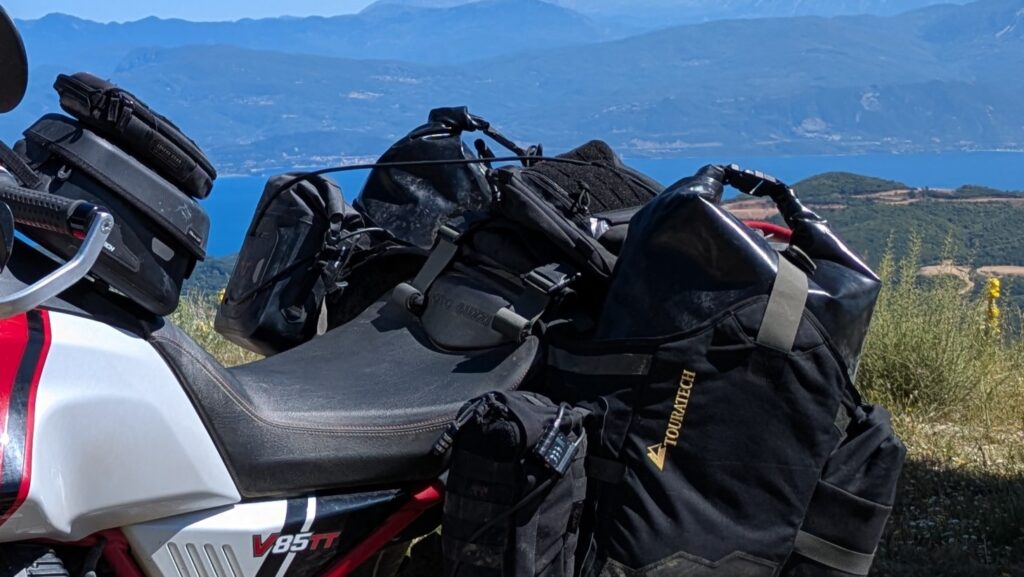
While luggage security is also one of the things to consider when deciding on a hard pannier or a soft luggage, locking quick-release systems secure panniers against opportunistic theft — a pannier that requires a key to remove is not worth a thief’s time when unlocked alternatives exist nearby. In practice, locking your panniers whenever you leave the bike unattended is a habit worth building from the first tour.
For urban overnight parking, the contents of panniers matter more than the panniers themselves. Valuables — camera equipment, electronics, documents — come inside regardless of how secure the mounting system is. A determined thief with tools and time can defeat any motorcycle luggage mounting system. The goal of security measures is to make your bike a less attractive target than the one parked next to it.
Cable locks threaded through pannier handles and around the frame add a visual deterrent for unlocked quick-release systems. They stop opportunistic theft, not determined theft, and cost 10–20 €. Worth carrying on a long tour, worth using every time you park in an urban area.
Budget Guide — What Mounting Systems Cost
- Entry level (80–150 €): universal racks, basic strap systems — functional for occasional short touring, not recommended for sustained long-distance use
- Mid-range (150–300 €): bike-specific pannier frame, basic quick-release — the minimum for serious touring and the starting point most experienced riders recommend
- Quality (300–500 €): premium bike-specific frame with locking quick-release, top case plate — the right investment for regular tourers covering significant distances annually
- Premium (500 €+): Touratech, full Givi or SW-Motech integrated system, maximum security and integration — justified for daily riders and those touring multiple months per year
A complete motorcycle luggage mounting system — frame, quick-release mechanism, and top case plate — at the quality tier costs 350–600 € before the luggage itself. It’s the investment that every other piece of touring equipment depends on, and the one that pays returns across every subsequent tour.
Final Thoughts
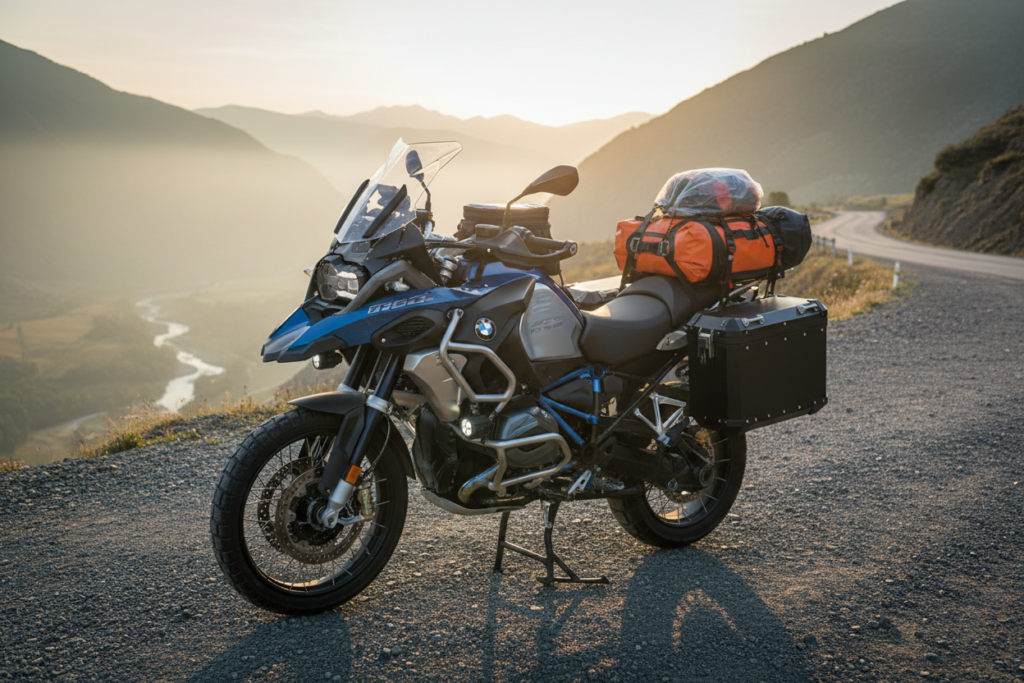
Motorcycle luggage mounting is unglamorous, technical, and invisible when it’s working correctly. It becomes very visible, very quickly, when it isn’t. The riders who invest in bike-specific, quality mounting systems from the start spend their touring time focused on the road rather than checking strap tension at every fuel stop and listening for rattles that weren’t there yesterday.
Buy the right system for your bike, fit it correctly, check it before every tour, and then forget about it. That’s the goal — mounting that earns its invisibility through reliability. Everything else on a long tour is complicated enough without the luggage adding to it.
What mounting system are you currently running and what would you change? Share it in the comments — there’s always a rider about to buy their first touring setup who’ll benefit from knowing what works in practice.